
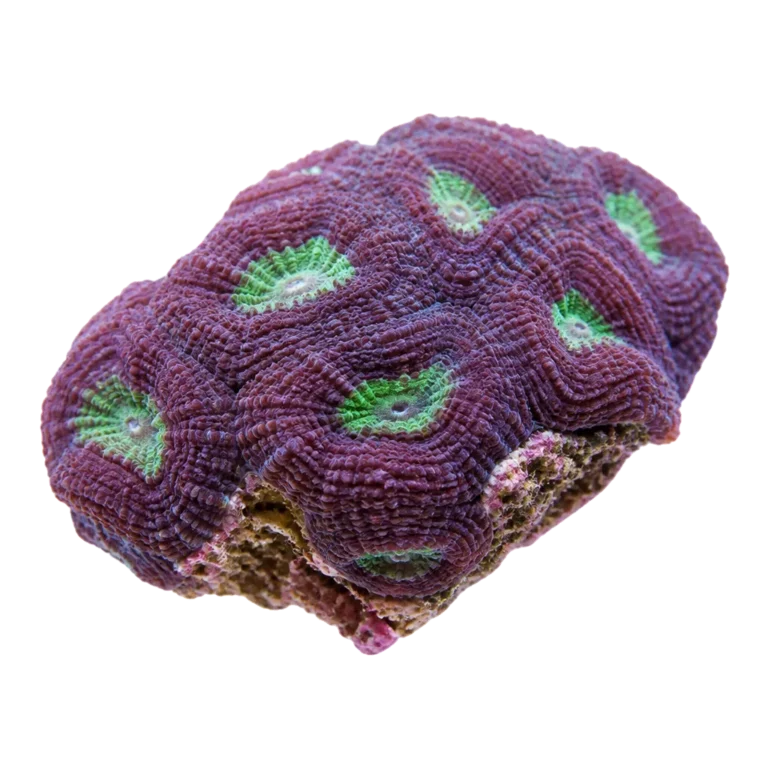
Echinophyllia Coral
Summary
Echinophyllia sp. is a genus-level identification used for several closely related chalice corals, so colour, rim shape, and feeding response can vary between frags. Most grow as low encrusting sheets that develop folded or outward-plating margins; plan for a coral that expands sideways rather than upward.
Its sheltered, lower-reef tendency is reflected in aquarium care: give it a lower-to-middle position with indirect movement, and avoid treating it like a high-energy, high-light SPS coral. The thin growing edge is the area most likely to show stress first.
General care
Place Echinophyllia sp. on a secure, level section of lower or middle rockwork, or on a stable substrate mount, with room for its rim to spread. Do not wedge it where the expanding edge will contact rock or another coral, as abrasion can cause localized tissue loss.
Handle the frag plug, bare underside, or solid skeletal base rather than gripping the living surface or thin perimeter. Inspect newly acquired frags for damaged edges, exposed skeleton, or recession around the corallites; these are reasons to give the coral a low-stress position and avoid repeated moves while it recovers.
Lighting needs
Start a new Echinophyllia sp. in the dimmer end of its intended placement and increase exposure gradually over several weeks. This is especially important for a frag coming from different lighting, because a sudden increase is more likely to bleach or recede tissue than to improve colour.
Too much light commonly shows as a washed-out surface, paling around the eyes, persistent contraction, or tissue recession beginning on exposed areas. Too little light is more gradual: the coral may remain dark but show little edge growth and reduced daytime fullness. Change placement or intensity slowly, one adjustment at a time.
Flow needs
Aim for gentle, indirect, variable flow that keeps loose debris from settling in the folds without pinning the tissue down. At an appropriate setting, the surface remains clean and the tissue shows subtle movement rather than being whipped or lifted.
Dead spots allow detritus to accumulate in valleys and along the rim, which can irritate tissue and encourage recession. A direct or excessive jet can cause the edge to stay tightly drawn in, flap sharply, or wear against the skeleton; redirect the flow rather than simply increasing or decreasing all circulation.
Feeding and growth
Photosynthesis supplies much of this coral's energy, but supplemental feeding is useful for newly settled frags, recovering specimens, and hobbyists seeking steadier tissue expansion and growth. Offer fine particulate coral foods or very small zooplankton-sized meaty foods when feeder tentacles are visible, often after lights dim, and use modest portions so food does not decay on the colony.
Growth is usually encrusting at first, then develops plates, folds, or raised rims depending on the individual within this variable genus. Leave open substrate and rock around the perimeter: the coral can occupy a broad footprint long before it appears tall.
Compatibility
Echinophyllia sp. is semi-aggressive because it can extend stinging sweeper tentacles, particularly after dark. Keep a minimum clear zone of 15 cm5.9 in from neighbouring corals, then check the colony at night after it has settled in; increase that space if sweepers reach farther or current carries them toward another coral.
Keep it away from corals that can overgrow or repeatedly touch its thin rim. Most reef-safe fish ignore established colonies, but coral-picking fish and invertebrates can damage exposed tissue, while mobile grazers can dislodge an unsecured frag; investigate repeated closed tissue, fresh bite marks, or a shifted plug promptly.
Water parameters
This is moderately demanding rather than unusually delicate, but it responds poorly to abrupt changes in alkalinity, salinity, temperature, or nutrient availability. Consistency matters most when the coral is newly introduced or healing, because rapid swings can turn a small damaged edge into progressing tissue recession.
Avoid pushing the system toward nutrient starvation in pursuit of an ultra-clean appearance. A chronically pale, shrunken colony with poor feeding response may need its light and nutrient balance reviewed, while sudden recession should prompt a check for chemistry changes, sediment accumulation, excessive flow, and nighttime contact from nearby corals.