
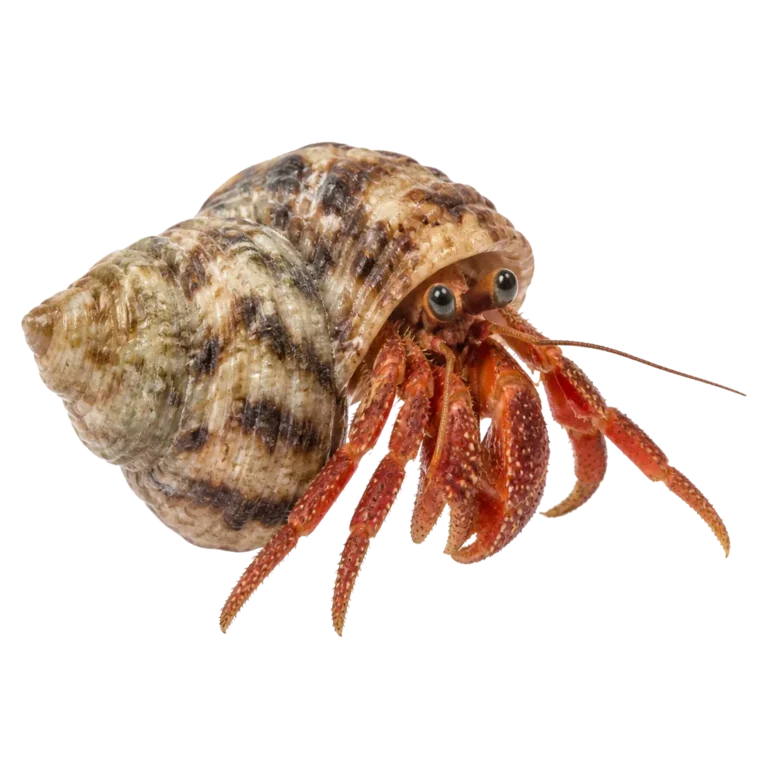
Dwarf Red Leg Hermit Crab
Summary
Clibanarius rutilus is a small marine hermit crab recognized by its red legs and its habit of carrying a borrowed gastropod shell. It was described from Indonesia and occurs in shallow intertidal habitats with rock, sand, mud, or rubble, which suits its constant surface-foraging behavior in an aquarium.
Care
Use an established reef or fish-only marine aquarium with live rock and open areas of sand or rubble for grazing and scavenging. A deep sand bed is not required, and the crab carries its own portable shelter; rock crevices are mainly useful as quiet retreats during a molt.
No specialized lighting or unusually strong flow is needed. Provide enough water movement to keep food and detritus from settling heavily while leaving accessible surfaces where the crab can graze; a newly set-up, overly sterile tank may not provide enough natural forage.
Feeding and role
Let Clibanarius rutilus graze film algae, short filamentous algae, detritus, carrion, and missed fish food, but do not rely on leftovers alone. In clean aquariums, place small portions of marine sinking pellets, dried seaweed, and occasional meaty marine foods near its usual foraging area so it does not become food-limited.
It is a useful small scavenger rather than a complete cleanup solution. One crab can pick at accessible algae and uneaten food, but it will not resolve heavy algae growth, remove established long algae reliably, or replace nutrient control and routine maintenance.
Compatibility
This species is generally suitable around corals because it is not a coral feeder, but it may disturb loose frags while climbing and can compete with snails or other hermit crabs for shells. Keep several empty, appropriately sized gastropod shells available; a crab persistently investigating occupied shells is a warning that suitable housing or food may be limited.
It can be kept singly and does not need companions to thrive. A small group can work in a sufficiently productive aquarium when food and a range of spare shells are available, but avoid adding a large number simply for algae control, as crowding increases competition with other shelled invertebrates. Keep it away from fish and large invertebrates that eat small crustaceans.
Good to know
Hermit crabs molt as they grow. A crab that remains hidden or stays tightly withdrawn may be molting, so avoid pulling it from its shell or assuming it has died; disturbance at this stage can injure it. A shed exoskeleton can resemble a dead crab and may be left briefly for the system to recycle or be eaten.
Like other crustaceans, Clibanarius rutilus is vulnerable to copper and other toxic metal contamination. Acclimate carefully to the aquarium’s salinity and temperature, and do not introduce it into water treated with copper-based medications.