
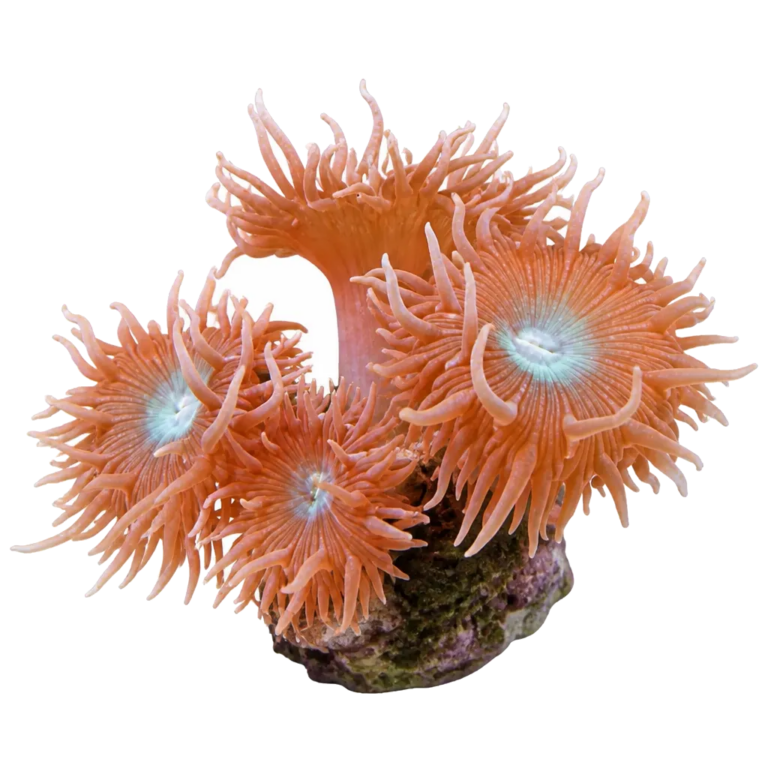
Duncan Coral
Summary
Duncan Coral, Duncanopsammia axifuga, is a branching LPS coral with large, fleshy polyps that extend from separate tubular skeletons. Its naturally sheltered, often deeper or turbid reef habitat helps explain its preference for gentler conditions rather than intense light or a direct powerhead blast. It is generally a workable choice for a mixed reef, provided its expanding heads are given room.
General care
Mount Duncanopsammia axifuga on stable rockwork in the lower to middle aquarium, where its polyps can open without being shaded by a growing colony above. Avoid placing it where sand can repeatedly settle into the cups; trapped debris irritates the tissue and can keep individual heads closed.
Handle the hard base or an exposed branch, never the inflated polyp. The branching skeleton can snap if a colony is leveraged by one thin branch, and torn tissue around a damaged head is slower to recover than a clean skeletal break. Inspect new frags for recession at the rim of each polyp before buying.
Lighting needs
Begin a new Duncan Coral in a dimmer position within its suitable lighting zone, then move it gradually only after it is opening consistently. This is especially important for frags coming from a different lighting system, because abrupt exposure can cause the polyp to stay contracted or lose color.
Adequate light is usually shown by regular daytime expansion, retained color, and new heads forming over time. Persistent shrinking, a pale or bleached appearance, and tissue withdrawing down the corallite suggest excess exposure; move it lower or provide partial shade. Slow growth with an unusually stretched, upward-reaching posture can indicate insufficient light, but first rule out weak flow and poor feeding response.
Flow needs
Aim indirect, variable flow across the colony so the tentacles sway and debris does not settle, without forcing the polyps to fold tightly to one side. A deflected return or broad wavemaker pattern is usually safer than a narrow stream aimed at the heads.
Too little flow leaves food, mucus, and detritus in the polyp cups and may lead to dull, dirty-looking tissue. Too much flow produces persistently shortened or sideways-pinned tentacles, incomplete expansion, and tissue irritation at the rim of the skeleton. Change flow direction or reduce the direct force rather than moving the coral immediately into a stagnant area.
Feeding and growth
Light can meet much of this coral’s energy demand, but target feeding is useful in low-nutrient systems, for newly recovering frags, or when the goal is faster budding. Offer small zooplankton-sized foods or finely chopped meaty items when tentacles are extended, and use only enough that each head can retain and swallow it. Repeatedly giving oversized pieces can cause the coral to release the food rather than benefit from it.
Duncanopsammia axifuga forms a branching, phaceloid colony: new heads bud from the branching skeleton and the colony gains height as well as width. A small frag can therefore become a multi-headed clump that shades nearby lower corals and reaches farther into surrounding space than its original plug suggests.
Compatibility
Although usually less aggressive than many LPS corals, Duncanopsammia axifuga can sting tissue that touches its tentacles. Keep at least 10 cm3.9 in of open space around it, and increase that buffer beside corals with longer sweepers or rapidly spreading growth. Do not let neighbouring colonies grow into it simply because the Duncan appears peaceful during the day.
Avoid fish or invertebrates that repeatedly pick at fleshy LPS polyps. Occasional inspection by a curious fish is different from repeated nipping: a Duncan that opens only briefly, has torn tentacle tips, or stays closed after the lights come on may be receiving physical harassment rather than having a lighting or chemistry problem.
Water parameters
This is a relatively forgiving coral when the aquarium is already functioning as a stable reef, but it responds poorly to abrupt changes in salinity, alkalinity, or temperature. Sudden swings commonly show first as several heads remaining withdrawn or as tissue receding from the upper edge of a corallite; correct the cause gradually instead of making repeated large adjustments.
As a stony coral, it needs dependable calcium and alkalinity availability to add new skeletal branches. It is more tolerant of ordinary reef nutrient levels than ultra-clean, aggressively stripped water, where color, feeding response, and budding can weaken. Treat a continuing failure to open as a warning to check for instability, sediment, excessive flow, or pests before assuming the coral needs more light.