
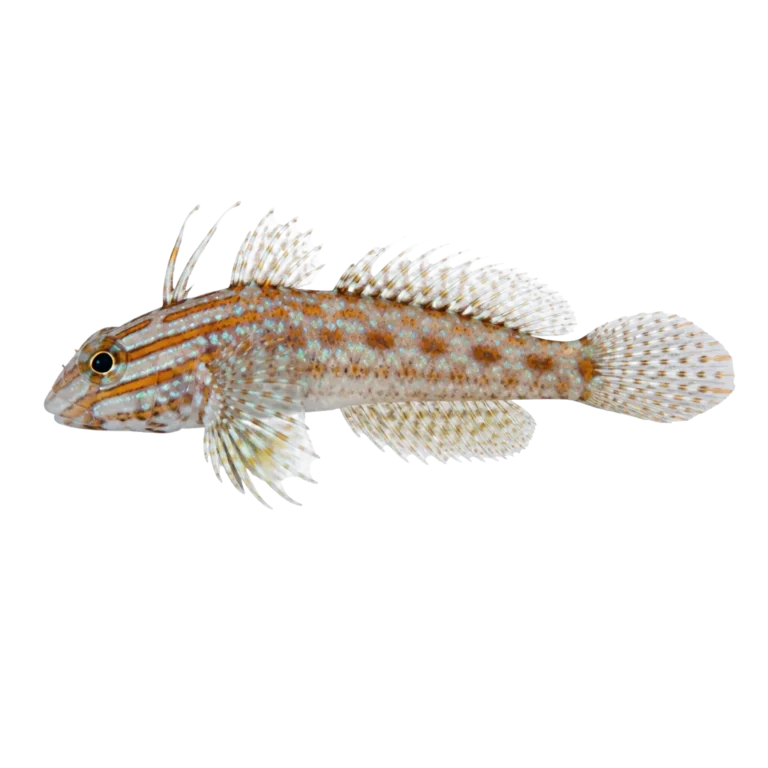
Dragonet
Summary
Despite the common name, Bovichtus angustifrons is a temperate bovichtid thornfish, not a typical tropical callionymid dragonet. It is a bottom-oriented ambush predator that commonly settles on rock or the aquarium floor rather than cruising in open water; long periods of stillness are normal when it is otherwise alert and feeding.
Its association with shallow rocky reefs explains the aquarium behaviour to expect: it will use ledges, crevices and shaded structure as perches, then make short feeding movements when food comes within reach. Plan for a predator that is inconspicuous for much of the day but capable of taking suitably small tankmates.
Care
Keep Bovichtus angustifrons only in a dedicated temperate marine system. A conventional tropical reef is the wrong environment even if the fish initially appears settled; the entire livestock plan, including corals and invertebrates, must tolerate the cooler conditions shown for this species.
Build broad, secure rockwork with low ledges, undercuts and several resting stations rather than prioritising open swimming space. Lock the structure firmly in place before introduction, because this fish will settle against rock and the substrate; a collapsing or unstable scape is a practical injury risk.
Give it sheltered routes between perches so it can remain close to cover while exploring. A specimen that never leaves one exposed corner, refuses food, or remains pinned by stronger fishes should be treated as stressed rather than merely sedentary.
Feeding
Offer a varied marine-meaty diet of thawed crustaceans, molluscs, worms and fish flesh, with pieces sized for the fish to swallow. Rotate foods rather than relying on one item, and remove uneaten material promptly because a sedentary predator can leave substantial scraps near its preferred perch.
Target-feed with tongs or place food directly near its resting area, then verify that it actually takes and swallows its share. Fast mid-water feeders can strip broadcast food before this fish reacts, leaving an apparently well-settled individual underfed.
Do not use ornamental shrimp, small crabs or small fishes as part of the feeding plan. Their movement can trigger predation, and the loss may be mistaken for unexplained incompatibility rather than normal feeding behaviour.
Compatibility
Plan on one Bovichtus angustifrons per aquarium. Do not assume that a pair or group will coexist simply because more than one is available for sale; reliable conspecific aquarium compatibility is not well established, while space and prey competition are difficult to manage with a benthic predator.
Choose robust temperate-water fishes that are too large to be swallowed and that will not continually displace it from its feeding perch. Avoid small bottom-dwellers, small slow fishes and any ornamental crustaceans that you expect to keep long term.
Its reef compatibility is conditional: the main concern is not coral grazing, but predation on mobile invertebrates and small fish. Stock the system around that limitation from the outset rather than adding this species to an established shrimp- or nano-fish-focused display.
Good to know
A motionless fish is not automatically a sick fish. For this species, assess condition by its feeding response, body condition and breathing rather than expecting constant activity; repeated missed meals are a more useful warning sign than resting behaviour alone.
Handle transfers with a rigid specimen container rather than relying on a net. Bovichtus angustifrons has strong spines at the rear of the head, which can catch in mesh and make both removal and release difficult.
The most consequential husbandry error is treating the name “dragonet” as evidence that it belongs in a normal warm-water reef community. Confirm that the display is genuinely temperate before purchase, since changing the whole system after introduction is usually far harder than selecting appropriate livestock first.