
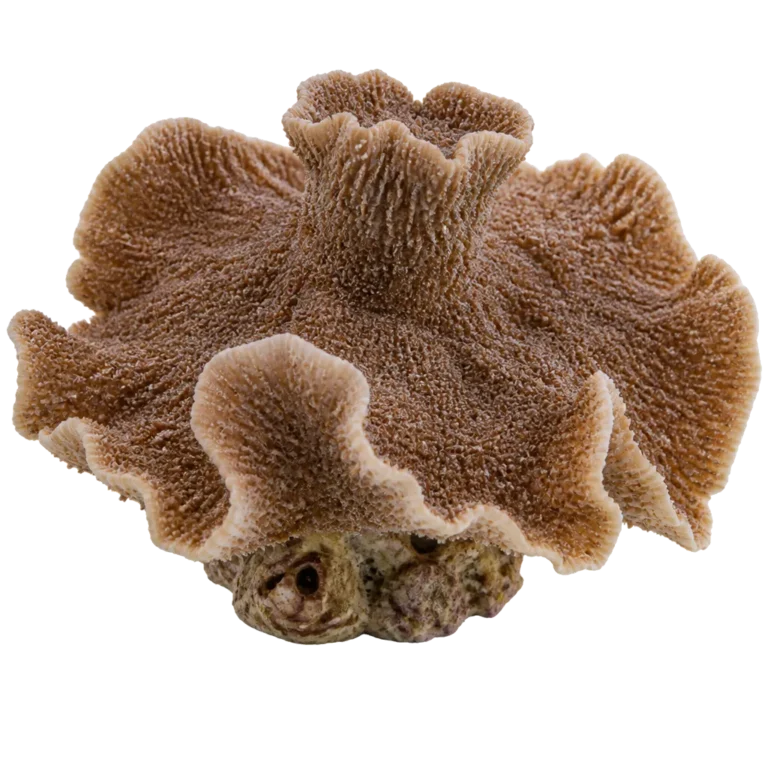
Diaseris Plate Coral
Summary
Diaseris distorta is a solitary, free-living fungiid coral rather than a coral that should be fixed to rock. Its low, fan-shaped segments and ability to inflate are normal features, and its natural habit of living on soft substrate explains why it is best kept on an open sand bed.
This species can reproduce by splitting along its radial skeletal divisions. A newly separated wedge is not automatically a dying coral, but any fragment should retain healthy, inflated tissue and be protected from being buried, overturned, or repeatedly knocked into other corals.
General care
Set Diaseris distorta directly on clear, stable sand at the bottom of the aquarium, with room for it to inflate fully. Do not wedge it into rockwork or glue it down: rigid contact points can abrade the fleshy edge, while a fall onto the skeleton can tear tissue.
Handle it only by exposed skeleton and support the whole piece from underneath. Avoid lifting an inflated coral by one thin segment or squeezing the tissue; the natural divisions can make small pieces easier to damage when they are handled roughly.
Lighting needs
Begin a new Diaseris distorta in the dimmer end of its suitable placement and increase exposure gradually over several weeks. This is especially important after shipping or when moving it from a shaded retail system, because abrupt brighter light can cause persistent contraction, paling, or bleaching.
At suitable light, the coral remains evenly inflated and maintains consistent colour. If it stays darkened and poorly expanded despite otherwise appropriate flow and water quality, move it slightly brighter; if it pales, develops bleached areas, or remains tightly contracted through the photoperiod, reduce light exposure and acclimate more slowly.
Flow needs
Use gentle, indirect, variable flow that keeps the tissue gently moving without folding the fleshy margin over the skeleton. Correct flow allows even inflation and helps prevent detritus or sand from sitting on the oral surface.
Too little flow leaves settled debris, mucus, or sand collecting between the skeletal ridges; gently baste this away and modestly improve circulation. Too much flow causes sustained retraction, a sharply folded edge, repeated lifting or tumbling on the sand, and can turn minor contact damage into tissue recession.
Feeding and growth
Light supplies much of this coral’s energy, but target feeding can be useful while it is recovering from shipping, rebuilding after a split, or being encouraged to grow. Offer fine zooplankton-sized foods or very small, soft meaty particles when feeding tentacles are visible, and avoid oversized pieces that sit on the mouth or trigger prolonged mucus production.
Growth commonly produces additional fan-shaped segments through natural fragmentation and regeneration rather than a single attached colony expanding across rock. Leave open sand around it from the start: healthy fragments can occupy more area than the original piece, and crowding makes contact damage more likely.
Compatibility
Diaseris distorta is semi-aggressive: its inflated tissue can sting or damage corals it contacts. Maintain at least 8–15 cm3.1–5.9 in of clear space on all sides, allowing extra room for daytime inflation, water movement, and newly separated segments.
Keep it away from corals that can fall onto it or send long sweeper tentacles across the sand. Sand-sifting fish, burrowing invertebrates, and animals that regularly overturn loose corals can bury or abrade the tissue; persistent nipping by angelfish, butterflyfish, or similar coral-picking fish can prevent full expansion and cause recession.
Water parameters
This is moderately demanding rather than a coral that tolerates repeated corrections. Keep salinity and major reef chemistry steady, especially alkalinity, because abrupt shifts can show up as poor inflation, loss of colour, or recession along the thin tissue margin.
Use a mature system with reliable nutrient availability rather than an aggressively stripped aquarium. The coral benefits from clean water, but it still needs enough dissolved and particulate nutrition to support tissue repair and recovery after natural fragmentation.