
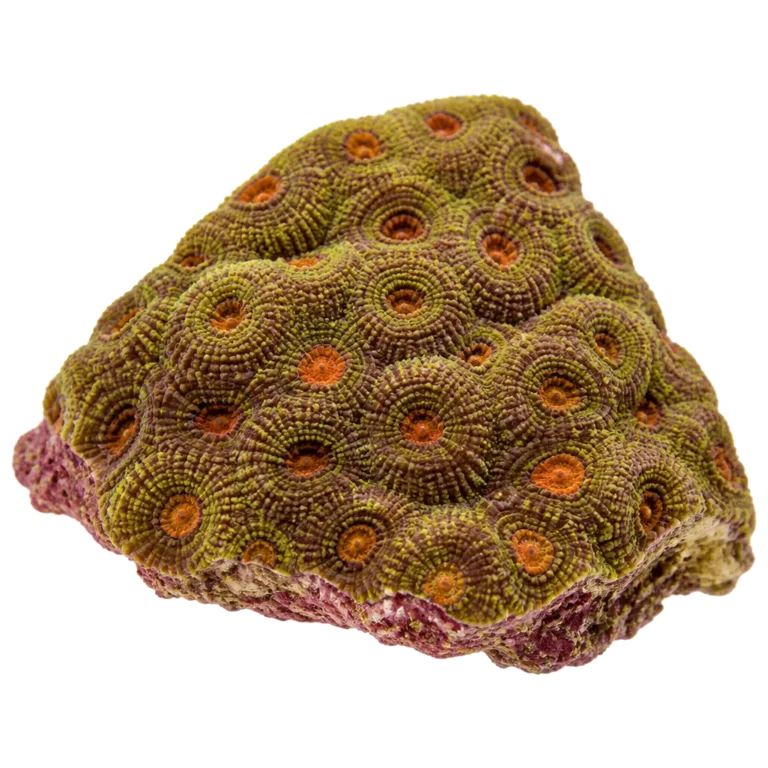
Cyphastrea Coral
Summary
Cyphastrea sp. is a genus-level identification, so colour, texture and exact growth habit vary among traded colonies. Most aquarium forms make a low, tightly encrusting sheet with small star-like corallites rather than upright branches. Their tendency to spread across the rock makes an isolated, removable rock a better long-term choice than a crowded section of the main aquascape.
Cyphastrea occurs across Indo-Pacific reef habitats, including comparatively shaded or lower-light surfaces. That helps explain why this coral is usually a better fit for lower-to-middle rockwork than for the brightest, most exposed position reserved for demanding branching SPS.
General care
Mount Cyphastrea sp. securely on lower-to-middle rockwork where it can gradually claim surrounding surface without reaching prized colonies. Place the frag plug or rock in its final orientation before it begins to encrust; moving an established colony often means breaking the growing edge or sacrificing the rock beneath it.
Handle only the plug, mounting rock or bare skeleton. Avoid rubbing, pinching or scraping the living surface, especially around the thin advancing edge, because damaged tissue can expose skeleton and invite algae to gain a foothold before the coral regrows.
Lighting needs
Begin a new Cyphastrea sp. in the dimmer end of its suitable placement and increase exposure gradually after it has settled. A colony that stays normally open and retains clear colour while adding a clean encrusting margin is adapting well.
Too much light commonly shows as paling, bleaching or persistently withdrawn polyps, particularly soon after a move; shift the colony lower or provide partial shade rather than making repeated abrupt lighting changes. Too little light is more often seen as weak colour and little new edge growth despite otherwise clean tissue; move it upward in small steps after ruling out poor flow or unstable chemistry.
Flow needs
Provide indirect, medium water movement that keeps the colony’s surface clean without blasting it from one direction. At the right flow, polyps can remain extended or visibly open, while fine debris does not settle between the corallites.
If flow is too weak, detritus accumulates on the textured surface and algae may establish along the edge; redirect circulation across the colony rather than aiming a pump directly at it. If flow is too forceful, polyps remain tightly retracted and tissue can look irritated on the pump-facing side; diffuse or alternate the current.
Feeding and growth
Photosynthesis supplies most of this coral’s energy, but occasional target feeding can help a newly cut frag, a recovering colony or a coral being grown for faster spread. Offer suspended zooplankton-sized foods or finely minced meaty particles when feeding tentacles are visible, often after lights dim, and avoid large pieces that sit on the tissue or foul the water.
Most Cyphastrea sp. colonies spread as a crust over rock, plugs and adjoining hardscape; some forms can become knobby or more irregular. Give the colony a dedicated growth surface from the start, because its space demand comes as much from steady lateral encrusting as from its visible height.
Compatibility
Treat Cyphastrea sp. as semi-aggressive. It can extend feeding or sweeper tentacles, and its advancing edge can overgrow slow-growing neighbours, so leave at least 5 cm2 in of open rock around it and inspect after dark before reducing that gap.
Keep it away from corals with long sweepers or fast, smothering growth, since Cyphastrea’s low profile makes it easy for a neighbour to contact or shade it unnoticed. Coral-picking fish and invertebrates can damage the thin living edge; repeated missing tissue, fresh bite marks or a colony that never opens warrants checking livestock behaviour, including after lights out.
Water parameters
Cyphastrea sp. is generally less demanding than many high-light branching SPS, but it is still a stony coral and responds poorly to rapid swings in salinity, alkalinity or temperature. In a small system, correct drift gradually rather than making large single-dose adjustments; sudden change can show first as closed polyps, paling or recession at the growing margin.
Avoid running the system so nutrient-poor that the colony becomes pale and stops adding new tissue, but also prevent detritus and algae from collecting on it. Consistent chemistry and a clean surface are more useful to this coral than chasing unusually elevated values.