
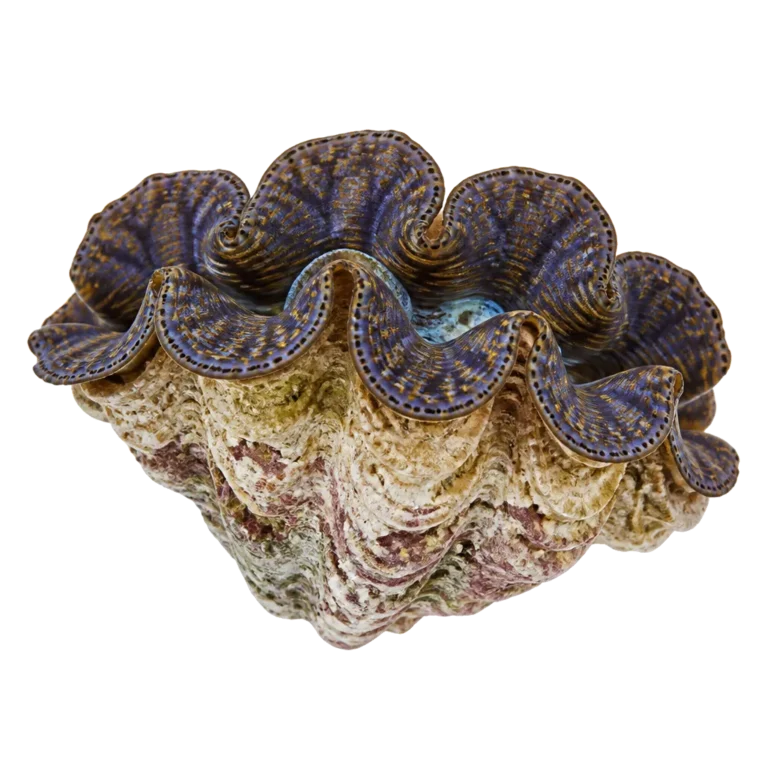
Crocea Clam
Summary
Tridacna crocea is a shallow Indo-Pacific giant clam that bores into limestone and coral rock, often leaving little more than its patterned mantle exposed. That natural habit explains its aquarium needs: it belongs on a secure hard surface under very strong light, not loose sand where it can be toppled or unable to anchor.
A healthy clam opens its mantle broadly in the light and snaps it partly shut when a shadow passes. Its mantle colour is highly variable, so choose by condition rather than colour: look for an even, responsive mantle and an intact byssal opening underneath.
Care
Place the clam upright on stable live rock, a flat piece of limestone, or a purpose-made clam cradle in the brightest suitable area of a mature reef. Give it a horizontal, unshaded view of the light so the entire mantle can receive illumination; a Crocea kept in a dim lower area may slowly bleach or lose condition even if it initially remains open.
Use indirect, moderate flow that keeps detritus from settling without folding, blasting, or persistently retracting the mantle. A concentrated pump outlet aimed at the clam can cause repeated closure and prevent normal light exposure.
Add this species only after the aquarium has demonstrated sustained reef stability and can support calcifying animals. Its shell growth depends on reliable calcium and alkalinity availability, while abrupt swings can show up as poor extension, gaping, or a failure to lay down clean new shell growth.
Feeding and role
Intense light is the main food source for Tridacna crocea because its mantle contains symbiotic zooxanthellae. It also filter-feeds fine phytoplankton from the water column; supplemental phytoplankton is most useful for small, recently settled-looking juveniles, which have less photosynthetic capacity than established larger clams.
Do not treat a Crocea clam as an algae eater or a substitute for nutrient export. It can take up dissolved nutrients and suspended plankton, but one specimen will not meaningfully clean nuisance algae, detritus, or a heavily stocked aquarium.
Compatibility
Tridacna crocea is reef-compatible with corals in the sense that it does not hunt or sting them, but give its mantle open space. Nearby corals that shade it, grow over its shell, or repeatedly touch the mantle with sweeper tentacles can cause chronic retraction and declining light intake.
Exclude fish and invertebrates known to pick at exposed mantle tissue, especially many butterflyfish, angelfish, triggerfish, puffers, filefish, and large predatory crabs. Repeated nipping is not harmless curiosity: the clam may remain closed, lose energy, and become vulnerable to infection or starvation.
This is not a social animal and is best chosen as an individual based on the available illuminated rockwork. More than one can be kept where each clam has its own secure, unshaded attachment site and enough room to open fully; there is no benefit to adding them as a group.
Good to know
Inspect the shell, byssal opening, and underside before purchase. Avoid a clam with a torn or badly damaged byssal area, and never pull an attached clam from rock; cut or detach the holding threads carefully only if moving is unavoidable, because injury around the byssal opening can be fatal.
Acclimate gently to the aquarium’s salinity and temperature, then introduce it to strong lighting progressively rather than placing a newly shipped clam immediately under maximum intensity. Bleaching, a persistently withdrawn mantle, failure to react to a passing shadow, or prolonged gaping are warning signs that need prompt investigation.
Check around the shell base and beneath the clam for tiny pyramidellid snails, particularly after lights out. These parasites can weaken a clam gradually, so physically remove any found and continue inspecting rather than assuming a fading mantle is only a lighting problem.
Keep copper medications out of any system containing this clam. Copper is toxic to bivalves, and a display-tank treatment can kill the clam even if fish appear to tolerate it.