
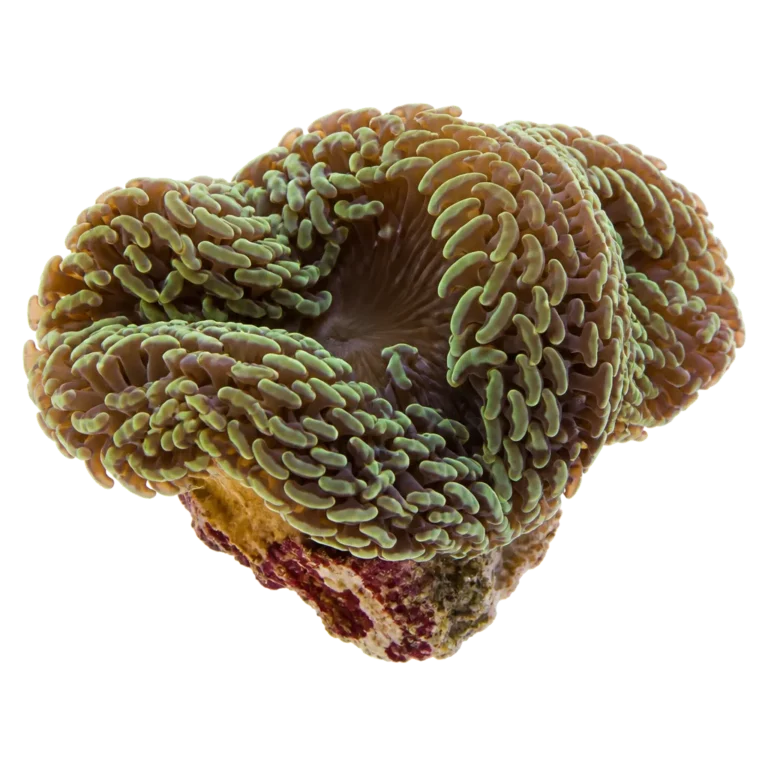
Cristata Hammer Coral
Summary
Fimbriaphyllia cristata is a large-polyp stony coral often recognized by its compact, short, thick tentacles and individual branching heads. Its Indo-Pacific reef origin helps explain its preference for moderate, indirect conditions rather than intense, one-directional exposure. Plan for a coral that needs open water around its polyps, not a crowded gap in the rockwork.
General care
Mount this coral low to mid-level where it can inflate without contacting rock, sand, or neighboring colonies. Secure the skeleton firmly before the polyps expand; a loose frag can tumble, tearing soft tissue against rock or exposing it to sand abrasion.
Handle Fimbriaphyllia cristata only by bare skeleton or the frag plug. Do not squeeze, scrape, or lift it by the fleshy polyp, and avoid placing it where a powerhead can drive tissue repeatedly into the skeleton; damaged tissue can recede quickly from the affected area.
Lighting needs
Introduce a new specimen under subdued exposure at its intended placement, then increase intensity gradually only after it resumes dependable daytime inflation. Sudden light increases are more likely to cause stress than a conservative starting position.
At suitable light, the polyps stay broadly inflated through the day and maintain their normal coloration. Persistent paling, bleaching, or tightly contracted tissue points to excessive exposure; gradual browning, weak growth, and reduced inflation despite otherwise suitable flow can indicate insufficient light.
Flow needs
Provide indirect, changing flow that makes the tentacles sway gently from several directions without pinning the polyp to one side. Correct flow keeps the coral inflated and clears mucus and detritus from between the tentacles.
If flow is too strong, tentacles remain stretched rigidly in one direction, the polyp stays partly withdrawn, or tissue whips against exposed skeleton. If it is too weak, detritus or mucus settles in the polyp, expansion becomes sluggish, and the coral may stay dirty even after routine maintenance.
Feeding and growth
Lighting supplies most of this coral’s energy, but occasional target feeding can support growth and recovery, especially in a low-nutrient aquarium or when a newly settled frag has resumed normal expansion. Offer very small zooplankton-sized or finely chopped meaty foods when the tentacles are receptive, and avoid large pieces that are repeatedly dropped or left to decay.
Fimbriaphyllia cristata usually develops into a branching colony with additional heads rather than remaining the footprint of its original frag. Leave room above and around the colony for both head formation and daytime inflation, rather than fixing it beneath an overhang or between immovable corals.
Compatibility
This is a semi-aggressive coral that can deploy sweeper tentacles and sting corals within reach, often after dark. Keep at least 15 cm5.9 in of clear space between it and other corals, and reassess that gap as new heads develop or when sweepers appear.
Clownfish may attempt to host in the fleshy polyp; persistent rubbing or diving can keep a small or recently introduced coral closed and may lead to localized tissue damage. Avoid fish known to nip coral tissue, and keep large crabs or other mobile invertebrates from climbing over the expanded polyp or stealing food during target feeding.
Water parameters
Fimbriaphyllia cristata is moderately demanding because it responds poorly to abrupt changes, particularly swings in alkalinity and salinity. Keep changes gradual; sustained contraction, failure to inflate, or tissue pulling back from the skeleton after a parameter shift should be treated as a warning rather than normal adjustment.
This coral is also vulnerable when damaged tissue is left in stagnant, dirty conditions. If recession begins, check for direct flow injury, neighboring stings, and recent chemistry changes promptly, because a small injured area can worsen if the underlying cause remains in place.