
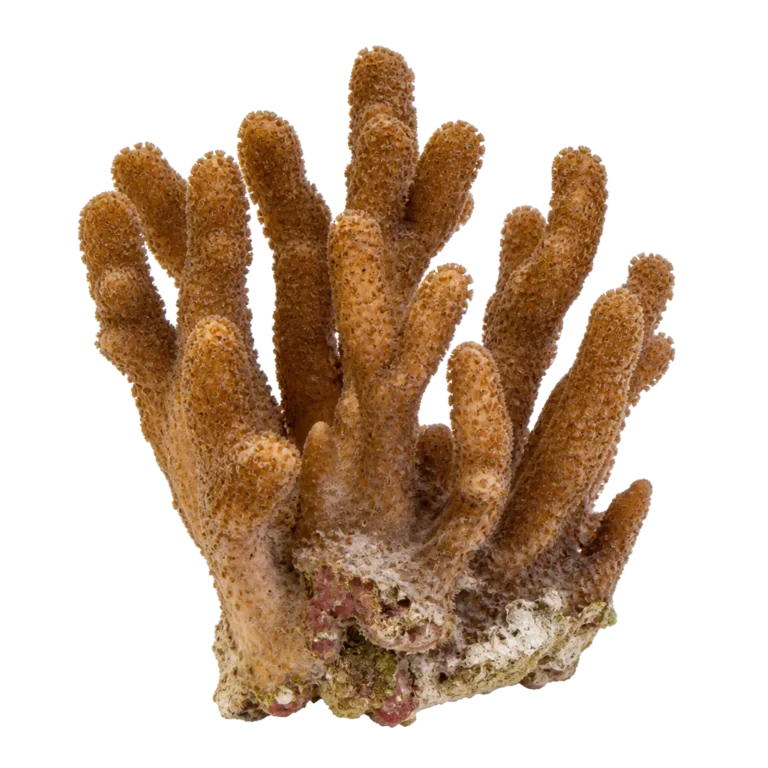
Corky Sea Finger
Summary
Briareum asbestinum is a Caribbean and western Atlantic octocoral that can grow as a knobby encrusting mat or develop short, finger-like lobes. In an aquarium, that natural shape variation matters less than its habit of spreading across any connected hard surface; buy it only if you can give the colony a defined boundary and are prepared to prune it.
Its corky-looking base contains small internal sclerites, while the extended polyps give it a soft, feathery appearance. Polyps commonly retract after disturbance or during environmental change, so judge its condition by whether it resumes regular extension over the following days rather than by a brief closure.
General care
Mount this coral on an isolated rock or removable island, with a clear route for removing or trimming the colony. Do not place it on the main rock structure if you want to prevent it from eventually reaching surrounding corals, overflows, or equipment.
Handle the rock or plug rather than squeezing the fleshy mat or pulling on its finger-like lobes. Torn tissue can recover, but rough handling and repeated relocation can leave exposed areas that collect algae before the coral re-establishes itself.
Lighting needs
Start a new fragment in a slightly shaded position and increase exposure gradually after it is opening reliably. This species is adaptable, but a sudden move into much brighter light can cause persistent retraction, paling, or a washed-out mat before it has time to acclimate.
Healthy lighting produces regular, full polyp extension without a bleached appearance. If it remains stretched toward the light, develops sparse extension, or gradually loses vigor while otherwise undisturbed, increase light slowly; if the colony stays tightly closed and pales after an increase, reduce exposure and acclimate more gradually.
Flow needs
Provide varied, indirect current that keeps the polyps moving freely without pinning them in one direction. Correct flow allows the colony to open broadly, sheds mucus and debris, and keeps the mat clean between polyps.
Too little flow lets detritus settle into the mat, often followed by patchy polyp extension and nuisance algae. Too much direct flow leaves polyps bent flat or withdrawn for long periods and can irritate the growing edge; redirect the pump rather than repeatedly moving the coral.
Feeding and growth
Feeding is optional in a mature, adequately lit reef, but occasional fine suspended foods or suitably small zooplankton can help a recently fragmented, recovering, or actively growing colony. Broadcast-feed fine foods with circulation temporarily reduced only enough for particles to contact the open polyps; large meaty pieces are not useful and can foul the mat.
Growth is usually by a creeping encrusting base that expands outward, sometimes followed by upright fingers. Leave at least 10–15 cm3.9–5.9 in between its expected growing edge and other sessile livestock, and treat trimming as routine maintenance rather than a one-time correction.
Compatibility
Its main aggressive mechanism is physical overgrowth: the expanding mat can cover neighboring corals, zoanthids, and desirable encrusting organisms. Keep a realistic buffer of at least 10–15 cm3.9–5.9 in from nearby colonies and inspect the perimeter often, because contact can begin beneath extended polyps before it is obvious from above.
Most reef-safe fish ignore established colonies, but persistent picking by angelfish, butterflyfish, filefish, large crabs, or similar polyp-nippers can keep it closed and prevent it from settling. Small grazing snails and hermits are usually less of a problem, although any animal that repeatedly crosses or dislodges a new fragment can interrupt attachment.
Water parameters
Briareum asbestinum is generally less chemically demanding than many stony corals, but it responds poorly to abrupt changes with prolonged closure and reduced polyp extension. Keep salinity and temperature swings small, especially after water changes, top-off failures, or major dosing corrections.
Avoid driving nutrients to an aggressively sterile state. A colony that remains clean but progressively thin, dull, and reluctant to extend in an otherwise stable system may benefit from slightly more available dissolved and particulate nutrition; conversely, algae growing through a closed mat usually points to excess accumulation, insufficient flow, or both.