
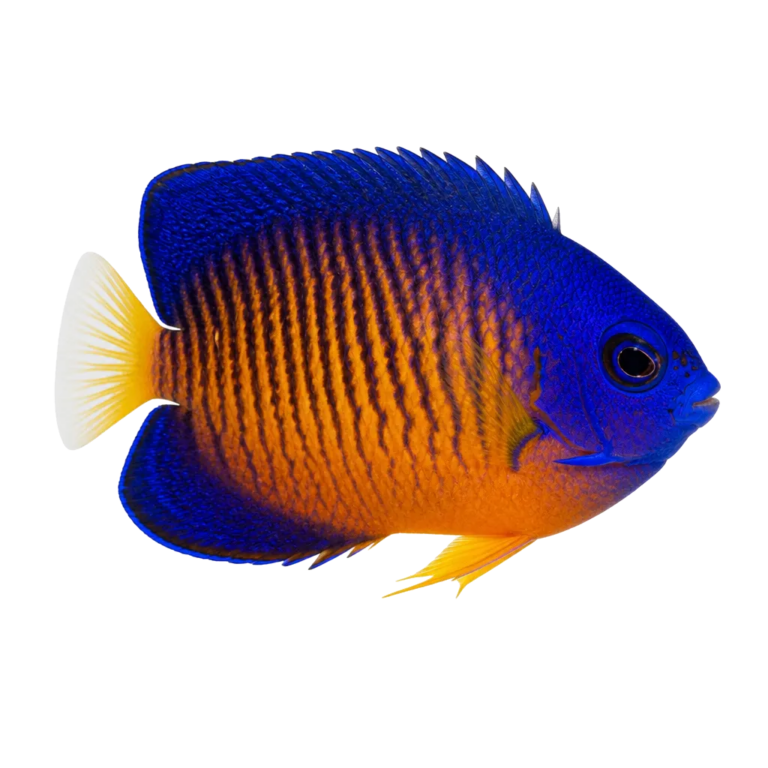
Coral Beauty Angelfish
Summary
The Coral Beauty Angelfish, Centropyge bispinosa, is a rockwork-oriented grazer that spends much of the day weaving through crevices and picking at film algae and attached foods. It suits a reef where its constant inspection of the aquascape will not be mistaken for a problem, but its interest in coral surfaces means it is not a guaranteed coral-safe choice.
A settled fish usually patrols a familiar section of rock rather than cruising the open water continuously. Choosing a specimen that emerges, explores, and feeds confidently is worthwhile: persistent hiding after the initial settling period can indicate that it is being intimidated or has not accepted the layout.
Care
Build the aquascape as connected rockwork with shaded holes, narrow passages, and a clear route around it. This fish moves in short, deliberate runs between grazing patches and retreats into a crevice when startled; an exposed or sparse layout can leave it withdrawn and more easily harassed.
Keep it in an established display with natural grazing on the rock, rather than treating it as a fish for a bare new system. It should have enough structure to establish a territory without having to defend every part of the aquarium; repeated chasing along the entire rockscape suggests the layout is too confined or a competitor occupies the same niche.
Expect it to settle into a particular sleeping crevice after lights-out. A fish that vanishes at night but resumes normal daytime grazing is behaving normally; one that remains hidden during the day, breathes heavily, or is excluded from the rockwork needs prompt investigation.
Feeding
Offer varied, small meals through the day, with marine algae or spirulina-based foods as a routine component and frozen meaty foods such as mysis as part of the mix. Rock grazing supplements feeding but is not a replacement for it, especially once the fish has cleaned much of the available film algae.
Feed in more than one area when fast planktivores or assertive wrasses are present, then watch that the angelfish gets both prepared food and time to graze. A fish that accepts only rich meaty foods may gradually lose condition if plant-based food is neglected; a pinched body or reduced interest in picking at rock warrants a change in feeding strategy.
Do not use heavy feeding as a dependable cure for coral nipping. Good, varied feeding may reduce food-driven experimentation, but an individual that repeatedly targets the same coral can retain that habit despite an excellent diet.
Compatibility
Keep one Coral Beauty Angelfish as the default plan. It can become territorial toward another dwarf angelfish, particularly one added later or one that uses the same rockwork; adding a second after the first has established itself is a common route to relentless chasing.
A pair or group is a specialist setup rather than a routine community choice. Introduce compatible individuals together only in a much larger, highly structured system with multiple separate grazing areas, and have a way to remove the subordinate fish if it is confined to a corner or stops feeding.
Favour peaceful community fish that use different zones of the aquarium, such as small open-water fish and bottom-associated species. Avoid combining it with established, similarly shaped dwarf angels or highly territorial rock-dwellers that can prevent it from reaching shelter and grazing surfaces. Adding the Coral Beauty after a peaceful community is established can limit its ability to claim all of the rockwork.
Reef compatibility is individual-dependent. It may nip both stony and soft corals, and clam mantles are also a risk worth considering. Do not choose this species for a coral collection where even occasional repeated picking, closed polyps, or the possibility of removing the fish would be unacceptable.
Good to know
Coral nipping may begin only after the fish has been settled for some time. Watch for repeated, deliberate visits to one colony rather than an occasional pass over the rockwork; persistent polyp closure or visible tissue damage means the fish and coral should be separated, not simply observed indefinitely.
Centropyge bispinosa is a protogynous angelfish, meaning social conditions can influence sex change. This matters mainly in multi-fish attempts: do not assume two similar-looking individuals will remain socially compatible, and act early if one repeatedly drives the other away from food or shelter.
Territorial behaviour can intensify as the fish learns the aquascape. Brief displays or short chases are less concerning than sustained pursuit, blocked access to a feeding area, or a tankmate that remains hidden; those signs call for rearranging territory or separating the fish.