
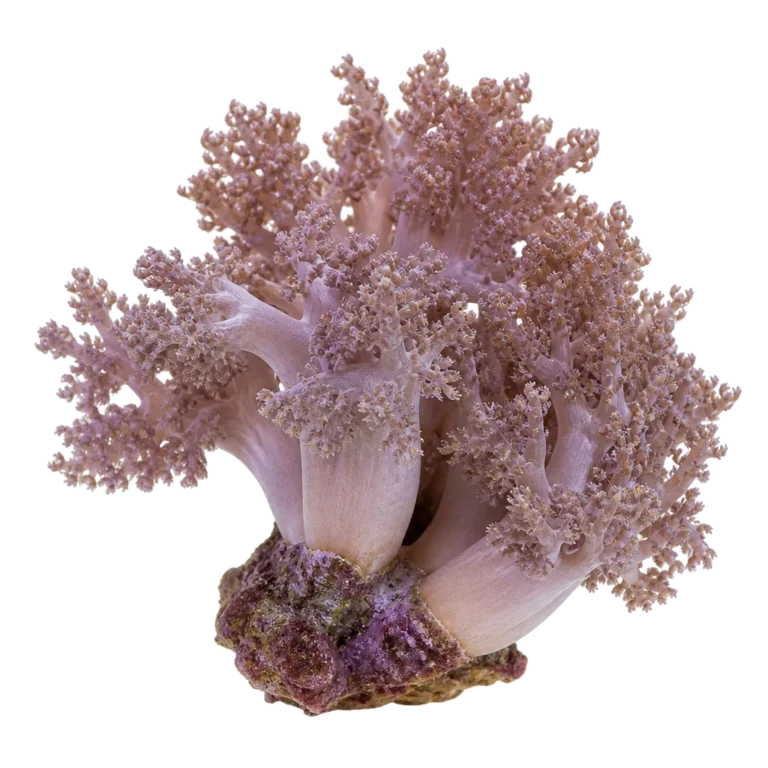
Colt Coral
Summary
Cladiella sp. is a soft, finger-lobed octocoral commonly sold as colt coral. Extended polyps give the branches a fuzzy appearance; when they retract, the colony can look smooth, deflated, or temporarily dull. Because this is a genus-level identification, individual colonies can vary in branching density, colour, and final size.
Cladiella occurs across Indo-Pacific reef habitats, including areas with moving, sometimes turbid water. In an aquarium, that translates to a coral that usually does best when its flexible branches can sway and shed settled debris rather than sit in a stagnant pocket.
General care
Place Cladiella sp. on secure mid-level rockwork where its branches have open water around them. Do not wedge the fleshy base tightly into a crevice: expansion can change the colony’s shape, and trapped detritus can irritate the tissue.
Handle it gently and briefly, supporting the base rather than pulling on branches. Colt corals are slippery and mucus-producing when disturbed; rough handling or a loose mount can tear soft tissue, even though healthy colonies generally recover well from minor damage. Expect occasional periods of reduced extension while the coral sheds surface mucus, but investigate if the tissue stays collapsed, develops damaged areas, or accumulates debris.
Lighting needs
Start a new Cladiella sp. in a slightly shaded position and move it toward its intended placement gradually over a few weeks. Colonies sold under the same common name can come from different light environments, so a slow transition is safer than placing a freshly shipped coral directly under intense LEDs.
In suitable light, the colony holds its branches upright and regularly extends a fine, fuzzy layer of polyps. Persistent stretching toward the light, sparse extension, or a weak, elongated form can indicate insufficient light. Sudden paling, bleaching, shrunken branches, or extended daytime closure after a lighting change suggests excess intensity or an overly rapid acclimation.
Flow needs
Provide indirect, changing flow that makes the finger-like branches sway without continuously folding or snapping them in one direction. Correct flow keeps the whole colony moving, allows polyps to extend, and helps it clear mucus and detritus from between branches.
Inadequate flow often leaves a film, trapped debris, or algae on the colony and may be followed by poor extension around sheltered areas. Excessive direct flow can keep polyps withdrawn, bend branches sharply, and abrade tissue where the colony is repeatedly forced against rock or neighbouring corals. Redirect the pump rather than placing the coral directly in a narrow jet.
Feeding and growth
Most established colonies are sustained largely by light, so target feeding is optional rather than essential. Occasional fine suspended zooplankton-sized foods can help support growth, especially in very lean systems, but large meaty foods are poorly suited to its small polyps and can foul the colony if they settle on it.
Growth is usually fast, producing a bushy mass of thick, rounded fingers that expands outward as well as upward. Choose a mounting spot with a clear perimeter from the start; a small frag can become a broad colony that shades lower corals and occupies more rock than its original footprint suggests.
Compatibility
Cladiella sp. competes mainly through allelopathic compounds released into the water, rather than through a fixed reach of long stinging tentacles. Leave at least 15 cm5.9 in of physical clearance so branches cannot lean onto nearby corals, but do not treat spacing as complete protection in a crowded mixed reef.
Run activated carbon and maintain effective export when keeping this coral with sensitive stony corals or other soft corals. If nearby corals repeatedly remain closed or decline as the colt coral grows, increase separation and chemical filtration rather than assuming a lack of direct contact makes the placement safe.
Avoid fish and invertebrates that repeatedly nip fleshy polyps or pick at the colony. Persistent clownfish rubbing, coral-feeding butterflyfish or angelfish, and destructive crabs can prevent extension and leave damaged areas that collect debris.
Water parameters
Cladiella sp. is generally less demanding than many stony corals, but it responds poorly to abrupt changes in salinity, temperature, or alkalinity. Sudden swings commonly show up as prolonged closure, heavy mucus production, or a limp colony; correct the cause gradually instead of making repeated large adjustments.
It does not need the high mineral consumption support associated with rapidly growing hard corals, but it still benefits from consistent reef conditions and adequate dissolved nutrients. Extremely nutrient-stripped water can coincide with weak polyp extension and loss of body fullness, while dirty, poorly filtered water makes mucus and chemical competition more problematic.