
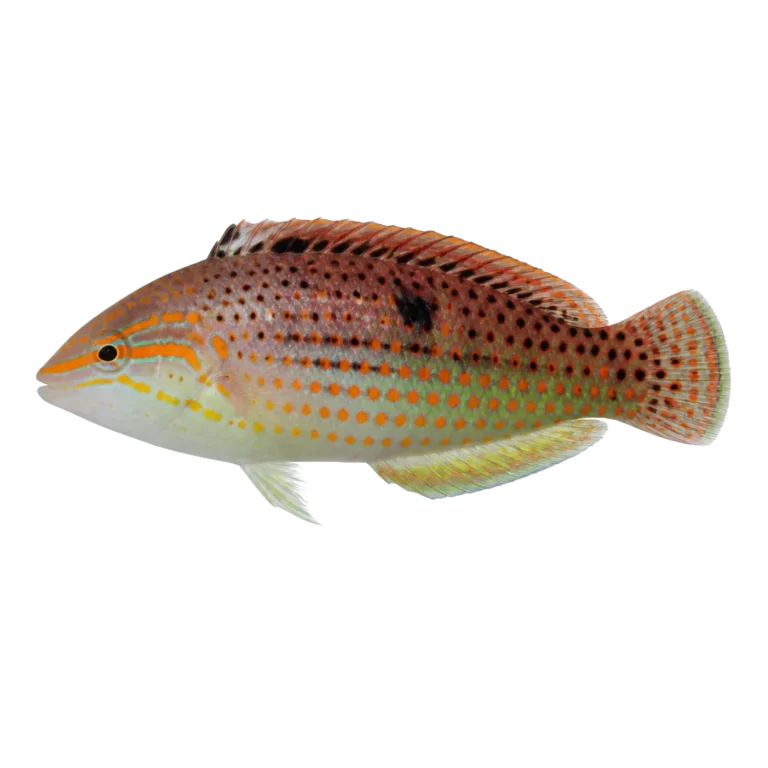
Clown Wrasse
Summary
Halichoeres maculipinna is a constantly moving, bottom-oriented wrasse that patrols rock edges and open substrate for small invertebrate prey. Expect it to spend the day weaving through the lower aquascape rather than hovering in open water, then to disappear into the sand after lights-out or when startled.
Its reef compatibility is conditional: corals are not the main concern, but small ornamental crustaceans and tubeworms can be treated as food. Choose this species for a fish-focused or invertebrate-selective reef, not a display built around delicate shrimp or feather dusters.
Care
Build the aquascape around a broad, accessible area of fine, soft sand and secure every rock directly on the tank base or other stable support. This wrasse dives into the substrate to sleep and escape perceived threats; coarse or shallow sand can prevent that behaviour, while unstable rockwork can shift when it digs beside it.
Leave open lanes along the rock-and-sand boundary for foraging, with broken sightlines in the rockwork rather than a wall of tightly packed stone. A fish that repeatedly paces the glass, stays pinned in one corner, or cannot settle into the sand at night is usually short of usable territory or being intimidated.
Use a tightly fitted lid from the day of introduction. Startled Halichoeres maculipinna can launch upward, especially during netting, disputes, or the first unsettled days in a new aquarium.
Feeding
Offer varied, meaty marine foods in small portions at least twice daily: frozen mysis, finely chopped crustacean flesh, copepod-rich foods, and other quality carnivore preparations are practical staples. Its natural foraging style is based on repeatedly picking benthic animal prey, so a single large feed or an exclusively dry diet is a poor fit.
Feed across more than one area when fast, midwater feeders are present. Watch the wrasse itself rather than assuming it is eating because it is actively hunting; a fish that spends all day searching but loses body condition needs more accessible prepared food, not just a reliance on pods and incidental prey.
Do not use live ornamental invertebrates as a feeding strategy. Small shrimp, tiny crabs, and exposed tubeworms may become targets once the wrasse learns to inspect the rockwork.
Compatibility
Keep Halichoeres maculipinna singly in most home aquariums. It can become territorial toward similar wrasses, and an established individual may repeatedly chase a newly added fish with the same shape, feeding zone, or colour pattern; this is more likely to worsen than to resolve in a confined layout.
Favour active but non-bullying community fish that use other parts of the aquarium, such as peaceful open-water fish and robust bottom companions that are not direct wrasse competitors. Avoid pairing it with highly pugnacious wrasses or fish that monopolize the lower rockwork, because the clown wrasse needs to patrol the substrate and reach its sleeping sand without harassment.
Add this wrasse before more territorial wrasses when possible, or rearrange portions of the rockwork before introducing it to an established community. In a reef, the important exception is invertebrates: established larger animals may be ignored, but small ornamental crustaceans and tubeworms remain a calculated risk.
Good to know
A missing clown wrasse after lights-out is often sleeping behaviour, not necessarily a loss. Check the sand surface and wait for the normal light cycle before disturbing the bed; digging through it to find the fish can expose and stress it when it is resting.
Halichoeres maculipinna is a protogynous wrasse, meaning individuals can change from female to male. Colour and pattern can therefore change substantially with maturity or social conditions, so do not use an apparent change in adult appearance alone as evidence of disease.
Treat sudden refusal to emerge, frantic dashing at the glass, or repeated failed attempts to bury as warning signs rather than normal shyness. These behaviours commonly follow bullying, an unsuitable sand bed, or a disruptive change around its established sleeping area.