
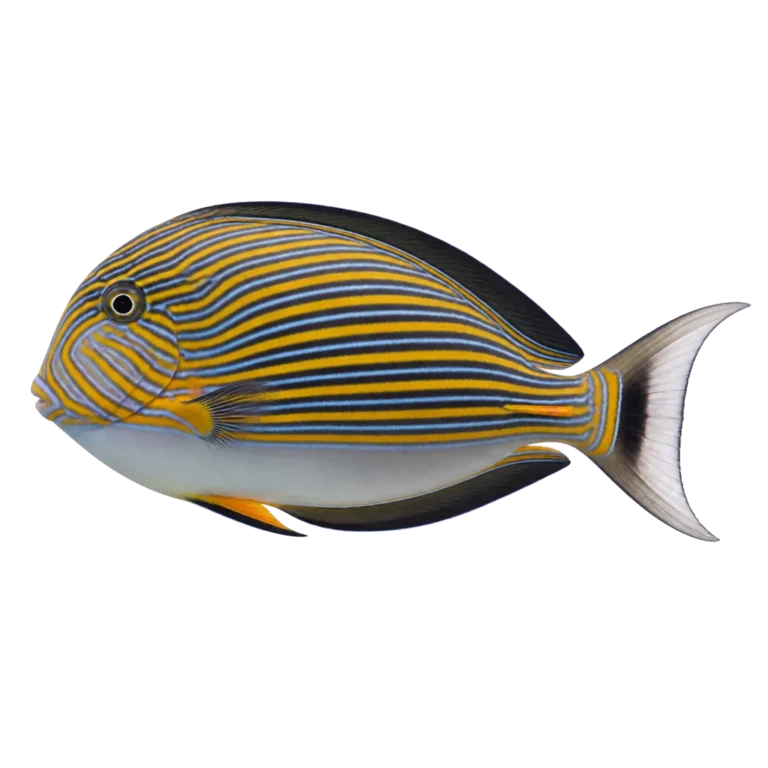
Clown Tang
Summary
Acanthurus lineatus is an almost constantly moving turf-algae grazer that treats productive rockwork as a feeding territory. In an aquarium, that instinct shows as repeated patrols, chasing of similarly shaped grazers, and a need for room to move rather than a fish that settles among corals.
Its difficulty is driven less by specialized equipment than by the combination of heavy grazing demand, high activity, territoriality, and poor tolerance of stress. A fish that spends the day hiding, is excluded from food, or repeatedly paces one pane is not simply being shy; its space, social setting, or acclimation needs should be reassessed.
Care
Build the aquascape around long, unobstructed swimming circuits. Use rock structures as islands or a ridge with open water in front and behind, while leaving grazing surfaces accessible; a solid wall of rock can turn its normal cruising into frustrated pacing and makes territory defense more concentrated.
Provide vigorous, oxygen-rich, irregular flow with sheltered lee areas rather than a single weak current. This species naturally works exposed reef habitat and should be able to swim into current, then retreat to calm cover when resting or pressured by tankmates.
Introduce it only to a mature display with abundant established algae films and enough open layout to dilute its patrol route. Crowding it into a decorative but fragmented reefscape commonly results in continual confrontations with other grazers.
Feeding
Offer marine algae repeatedly through the day, using nori or other marine seaweed, algae-based prepared foods, and access to natural grazing. Supplement with varied frozen fare in modest amounts, but do not make meaty foods the dietary foundation; poor algae intake is a common route to weight loss despite apparent enthusiasm at feeding time.
Place seaweed in more than one feeding location when other herbivores are present, and watch the fish rather than assuming food reaches it. A dominant tang can monopolize a clip, while a Clown Tang may prevent slower grazers from feeding; torn fins, hanging back at meal times, or a pinched body profile call for a stocking or feeding change.
Remove uneaten sheets before they foul the water, but feed often enough that it can graze between meals. A fish that begins sampling ornamental macroalgae is usually responding to an available food source, so decorative algae should not be relied on as a compatible display feature.
Compatibility
Keep Acanthurus lineatus singly in most home aquariums. Wild social structure includes defended feeding areas and groups, but that does not translate into a reliably peaceful captive pair or group; adding another Clown Tang can produce sustained chasing and tail-spine injuries rather than a hierarchy that settles.
Avoid other Acanthurus tangs, surgeonfish with a similar outline, and competing grazing fish, especially once this species has established a route through the rockwork. More suitable companions are confident fish that use a different feeding niche and have enough speed and space to avoid its patrols; timid grazers are poor candidates.
Add the Clown Tang after other fish, particularly any tangs or rabbitfish that will remain in the system, so it cannot claim the entire aquascape before they arrive. Even then, it is often the wrong choice for a mixed-tang plan rather than a fish that can be made compatible through stocking order alone.
It is generally suitable around corals and mobile invertebrates, but its grazing can remove desirable macroalgae and it may investigate algae-covered surfaces around sessile animals. Ensure it has regular marine-algae feeding rather than expecting the reef to supply its full diet.
Good to know
Stress is a major practical risk with this species. Shipping, food competition, confinement, and relentless harassment can quickly coincide with loss of appetite, rapid breathing, flashing, or visible external parasite signs; respond early by reducing social pressure and addressing the health issue rather than waiting for a stressed fish to resume grazing on its own.
Use caution during capture, transfer, and maintenance. The tail spines are sharp and venomous, so a net can entangle the fish and increase injury risk to both fish and keeper; guide it with a rigid container when possible and never handle it casually.
Territorial behavior can intensify after an initially calm settling period. Repeated lateral displays, circling, charging, or a fish being confined to one corner are warning signs that require separation or a revised stocking plan, not a behavior that should be expected to resolve through continued exposure.