
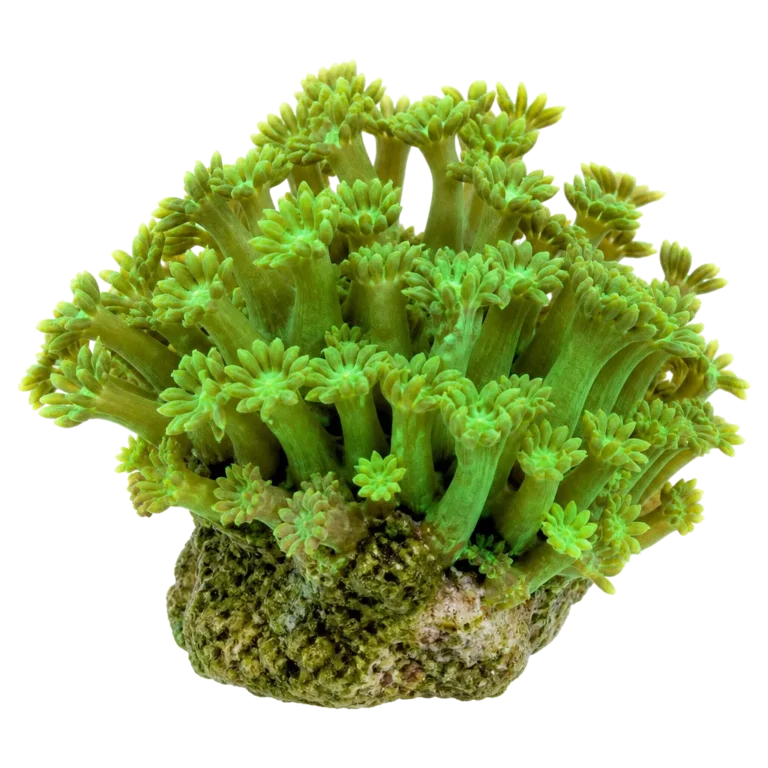
Clove Polyp
Summary
Clavularia viridis is a mat-forming octocoral with feathery eight-tentacled polyps that emerge from spreading stolons rather than from a rigid branching skeleton. Its shallow Indo-Pacific reef and rubble habitat helps explain its aquarium behavior: it accepts moderate light and moving water well, but it is built to colonize open surfaces quickly.
Treat its spreading habit as the main stocking decision. A small frag can become a broad living mat that crosses connected rockwork, so it suits tanks where regular pruning is acceptable or where its territory can be physically contained.
General care
Mount Clavularia viridis low to mid-level on an isolated rock or removable island, with a clear break between it and the main aquascape. This makes future trimming practical; once the stolon reaches adjoining rock, removal becomes much more laborious.
Handle the plug, attached rubble, or basal mat rather than the extended polyps. The soft tissue can tear if it is pulled or scraped, and a loosely attached frag can be dislodged by snails, crabs, or flow before it has secured itself.
Lighting needs
Begin a new frag in the lower part of its intended light zone, then increase exposure gradually over roughly two weeks by raising the coral or increasing fixture output in small steps. This is especially important when a freshly shipped specimen comes from dimmer holding conditions.
Underpowered light is suggested by sparse extension, elongated-looking polyps reaching upward, fading color, and little new mat at the edges. Excess light is more likely when polyps remain tightly closed during the photoperiod, tissue pales, or the colony shrinks back after a lighting change; reduce intensity or add partial shade rather than moving it repeatedly.
Flow needs
Provide indirect, variable flow that keeps the feathery tentacles open and gently moving without pinning them in one direction. Proper flow carries away mucus and detritus while allowing each polyp to remain fully displayed.
If flow is too weak, debris settles in the mat, algae gains a foothold between polyps, and the colony may stay partly closed or look dull. If it is too forceful or delivered as a constant direct jet, polyps remain retracted, lean sharply in one direction, or the mat begins lifting at an edge; diffuse or redirect the current.
Feeding and growth
Most established colonies meet much of their energy demand through photosynthesis, so target feeding is optional rather than a requirement. Fine suspended planktonic foods can help a newly recovering frag, a colony in a very nutrient-poor system, or a grow-out setup, but heavy feeding can foul the mat and encourage nuisance algae.
Use very small particulate foods and briefly reduce the strongest pumps so food passes through the open tentacles rather than accumulating on the colony. Expect growth as an encrusting stolon mat that adds new polyps at its margin, not as a compact clump; leave a removable buffer zone around it from the start.
Compatibility
Its primary aggression is space competition: Clavularia viridis advances by encrusting over available substrate and can shade or smother slower sessile corals without needing powerful sweeper tentacles. Keep at least 10–15 cm3.9–5.9 in of bare, maintainable space between the colony and other corals, and more importantly prevent a continuous rock bridge into the rest of the reef.
Avoid placing it beside corals that cannot tolerate being repeatedly trimmed back or shaded at their base. Butterflyfish and some angelfish may pick at the soft polyps, while large crabs, urchins, and bulldozing snails can dislodge an unsecured frag; watch for persistent closed polyps after these animals pass through the area.
Water parameters
This is generally less demanding than many stony corals and does well in a normally maintained reef system, but it responds poorly to abrupt swings rather than to a narrow setpoint. Acclimate slowly to changes in salinity and temperature, because sudden shifts commonly show up as prolonged closure or sloughing tissue at damaged edges.
Do not run the system so nutrient-stripped that the colony fades and stalls, and do not allow detritus to collect in the mat. Consistent chemistry and clean, moving water usually produce regular daily extension; a colony that stays closed for several days should prompt checks for recent parameter changes, sediment, pests, or excessive direct flow.