
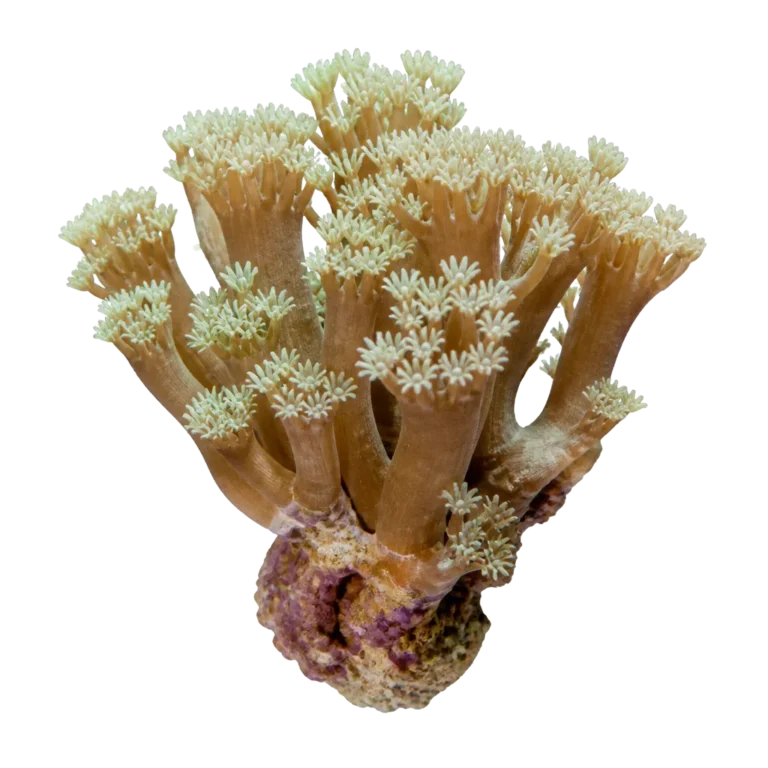
Clavularia Coral
Summary
Clavularia sp. is a genus-level identification, so color, polyp size, and growth speed can vary among trade specimens. Typical colonies have individual feathery, eight-tentacled polyps emerging from a shared creeping stolon rather than a hard branching skeleton.
Many Clavularia occur on tropical Indo-Pacific rubble and low reef surfaces, which helps explain their ability to attach to irregular rock and spread across available substrate. Treat its fast encrusting habit as the main stocking consideration: choose it for an isolated rock or removable island, not for mixed coral rockwork where it can reach valuable neighbours.
General care
Place Clavularia sp. on lower-to-middle rockwork where it can receive open, indirect circulation and where its spreading edge can be inspected. A separate rock surrounded by sand is the most practical containment plan; once the stolon reaches adjoining rock, removal becomes much more difficult.
Handle the plug, rock, or basal mat rather than squeezing the extended polyps. The colony has no rigid skeleton to protect it, so pinching, scraping, or prolonged exposure during mounting can tear tissue and leave damaged areas prone to algae settlement.
Lighting needs
Begin a new colony in a dimmer part of its intended area or use temporary shading, then increase exposure gradually as it settles. This is especially useful for specimens moved from dealer systems with different spectrum or intensity.
Healthy lighting usually produces regular daytime polyp extension and a colony that gradually adds polyps at its edge. In insufficient light, extension and spreading often slow and the colony may stretch toward brighter areas; excessive light can cause washed-out color, persistently shortened polyps, or repeated daytime closure.
Flow needs
Provide moderate, irregular flow that keeps the feathery tentacles moving gently and clears debris without forcing the polyps flat. Aim a pump across or past the colony rather than directly at it.
Too little flow allows detritus and film algae to settle between the stalks, often followed by poor extension from the affected patch. Too much direct flow makes polyps lean hard in one direction, whip continuously, or remain retracted; redirect the flow before the mat starts lifting at an edge.
Feeding and growth
A settled, well-lit colony is primarily photosynthetic, so target feeding is optional rather than essential. Feeding can help in lightly stocked systems or when growth has slowed despite otherwise good extension; use fine suspended planktonic or particulate foods that the small polyps can capture, and avoid large meaty pieces that simply foul the colony.
Growth is usually by a creeping stolon that lays down new polyps across rock, plugs, and adjacent hard surfaces. Leave an intentional buffer and plan to trim or remove advancing edges, because a small starter colony can occupy substantially more rockwork than its initial footprint suggests.
Compatibility
Clavularia sp. has only a weak sting, but its practical aggression is physical overgrowth as its stolon advances over available surfaces. Keep at least 10–15 cm3.9–5.9 in between the colony and neighbouring corals, while recognizing that spacing only delays contact; an isolated island is more reliable than relying on a gap alone.
Most reef-safe fish leave established colonies alone, but coral-feeding butterflies, angelfish, and other persistent nippers can prevent normal extension. Watch for polyps closing only when a particular animal approaches, or for localized missing tissue, rather than assuming that all daytime closure is a lighting or flow problem.
Water parameters
This is generally more forgiving than many stony corals, but it performs best in a mature reef with consistently mixed, oxygenated water. Sudden salinity or temperature changes can cause the whole colony to stay closed for extended periods, and repeated swings may lead to recession at the mat edge.
Avoid driving nutrients to an ultra-clean state solely for this coral. A colony that remains intact but becomes pale, sparse, and slow to spread may be receiving too little available nutrition, whereas accumulating detritus and nuisance algae around the stolon point more toward inadequate flow or excessive organics.