
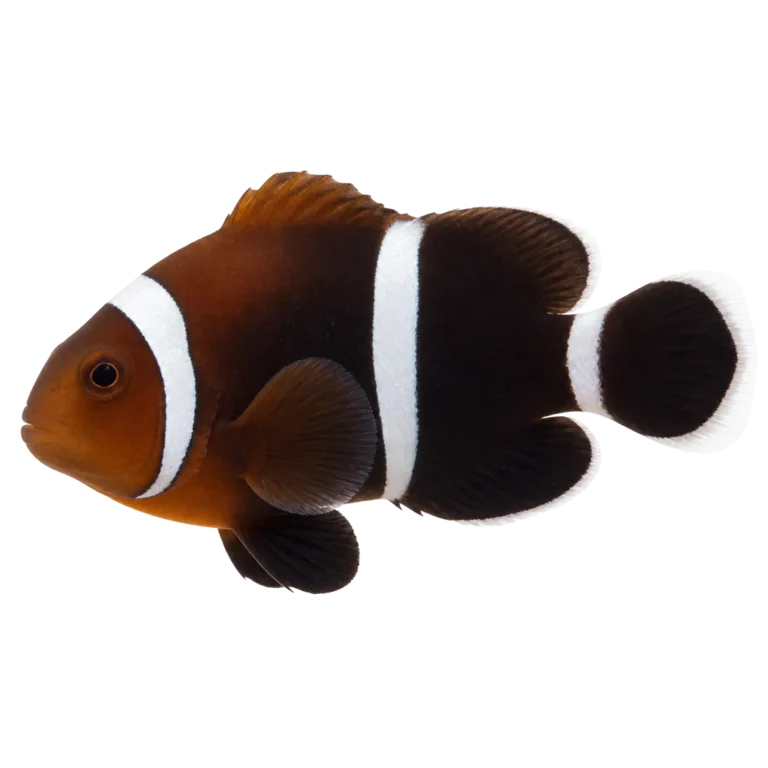
Cinnamon Clownfish
Summary
Amphiprion melanopus is a site-attached clownfish that usually chooses one corner, rock crevice, anemone, or occasionally a large fleshy coral as its base and repeatedly patrols the surrounding area. This is normal settled behaviour, not a sign that it needs more open swimming space; the stocking concern is that its confidence and territorial defence often increase markedly after it claims that site.
Expect a bolder, more defensive temperament than from many common clownfish. An established individual may rush, chase, or nip fish that pass close to its chosen shelter, particularly at feeding time or when it has formed a pair.
Care
Build the aquascape with a clearly defined home area: a protected nook in stable rockwork with nearby open water lets Amphiprion melanopus retreat, hover, and patrol without having to compete for the only sheltered space. It does not require a host anemone to settle, and adding one should be a deliberate decision because the clownfish may defend it much more intensely.
Use securely fixed rock and corals around its preferred territory. This species makes short, purposeful dashes between cover and the water column rather than ranging continuously through the aquarium, so a loose frag, unstable coral, or crowded passage beside its home can become a repeated source of conflict.
Keep water movement broad rather than directing a harsh, constant jet at its sleeping and sheltering spot. A fish pinned behind rockwork or persistently avoiding its usual territory is more likely being displaced by flow or a tankmate than simply behaving like a clownfish.
Feeding
Offer a varied omnivorous diet of quality marine pellets or flakes with algae content alongside frozen zooplankton-sized foods, finely chopped crustaceans, and other marine-based preparations. Rotate foods rather than relying on one rich frozen item; a fish that accepts only one food may remain outwardly active while receiving a narrow diet.
Feed in small portions that can be eaten promptly, preferably split across the day when practical. Amphiprion melanopus is usually assertive at the food source, so scatter or target-feed slower, shyer fish first if the clownfish begins intercepting most of the ration.
Do not mistake persistent begging for a need for large meals. Clownfish readily learn feeding routines, and repeated heavy feeding can raise nutrient input without improving condition; use body fullness and steady activity rather than begging behaviour to judge portions.
Compatibility
Keep one individual or a deliberately formed pair. The most reliable route is two juveniles introduced together, or a clearly smaller juvenile introduced cautiously to a settled larger fish; adding another similar-sized or adult Cinnamon Clownfish can escalate from display behaviour to sustained biting and exclusion.
Avoid mixing Amphiprion melanopus with other clownfish, especially where both would compete for the same shelter, anemone, or side of the aquascape. A single pair can regard another clownfish as a direct territorial rival even in an otherwise peaceful community.
Choose tankmates that can ignore a defended corner and are neither easily intimidated nor likely to harass the clownfish. Add delicate, timid fish and other fish that need the same low-rock shelter before the clownfish or pair becomes established, because later additions are more likely to be treated as intruders.
It is reef compatible, but there is an important exception: a fish without an anemone may adopt a fleshy LPS coral or soft coral as a surrogate host. Repeated rubbing and nest-site activity can keep that coral retracted or cause localized tissue damage, so move or protect the coral rather than expecting the clownfish to abandon its chosen host.
Good to know
A settled pair develops a clear hierarchy: the larger dominant fish is female, while the smaller partner is male. If the female is lost, the male can change sex and become the new female; introducing a replacement that is too large can therefore trigger serious dominance fighting rather than restore a peaceful pair.
Brief chasing, side-on posturing, and the smaller fish’s submissive shaking can occur while a pair forms. Intervene if the subordinate fish is prevented from feeding, remains trapped at the surface or in a corner, shows torn fins, or is chased whenever it leaves cover; those signs indicate incompatible fish rather than normal pair negotiation.
Watch closely for Brooklynella and other fast-moving external disease signs when obtaining clownfish. Heavy mucus, rapid breathing, clamped fins, or sudden withdrawal from its usual territory warrant prompt isolation and diagnosis, because clownfish can deteriorate quickly once respiratory irritation is apparent.
Once a pair begins guarding a cleaned patch of rock, expect territorial behaviour to intensify around that site. Rearranging their preferred shelter or repeatedly placing hands and tools beside it can provoke nipping; work deliberately and give the fish space rather than treating the behaviour as random aggression.