
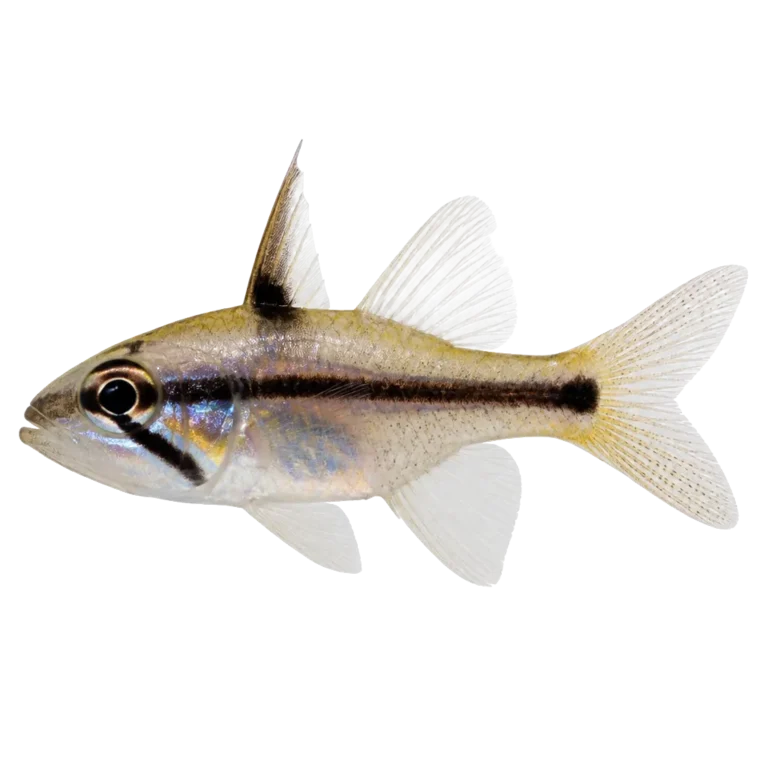
Cheek-bar Cardinalfish
Summary
Ostorhinchus sealei is a peaceful cardinalfish that naturally gathers in aggregations close to branching coral structure. In an aquarium, it usually spends the day hovering quietly around a chosen refuge rather than constantly crossing open water, then becomes more visible and purposeful around dusk.
Keep it as a social fish rather than expecting a single specimen to provide the same behavior. A settled group will often hold loosely together around cover; a fish that remains isolated, pinned into a corner, or excluded from the shelter is more likely being pressured or outcompeted than simply behaving shyly.
Care
Build the aquascape with branching coral skeletons, open rockwork, or other intricate cover that allows the group to hover within and retreat through it. This matters because O. sealei uses structure as a daytime reference point; a bare, exposed layout can leave it withdrawn and difficult to feed reliably.
Provide calm pockets around the shelter while retaining normal reef circulation elsewhere. Direct, persistent pump flow through its preferred refuge can make the fish abandon the area or continually struggle to hold position. Give the group several nearby refuge points so subordinate fish are not forced into exposed water.
A peaceful, established reef suits this species best. It is not a strong territorial defender, so its apparent calmness should not be mistaken for resilience against boisterous tankmates or repeated disturbance around its resting area.
Feeding
Offer small marine plankton foods in portions that remain suspended long enough for the fish to pick them off: copepods, mysis, enriched brine shrimp, finely chopped marine foods, and other suitable zooplankton-sized fare. Feed more than once through the day when possible, with one feeding near dusk if the group is most active then.
Target-feed or briefly reduce flow if faster fish strip the water column before the cardinalfish can feed. Watch the quieter individuals, not only the boldest fish at the front; a group can look well fed while lower-ranking members repeatedly miss meals.
Do not rely on nutritionally weak foods such as unenriched brine shrimp as the staple. Rotate varied frozen and prepared marine foods so the diet is not narrow, especially when the fish are sharing food with more assertive planktivores.
Compatibility
Keep O. sealei with gentle community fish that do not monopolize suspended foods, such as peaceful gobies, blennies, assessors, smaller fairy wrasses, and similarly mild-mannered reef fish. Avoid large predators and highly assertive feeders, including fish able to treat a cardinalfish as prey or keep it confined to cover.
Introduce the intended group together, preferably before territorial or highly active fish are established. Adding a lone newcomer to an existing group can leave it without access to the preferred shelter and feeding lane.
This species is reef-compatible with corals, but reef-safe does not automatically mean safe with every small invertebrate. Very small ornamental shrimp or similarly sized mobile animals may be at risk from a fish large enough to swallow them, so assess prey size rather than relying on the coral-safe label.
Good to know
Expect activity to increase toward evening. A group that is barely visible in bright daylight but emerges to forage as the lights dim is often behaving normally; sudden daytime hiding combined with refusal of food is more concerning and points to social pressure or a tankmate problem.
Males are mouthbrooders. A male carrying eggs may show a fuller mouth and reduced interest in food; avoid chasing, netting, or repeatedly trying to make it feed, as disturbance can cause the brood to be lost.
Use a secure cover. Cardinalfish can jump when startled, particularly during introductions, maintenance, or conflict, so an unexplained disappearance should prompt an immediate check around the aquarium.