
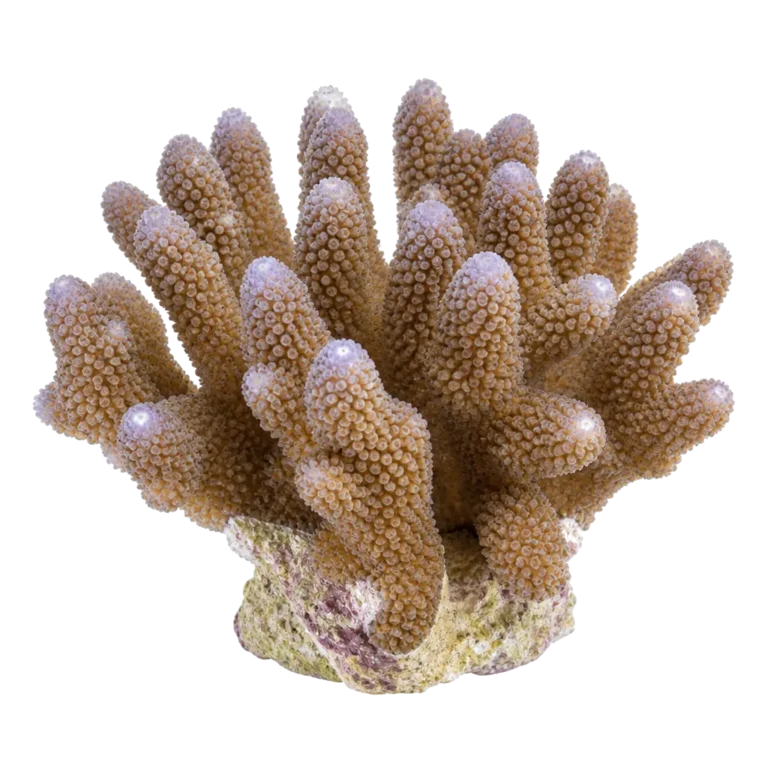
Cat’s Paw Coral
Summary
Stylophora pistillata is a branching SPS coral with compact, blunt-ended branches and a bushy growth habit. It comes from Indo-Pacific reefs, often in shallow, wave-exposed habitat, which explains its preference for bright light, energetic water movement, and a firmly secured position.
Buy it only if the aquarium already supports stable SPS conditions. A healthy frag should show intact tissue over the branch bases and tips, with no rapidly expanding bare-white areas or algae growing into exposed skeleton.
General care
Place Cat's Paw Coral in the upper-middle rockwork, where it receives strong but indirect, changing flow rather than a fixed jet. Secure the frag plug or base firmly; its branching shape catches current and can be knocked loose as it grows.
Handle Stylophora pistillata by the plug or bare skeleton whenever possible. Avoid pinching living branch tips or rubbing tissue against rock, because small abrasions can leave exposed skeleton that may collect algae before the coral heals.
Lighting needs
Acclimate a new frag by starting it in a less intense part of its intended area, or by reducing the initial exposure with shading, then increase exposure gradually over the following weeks. This gives its symbionts time to adjust instead of turning a lighting upgrade into sudden bleaching.
Underpowered light often produces a darker or browner appearance, slower tip growth, and open but less vigorous-looking polyps. Excess light is more urgent: look for paling, bright-white tissue, persistent polyp retraction during the photoperiod, or tissue loss beginning on the most exposed branch tips; reduce exposure promptly if these signs follow a lighting change.
Flow needs
Provide turbulent, multidirectional flow that keeps the fine polyps gently active and carries suspended food past all sides of the colony. Correct flow leaves the branches clean, prevents detritus from lodging between them, and does not hold the polyps flattened in one direction.
Too little flow allows debris, film algae, or cyanobacteria to settle in the branch structure and can lead to poor extension or recession in shaded inner areas. Too much direct flow causes persistent retraction, tissue that appears scoured on the side facing the pump, or a colony that stays bent in one direction; redirect the outlet rather than simply reducing all circulation.
Feeding and growth
Most of this coral's energy comes from light, so feeding is supplemental rather than mandatory. Broadcast fine suspended coral foods, zooplankton-sized particles, or very small planktonic foods when nutrient availability is lean, during recovery, or when trying to support faster growth; large meaty pieces are poorly suited to its small polyps.
Stylophora pistillata usually builds a dense branching clump, adding growth at branch tips and gradually filling the space between them. Leave open water around the colony and plan for regular trimming or fragging, because fast-growing branches can shade nearby corals and turn a modest frag into a broad, space-consuming colony.
Compatibility
Cat's Paw Coral is generally peaceful, but its tissue can sting corals that touch it. Give it at least 10 cm3.9 in of clearance from neighboring corals, and increase that buffer if either colony is growing quickly toward the other.
Do not place slow-moving or sessile corals where falling branches can land on them. Fish and mobile invertebrates are usually not a direct problem, but persistent perching, picking, or climbing through the fine branches can break tips or irritate tissue; move the coral if repeated contact prevents normal polyp extension.
Water parameters
Treat Stylophora pistillata as more demanding of consistency than most soft corals and many hardy LPS. Keep changes to alkalinity, salinity, and temperature gradual, because abrupt shifts can show first as reduced polyp extension, faded color, or tissue recession even when the final test result appears acceptable.
Avoid letting nutrients become chronically depleted while maintaining a stable, clean reef environment. A coral that suddenly pales, stops extending, or develops fresh exposed skeleton should prompt a check for recent chemistry swings, unstable nutrient availability, and localized flow problems before making several corrections at once.