
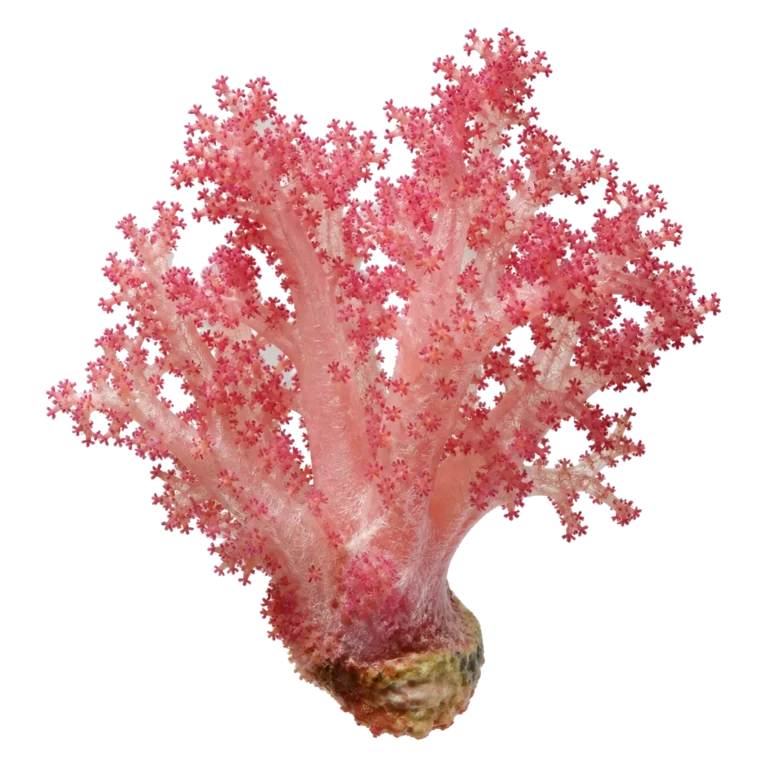
Carnation Coral
Summary
Dendronephthya divaricata is a non-photosynthetic, branching soft coral that depends on suspended plankton rather than light for its energy. Its tree-like colony should inflate, stand upright, and extend a fine feeding canopy in a food-bearing current; a persistently shrunken colony is a husbandry warning, not normal soft-coral behavior. This is a specialist animal best reserved for a mature system designed around continuous fine-particle feeding and strong circulation.
General care
Mount it in an open lower-to-middle flow lane where every branch can receive moving water, rather than in a cave or against dense rockwork. Secure the base to rubble or a plug before introduction, and keep detritus, cyanobacteria, and filamentous algae from collecting around the attachment point; trapped debris can smother the tissue and prevent normal expansion.
Handle Dendronephthya divaricata only by its base while fully submerged whenever possible. It has no rigid branching skeleton to protect it, so squeezing, lifting by a branch, or allowing it to whip in air can tear tissue or damage the feeding polyps. Temporary deflation after handling can occur, but torn tissue, sloughing surface film, or progressive branch collapse needs prompt correction of flow, cleanliness, and nutrition.
Lighting needs
Treat lighting as a placement convenience rather than a food source. This coral gains no nutritional benefit from stronger lighting, so choose a dim or shaded position if that makes it easier to provide the required current without competing with light-demanding corals.
Do not interpret poor polyp extension, thinning branches, or a collapsed colony as a need for more light; assess feeding delivery and flow first. Excessive direct illumination is mainly a practical problem when it encourages algae or cyanobacteria to grow on the base, or adds localized heat, rather than a cue for the coral to photosynthesize.
Flow needs
Provide strong, broad, and preferably changing flow that keeps the colony upright and the polyps open without pinning the branches in one direction. Correct flow carries fine food through the entire crown: individual polyps should remain extended and the branches should sway or flex rather than fold over.
Too little flow leaves the colony limp, allows detritus to settle between branches, and reduces feeding opportunity. Too much direct flow causes branches to flatten, bend hard downstream, or repeatedly retract polyps; redirect or diffuse the stream rather than simply increasing food.
Feeding and growth
Feeding is essential rather than supplemental because Dendronephthya divaricata cannot rely on light-derived energy. Use frequent or continuous broadcast delivery of very fine live phytoplankton, nanoplankton, and other suspended plankton-sized foods that can remain in the water column; large meaty foods are poorly matched to its small feeding polyps and can foul the colony.
A properly nourished colony develops a fuller, branching tree form, while chronic underfeeding usually appears as reduced polyp extension, thinning branch tips, loss of volume, and gradual tissue recession. Leave room above and around the colony for its expanded crown and for water to pass through it, rather than wedging it among rock or dense corals.
Compatibility
Dendronephthya divaricata is not a sweeper-tentacle coral, so its main spacing requirement is access to flow and protection from neighbours that can overgrow, sting, or physically contact its delicate branches. Keep at least 10–15 cm3.9–5.9 in of open space around the expanded colony, increasing that clearance near corals with long nighttime tentacles or rapidly spreading tissue.
Avoid angelfish, butterflyfish, and other known coral pickers, along with crabs or large mobile invertebrates that may climb through, tear, or dislodge the colony. Planktivorous fish can coexist if the feeding system still delivers enough fine food to the coral, but they can intercept suspended foods and make an already demanding feeding schedule harder to maintain.
Water parameters
This species is more demanding than a typical reef coral because the heavy, frequent feeding needed to sustain it can quickly create nutrient accumulation, bacterial films, and reduced oxygen if export and circulation do not keep pace. A colony that suddenly stays contracted while the water turns cloudy or develops surface film should be treated as a system-level warning, not solved by adding still more food.
Keep salinity and other core chemistry steady, especially during automated feeding, top-off, and water-change routines. Rapid swings can compound the stress of transport or underfeeding, but the most common long-term failure is a mismatch between nutritional input and the system's ability to maintain clean, oxygen-rich water.