
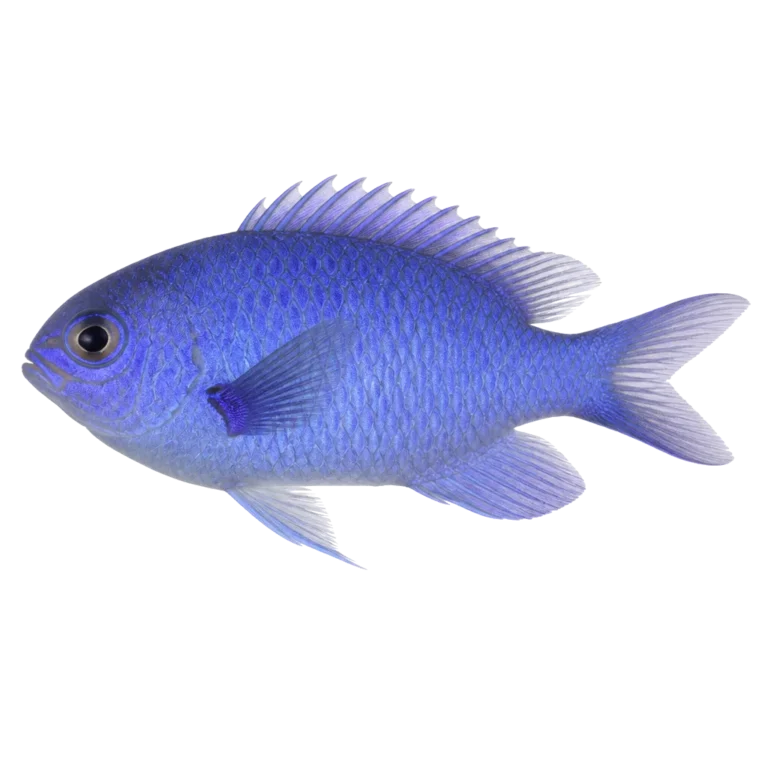
Caerulean Damselfish
Summary
Pomacentrus caeruleus is an alert, active damselfish that spends much of the day making short forays above and around the rockwork, then retreats quickly to a chosen crevice or rubble-like shelter. That close attachment to a patch of reef structure explains why a fish that seems peaceful when newly introduced can become a persistent defender of one area as it settles in.
Choose it for a community where a small, assertive fish fits the stocking plan, rather than treating it as a passive blue fish. Repeated dashing at fish that cross a particular rock face is territorial behaviour, not play, and usually becomes more consequential as the fish matures.
Care
Build the aquascape with interconnected rockwork, overhangs, and several separate crevices rather than one open pile. Pomacentrus caeruleus uses structure as both a refuge and a territorial reference point; broken lines of sight give other fish a way to pass without being continually challenged.
Leave open water immediately around the rockwork for its active, darting swimming style, but avoid a sparse layout with no defined retreats. A fish that remains pressed into a corner, hides continuously, or is unable to return to the rocks may be receiving too much attention from established tankmates.
A mature reef with natural grazing surfaces suits this species better than a bare, newly arranged display. It will inspect rock and substrate throughout the day, so keep the rockwork secure before introduction; a fish repeatedly charging through loose pieces can destabilize an unstable scape.
Feeding
Offer a varied omnivore diet in small portions across the day: finely sized frozen crustacean foods and other meaty plankton substitutes should be paired with quality prepared foods containing algae or spirulina. This reflects its mixed feeding habits and avoids relying on rich meaty foods alone.
Feed where the fish can intercept food in the water column, then ensure some prepared food reaches the rockwork for grazing. Pomacentrus caeruleus is usually quick at meals and can monopolize a single feeding spot; disperse food or feed from more than one area when slower, shyer fish are present.
Watch body condition rather than assuming an eager feeder is adequately nourished. A fish that takes only meaty items while refusing plant-containing foods is a cue to broaden the diet, not simply increase the amount fed.
Compatibility
Keeping a single Pomacentrus caeruleus is the most predictable option in a mixed reef. Multiple juveniles may initially coexist when introduced together into a spacious, complex aquarium, but do not assume that early schooling behaviour will persist once individuals establish territories.
Avoid combining it with other similarly shaped damselfish or timid fish that use the same lower-to-midwater space around the rocks. The usual result is repeated chasing focused on the nearest territorial competitor, while confident, similarly robust community fish are generally better able to ignore brief displays.
Add this species after more peaceable fish have settled, rather than allowing it to claim the aquascape first. If an established individual is already patrolling most of the rockwork, adding a new small fish is more likely to trigger sustained harassment than a short introduction-period dispute.
It is suitable around corals, but observe ornamental benthic invertebrates closely. Individuals may investigate or pick at small invertebrates on the rockwork, so do not treat reef compatibility as a guarantee of complete indifference to every invertebrate.
Good to know
Territorial behaviour often develops after an apparently uneventful settling period. Treat repeated lunges, fin nipping, refusal to let another fish approach a feeding area, or a tankmate hiding through the day as a stocking problem early; waiting for a clear hierarchy can leave the targeted fish exhausted and underfed.
If aggression is centred on one defended rock, changing the territory by rearranging that section of rockwork can interrupt the resident’s advantage before a new introduction. Use this as a deliberate intervention, not routine maintenance, and be prepared to separate the damselfish if chasing continues.
Breeding behaviour can intensify defence of a chosen substrate. A fish that cleans or closely guards a patch of rock and drives away passersby may be tending a nest; the practical response is to give that area space and monitor nearby fish for escalating stress.