
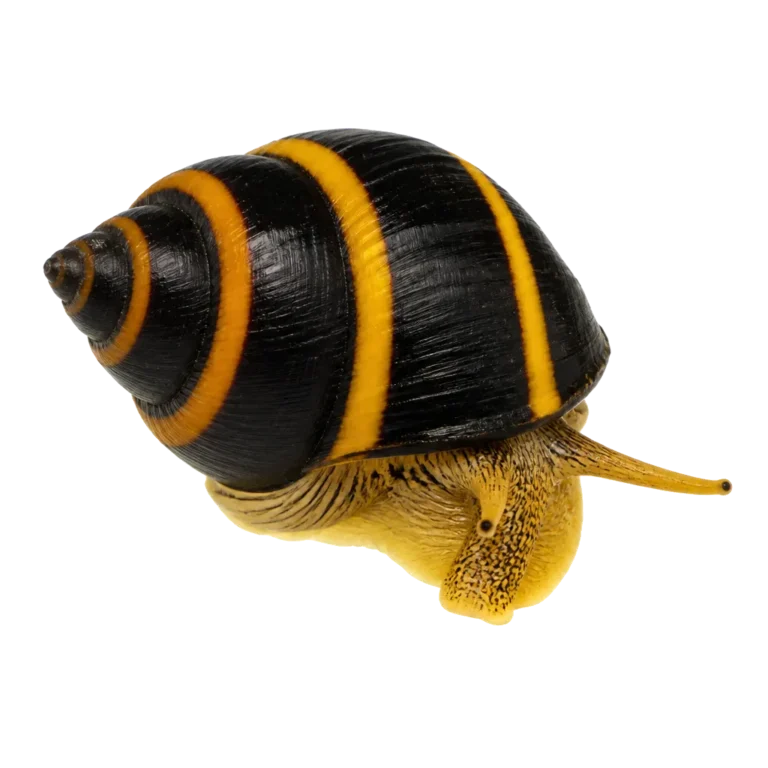
Bumble Bee Snail
Summary
Engina mendicaria is a small, black-and-yellow banded whelk-like snail rather than an algae-grazing snail. Its natural habit of sheltering in rockwork and foraging over rubble and sand after dark explains why a newly added animal may remain hidden by day and become active only once the aquarium lights are out.
Choose it for scavenging leftover animal-based foods and carrion, not for clearing film algae. The same opportunistic feeding behavior that makes it useful around uneaten food can also put very small snails, worms, and desirable microfauna at risk.
Care
Add Engina mendicaria to an established aquarium with mature rockwork, a forageable sand or rubble area, and crevices it can retreat into during daylight. A freshly cycled or unusually sterile tank may not provide enough natural food, while a sand bed is helpful but not essential if the snail can search rockwork and receive target feeding.
No specialized lighting or flow pattern is needed. Its daytime absence is usually normal nocturnal behavior; assess its condition after dark, when it should emerge and move purposefully while searching surfaces and substrate.
Feeding and role
Feed this carnivorous scavenger meaty leftovers, carrion, and small benthic invertebrates. In a lightly stocked or very clean system, place a small amount of mysis, finely chopped seafood, or a sinking carnivore food near its usual nighttime route after lights-out. A snail that repeatedly roams widely but finds no food may begin taking accessible worms or small snails instead.
Its cleanup role is limited to consuming stray meaty food and dead material in places fish may miss. It does not replace algae grazers, and one specimen should not be expected to solve a vermetid, bristleworm, or detritus problem; any predation on nuisance invertebrates is variable and usually gradual.
Compatibility
Engina mendicaria is generally safe around corals because it does not feed on coral tissue, but it is reef-compatible with caution around very small snails, tube worms, bristleworms, and other benthic microfauna. Do not choose it for a display built specifically to preserve a diverse worm and micro-snail population.
Keep it away from animals that crush or pick at snails, including puffers, triggerfish, and snail-eating wrasses. Add individuals according to available food rather than for social reasons: they do not need a group, and adding several to a small food base increases the chance that they compete with one another or prey on other small invertebrates.
Good to know
Acclimate slowly to avoid abrupt salinity change, which can leave a snail inactive or unable to recover after introduction. If it has not emerged after dark for several nights, inspect it gently rather than assuming daytime hiding is the cause.
Avoid copper-based medications and other treatments not confirmed as safe for marine snails. Do not interpret a lack of visible algae grazing as illness: Engina mendicaria is a carnivorous scavenger, so its most normal feeding behavior is searching for animal-based food rather than scraping green surfaces.