
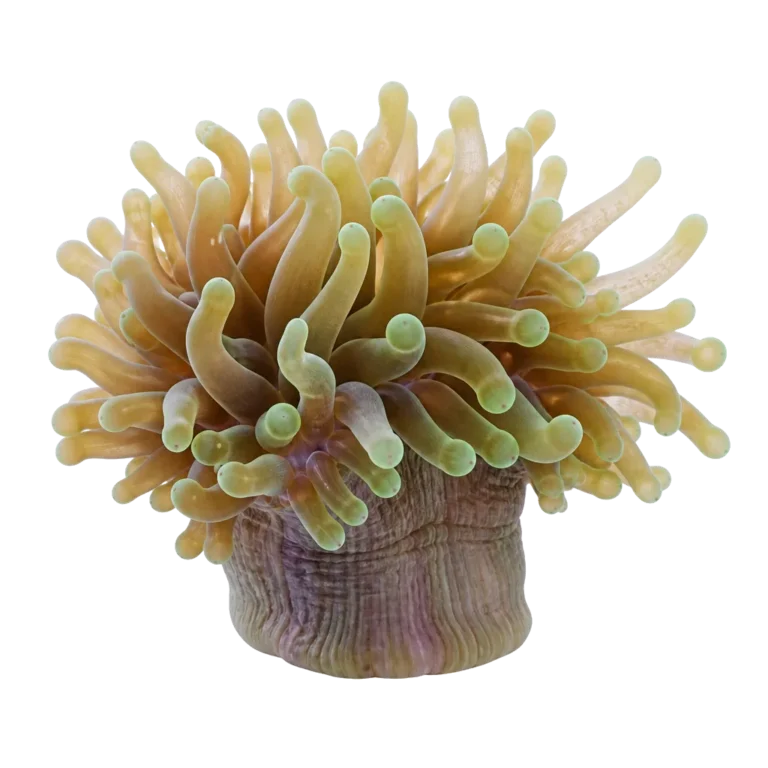
Bubble Tip Anemone
Summary
Entacmaea quadricolor is a photosynthetic, clownfish-hosting sea anemone whose tentacles may be distinctly bulb-tipped or more elongated; tentacle shape can change with conditions, so it is not a reliable health test by itself. Its adhesive foot anchors deep in rock crevices while the oral disc expands into the light, which explains its need for secure rockwork and its tendency to relocate when a chosen spot no longer suits it.
A settled anemone is usually firmly attached, inflated, and responsive to food. A newly introduced specimen may wander while selecting a site, but repeated roaming after it has settled often means the available light, flow, or foothold is unsuitable.
Care
Place the foot into a protected hole or crevice in stable live rock, with the oral disc able to reach open water and light. Do not try to bury the foot in sand or repeatedly move an attached animal; tearing the foot can be fatal. Arrange rock securely before introduction, because it may climb behind or between structures.
Provide strong reef lighting and allow a specimen that arrives from dimmer conditions to acclimate gradually. Entacmaea quadricolor relies heavily on its symbiotic algae, so fading or persistent paling under otherwise clean conditions is a warning that its light or overall husbandry is inadequate.
Use moderate, variable flow that keeps the tentacles moving without folding the animal over or blasting the foot loose. Choose a mature, established reef rather than a recently set-up aquarium: anemones tolerate neither unstable chemistry nor the rapid swings common during early cycling.
Feeding and role
Its symbiotic zooxanthellae supply much of its energy under appropriate lighting, but feed small, marine-based portions such as mysis, krill, or finely chopped marine flesh once or twice weekly. Offer food that the tentacles can hold and remove uneaten pieces; oversized meals can be regurgitated and foul the water.
It is not a cleanup-crew animal. It does not consume nuisance algae, detritus, or routine waste in a useful way, and should be stocked for its own care requirements rather than for aquarium cleaning.
Compatibility
Give it a coral-free margin around its likely path and final position. Entacmaea quadricolor can move unexpectedly, and contact with its stinging tentacles can damage or kill corals, clams, and other sessile invertebrates. A fixed anemone can still expand far beyond its apparent footprint, so judge spacing with the animal fully open.
Avoid fishes and invertebrates known to pick at anemones, including many butterflyfishes and larger angelfishes. Conversely, a healthy anemone can sting and retain very small fishes or weakened animals that blunder into its tentacles. Clownfish may use it as a host, but hosting is never guaranteed; a particularly forceful clownfish pair can also keep a small or recently introduced anemone contracted.
Start with one specimen unless the aquarium has deliberate space for more. Clonal individuals produced by splitting can remain near one another, but separately acquired anemones may each roam and create multiple coral-sting zones; add additional specimens only when the first has been stable and there is room for every animal to expand.
Good to know
Cover every pump and overflow intake with a suitable guard before introduction. A roaming anemone can be drawn into unprotected equipment, causing severe injury and potentially polluting the aquarium. Check guards routinely, as reduced flow through a clogged guard can create a different problem.
Acclimate carefully to differences in salinity and temperature, and never expose the animal to copper-based medication. It may deflate briefly to expel water or waste, but a persistently collapsed anemone, a gaping mouth, loss of attachment, or rapidly deteriorating tissue calls for prompt action: protect it from flow and intakes, check water quality, and remove it only if it is clearly disintegrating.
Healthy Entacmaea quadricolor can reproduce by longitudinal fission. Splitting is not automatically an emergency if both halves retain intact mouths, attached feet, and recover inflation, but do not feed heavily or handle the pieces while they are healing.