
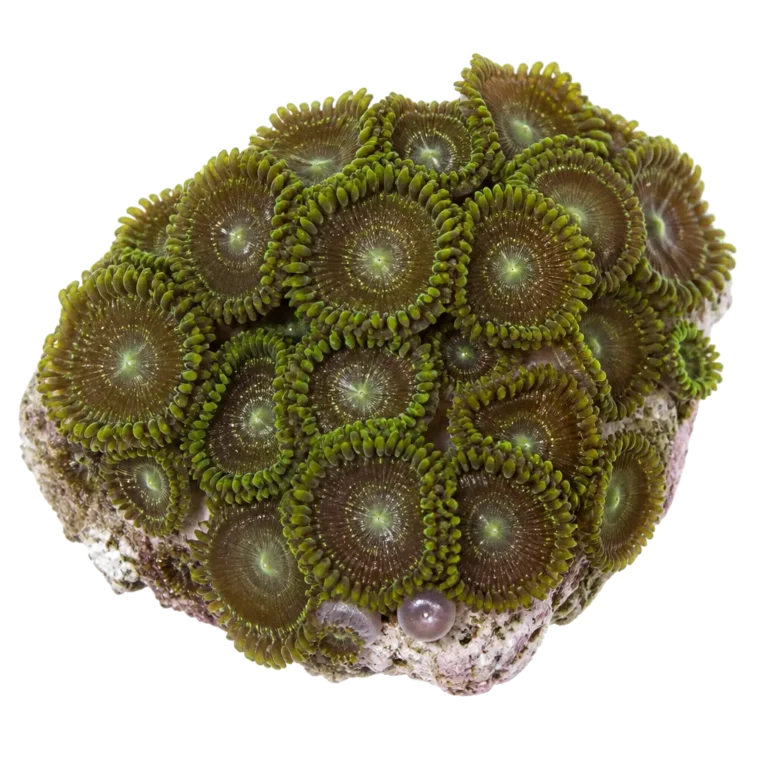
Broad Zoanthid
Summary
Palythoa mutuki is a large-polyped, sand-encrusting zoantharian that forms connected patches rather than a branching hard-coral colony. Its natural occurrence on shallow reef flats and rocky shore habitat helps explain its tolerance of typical reef conditions, but also its tendency to claim open rock quickly once settled.
Plan its location before purchase. A small frag can become a broad mat that crosses seams, rubble, and adjoining rockwork, so it is best treated as a spreading colony rather than a compact accent coral.
General care
Mount Palythoa mutuki on an isolated, removable rock in the middle of the aquascape, where its expansion can be inspected and trimmed without dismantling the reef. Avoid wedging the frag into a crevice shared with other corals; once the colony establishes beyond the plug, removal becomes much harder.
Handle every colony as potentially containing palytoxin. Wear gloves and eye protection, keep it submerged while moving or trimming when practical, and never cut, scrape, crush, scrub, boil, or blast it with hot water. Work in a well-ventilated area, prevent splashes, and keep pets and children away from the work area; damaged tissue can release hazardous material into droplets and on tools.
Lighting needs
Start a new frag slightly shaded or under a reduced lighting schedule, then move it into its intended exposure gradually after it is opening reliably. This avoids a sudden light shock, especially when its previous lighting is unknown.
Under insufficient light, polyps may stretch upward on longer columns, look less full, and add new polyps slowly. Excess light is more likely when the colony remains partly closed during the photoperiod, pales or loses contrast, or develops tightly cupped oral discs; reduce intensity or provide partial shade rather than moving it repeatedly.
Flow needs
Provide indirect, irregular moderate flow that makes the tentacles and oral discs move gently without holding the polyps shut. Correct flow lets the colony open broadly while keeping sand, detritus, and algae film from collecting between polyps.
If flow is too weak, debris accumulates around the bases and polyps may stay contracted or develop a persistent film. If a pump is aimed too directly at the colony, polyps bend hard in one direction, fold their discs, or stay closed; diffuse or redirect the stream instead of increasing total flow blindly.
Feeding and growth
Palythoa mutuki can meet much of its energy demand through light, so feeding is most useful for recently established frags, colonies in very nutrient-poor systems, or keepers deliberately supporting faster propagation. Offer a small broadcast or gentle target feed of fine zooplankton-sized foods or finely minced meaty food only when the polyps are open; oversized pieces are often dropped or foul the colony.
Expect a low, spreading mat of large polyps that encrusts the rock and may bridge onto adjacent surfaces. Leave an open buffer around its mounting rock and be prepared to remove advancing edge polyps before they contact another coral.
Compatibility
Its primary competitive weapon is rapid physical expansion: Palythoa mutuki can shade, crowd, and overgrow sessile neighbors by direct contact. Leave at least 10 cm3.9 in of bare, inspectable space around the colony, understanding that this is a management buffer rather than a permanent boundary for a fast-growing mat.
Avoid placing it beside slow-growing encrusting corals or colonies that cannot be moved. Coral-nipping fish can keep polyps closed, while zoanthid-eating nudibranchs, their egg spirals, and sundial snails can cause localized closure and loss; inspect any sudden patchy decline closely before assuming it is a lighting or water-quality problem.
Water parameters
This is generally more forgiving than many stony corals, but it responds poorly to abrupt swings, especially in salinity, alkalinity, and temperature. A colony that was consistently open and then closes across most polyps after a maintenance event is a reason to check for a rapid change rather than immediately increasing light or feeding.
It does not need unusually elevated calcium demand, but it benefits from a mature reef with enough available nutrients to support its symbionts and feeding response. Persistent pale color, weak expansion, and little new growth in an ultra-clean system can indicate that nutrient export is being driven too hard; correct that gradually, since sudden nutrient changes can also trigger prolonged closure.