
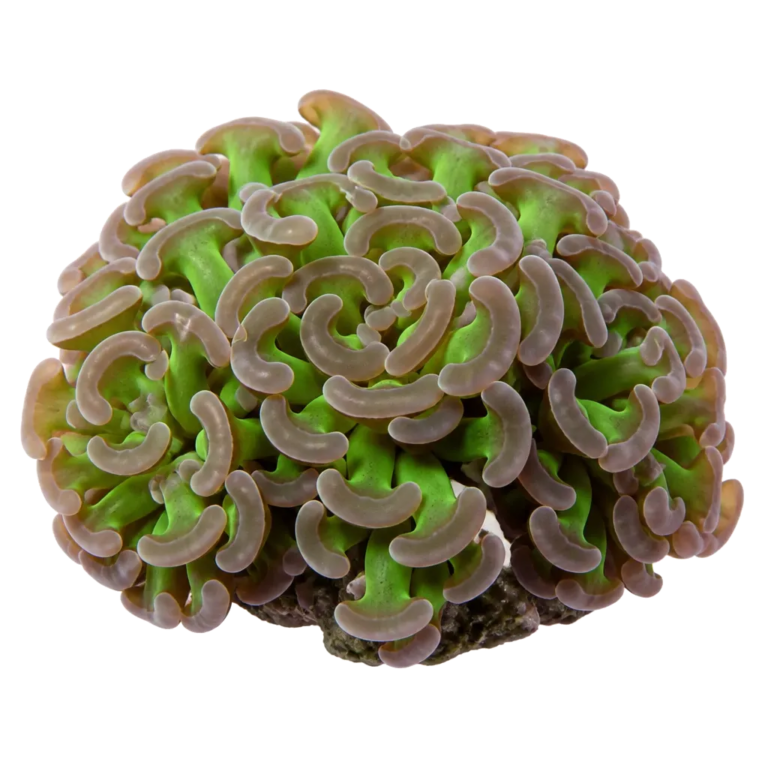
Branching Hammer Coral
Summary
Fimbriaphyllia paraancora is a branching LPS coral whose fleshy tentacles end in broad hammer or anchor-shaped tips. Each head sits on a separate branch, so a healthy colony develops into a cluster rather than a continuous wall. Its Indo-Pacific reef-slope and lagoon background helps explain its preference for moderate, indirect movement rather than a forceful pump stream.
General care
Mount it securely in the middle of the aquascape where the inflated polyps have open water around them and cannot rub against rockwork. Handle only the bare branch skeleton, never the expanded tissue; a dropped or poorly supported frag can tear flesh where it meets the skeleton and leave an opening for rapid tissue loss. Buy specimens with fully inflated heads, intact tissue around every branch, and no brown, stringy material or exposed skeleton at the base.
Lighting needs
Start a new Fimbriaphyllia paraancora in a somewhat dimmer part of its intended area or reduce initial LED exposure, then increase exposure gradually after it has resumed normal daytime inflation. Sudden excess light commonly shows as paling, washed-out color, shortened tentacles, or persistent daytime contraction. Too little light is more often a slow decline: the coral remains dark but expands poorly, loses fullness, and shows limited growth despite suitable flow and feeding.
Flow needs
Aim a broad, indirect, alternating current across the colony. At the right flow, tentacles sway and separate gently without being held to one side or driven into the skeleton. Too little flow leaves the polyps limp and allows debris to settle between heads; too much makes the coral stay tightly withdrawn, whip in one direction, or show tissue irritation along the branch edges. Redirect the pump rather than placing the coral directly in a nozzle’s path.
Feeding and growth
Light supplies most of this coral’s energy, but occasional feeding is useful for newly recovering, recently divided, nutrient-poor, or actively growing colonies. Offer small zooplankton-sized foods, finely chopped meaty fare, or small pellets only when tentacles are receptive; oversized pieces are often dropped or can foul the colony. Feed gently enough that the food remains on the polyps rather than blasting it away.
As heads multiply, the branching skeleton expands outward in a cluster and the daytime polyp span grows well beyond the visible skeleton. Leave room for both future branches and nighttime reach before fixing the frag permanently.
Compatibility
Fimbriaphyllia paraancora is an aggressive neighbour because it can extend potent sweeper tentacles, especially after dark, and sting corals outside its daytime outline. Keep at least 15 cm5.9 in of clear space to corals outside the hammer and frogspawn group, then check the colony after lights-out before assuming a closer placement is safe. Move either coral at the first sign of repeated localized recession or pale, damaged tissue on the neighbour.
Avoid persistent LPS pickers, as repeated nipping prevents full inflation and can expose tissue. Clownfish may try to host a large colony; this is usually less problematic with an established, robust colony, but constant rubbing can keep a small frag closed. Shrimp may steal target-fed food, so shield or feed the coral after distracting them elsewhere.
Water parameters
This is moderately demanding rather than a coral that tolerates abrupt corrections. Keep salinity and alkalinity especially consistent, because swings can show up as incomplete inflation, recession beginning at the base of a head, or sudden failure of a previously healthy head to open. Stable calcium and magnesium support branch growth, while prolonged nutrient starvation can leave the coral pale and unable to maintain tissue.
Respond quickly to brown, stringy tissue breakdown or a head that is rapidly sloughing tissue: improve circulation around the colony, remove decaying material if it can be done without tearing healthy tissue, and separate the affected coral from close neighbours. Rapid tissue loss is not a normal adjustment response and can spread through a stressed branching colony.