
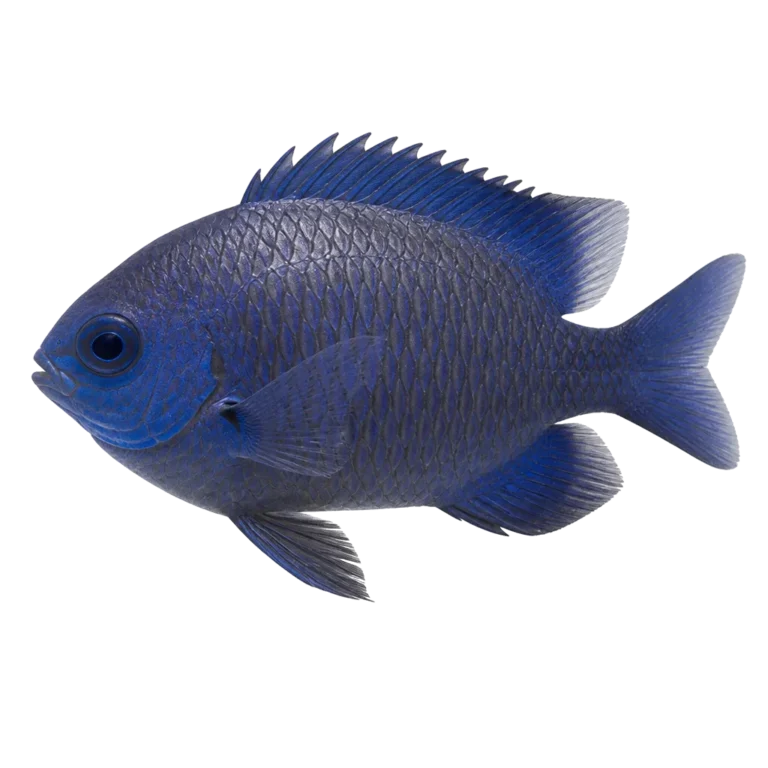
Bluefin Damsel
Summary
Neoglyphidodon melas is best treated as a territorial fish that becomes substantially more difficult to house as it matures. A juvenile may appear manageable in a mixed community, but an adult commonly patrols and defends a chosen section of rockwork, repeatedly driving away fish that enter it.
Its association with branching corals when young and soft-coral-rich areas as an adult helps explain both its close attachment to structure and its reef-with-caution status. Do not choose it for a peaceful soft-coral display or on the assumption that its juvenile behaviour will remain unchanged.
Care
Build the aquascape as several visually separated rock zones rather than one open wall. Neoglyphidodon melas uses a home area for short patrols and retreats; broken sightlines give pursued tankmates a route out of its defended space instead of forcing constant face-to-face encounters.
Keep open water immediately around the rockwork for its active daytime patrols, while retaining deep crevices and overhangs within each structure. A fish that remains pinned into cover during the day, rather than emerging to patrol and feed, is usually being outcompeted or harassed.
Treat the stated minimum tank size as a starting point for a single individual, not proof that a mixed community will work. The practical limit is territorial footprint: if one fish can dominate every route through the aquascape, the arrangement is too cramped for more passive tankmates.
Feeding
Feed a varied omnivore diet in two or more small meals, combining quality marine-algae foods with mysis, enriched brine shrimp, and finely chopped marine seafood. Include vegetable matter routinely rather than using a meat-only diet, since algae is a meaningful part of its natural feeding.
Disperse food across the tank or target-feed slower companions first. This damsel is an assertive feeder and can turn a food response into repeated displacement of quieter fish; a tankmate that stops reaching food is a compatibility problem even if no obvious injury is visible.
Good feeding reduces pressure to graze throughout the display, but it does not make soft corals safe. Do not use feeding frequency as a remedy for persistent polyp nipping.
Compatibility
Keep one Neoglyphidodon melas in most home aquariums. Although adults can occur in pairs in nature, unrelated aquarium individuals can escalate into sustained fighting, and a small group is a poor choice once hierarchy and territory formation begin.
Choose robust, quick-feeding fish that can hold their own and have access to separate areas of the aquascape. Avoid small, slow, shy, or easily intimidated fish, especially other damselfish or similarly shaped fishes likely to be treated as territorial rivals.
Add this species after more peaceful residents have settled, not before. An established adult can make later additions difficult; if one is already defending the whole display, rearranging rockwork before introducing a new fish may reduce its territorial advantage, but is not a guarantee of success.
Reef compatibility has a specific exception: adults may eat soft-coral polyps. Keep it only where occasional or escalating damage to soft corals is acceptable, and act if a colony remains retracted or shows repeated bite damage.
Good to know
Expect aggression to intensify with maturity, not simply during initial acclimation. Repeated charging, fin damage, a tankmate sheltering in one corner, or a fish missing meals are signs to separate the fish rather than waiting for the social order to settle.
Its juvenile and adult appearance can differ markedly, so identify purchases as Neoglyphidodon melas rather than relying on a shop label or juvenile colour pattern. Plan for the adult temperament before stocking it.
This is a daytime fish. Brief hiding after introduction is normal, but persistent daytime hiding combined with poor feeding is an observable warning that the fish is being bullied or cannot establish a secure area.