
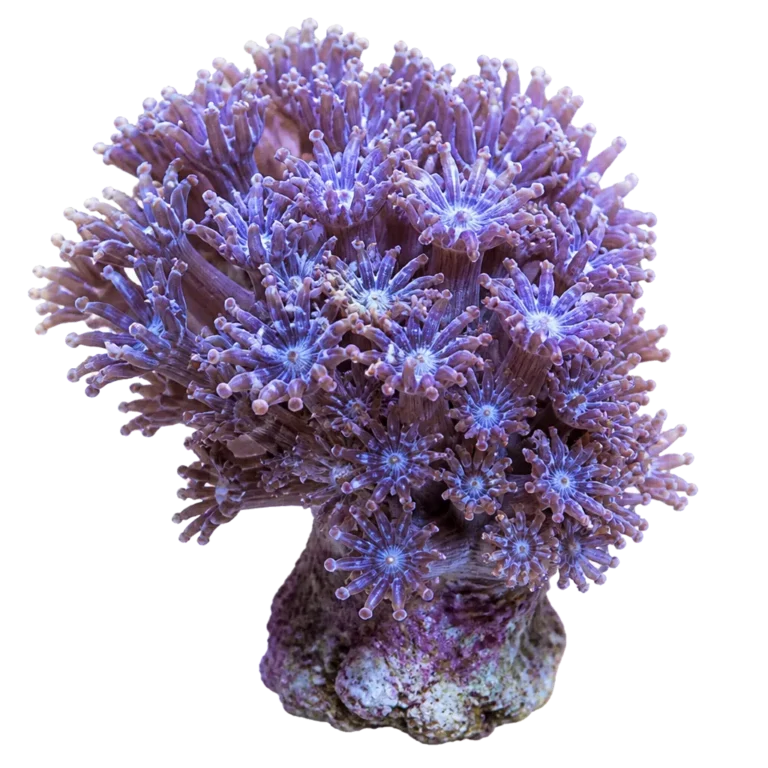
Blue-Purple Goniopora
Summary
Goniopora tenuidens is a Blue-Purple Goniopora with closely packed, evenly sized polyps that give a healthy colony a uniform, flower-like surface. It is an Indo-Pacific reef coral associated especially with protected lagoon environments, which helps explain its preference for moderate conditions rather than intense, direct light or blasting flow.
Choose a colony that opens consistently and has intact tissue extending down to the skeleton. Fresh white areas, a receding edge, persistent mucus, or polyps that remain tightly withdrawn after settling are warning signs, because this species can decline slowly after shipping or environmental stress.
General care
Place this Goniopora low in the aquarium on a stable rock or on the sand with its living tissue kept clear of the substrate. Do not wedge it into a crevice or allow sand to collect around its base; trapped detritus can irritate the lower tissue and lead to recession.
Handle only by exposed skeleton or a securely mounted plug, keeping fingers, tools, and glue away from the fleshy polyp area. Its thin, extended polyps are easily bruised or torn, so avoid buying a specimen with damaged tissue around the edge or with a loose, cracked skeleton.
Lighting needs
Introduce Blue-Purple Goniopora under subdued exposure within its recommended lighting zone, then increase intensity gradually only after it is opening reliably for several days. A newly shipped colony should be allowed to settle before being moved repeatedly, since frequent changes make it difficult to distinguish light stress from handling stress.
Too little light is more likely to show as declining colour and reduced long-term vigour than as an immediate closure response. Too much light usually causes shortened or persistently retracted polyps, paling or bleaching on the most exposed surface, and a colony that looks better after the lights dim; reduce exposure rather than making a sudden move into shade.
Flow needs
Provide indirect, changing medium flow that lets the tentacles sway independently and carry away suspended waste without folding the whole colony in one direction. The goal is a relaxed, full extension with gentle movement, not still polyps and not constant whipping.
If flow is too low, debris may settle among the polyps or at the base, and the colony can stay partly closed or develop irritation on the sheltered side. If it is too strong or too direct, polyps repeatedly snap shut, lean hard in one direction, or show damaged-looking tissue at the side facing the pump; redirect the flow across rather than straight at the colony.
Feeding and growth
Photosynthesis supplies much of this coral’s energy, but fine particulate foods can be useful in lean systems, during recovery from shipping, and when trying to support growth. Offer suspended, very small zooplankton-sized foods or fine coral foods gently around open polyps; large chunks or a hard jet of food usually cause retraction rather than feeding.
Goniopora tenuidens typically develops as a slow-growing, solid or irregular dome rather than a branching coral. Plan for its expanded polyp field as well as its skeleton, because a small frag can eventually occupy a broad footprint and reach neighbouring corals long before the hard base appears close to them.
Compatibility
Treat this coral as semi-aggressive because its long extended tentacles can sting corals within reach. Leave at least 10 cm3.9 in of open space around it, and increase that gap if the colony extends farther at night or after feeding; repeated contact can cause a neighbour to retract or lose tissue even when both corals look separated while closed.
Avoid placing it where coral-nipping fish, large hermit crabs, urchins, or other animals regularly walk across the polyps. Repeated picking or disturbance prevents normal extension and can turn a manageable irritation into tissue loss; a fish that repeatedly tests the tentacles is a poor match.
Water parameters
This is more demanding than a typical forgiving reef coral because it responds poorly to abrupt changes in salinity, temperature, and especially alkalinity. Keep adjustments slow and deliberate: a colony that suddenly remains closed after maintenance or dosing should prompt a check for a recent swing before its placement is changed.
Avoid running the aquarium aggressively nutrient-stripped. Blue-Purple Goniopora can remain extended for a time while gradually losing condition in water with too little available nutrition; fading colour, weakening daytime extension, and tissue pulling back from the skeleton are reasons to review nutrient availability and feeding alongside basic chemistry stability.