
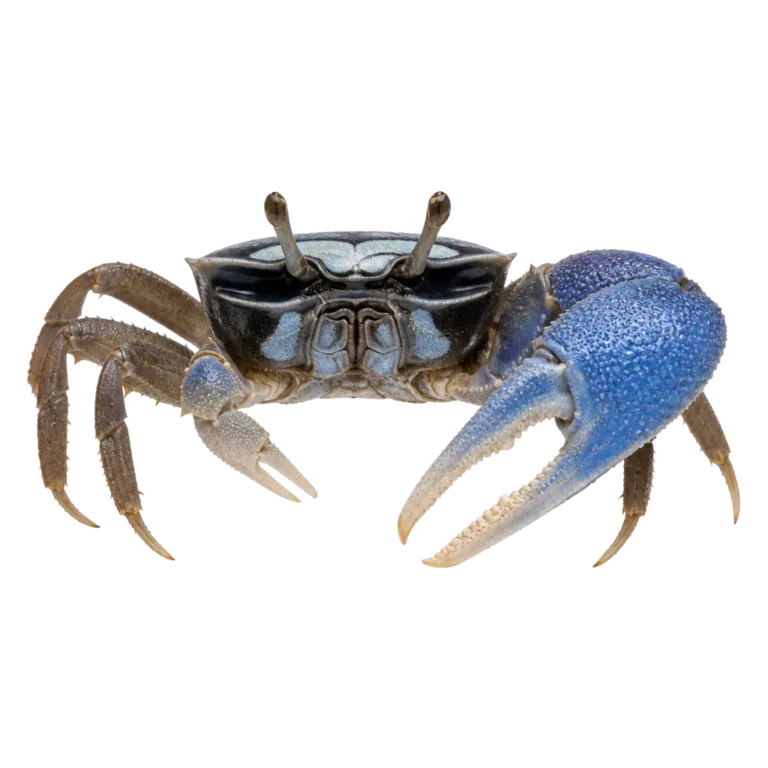
Blue Fiddler Crab
Summary
Gelasimus tetragonon is an intertidal fiddler crab, sometimes sold as a Blue Fiddler Crab. Males are recognizable by one greatly enlarged display claw; that claw is used in signaling and disputes, so apparent waving or sparring is normal behaviour rather than feeding.
It is not a fully aquatic reef invertebrate. This species lives on exposed coastal sand or mud and uses burrows above the waterline, so a conventional reef aquarium will eventually fail to provide the land access and substrate it needs. Choose it only for a marine or brackish intertidal paludarium.
Care
Build the enclosure around a broad, securely retained area of damp sand or sandy mud that remains above the waterline, with a shallow water section for the crab to wet its gills. The substrate must be deep and cohesive enough to hold burrows; loose decorative gravel leaves the crab exposed and prevents its normal retreat behaviour.
Keep the land area humid without submerging it, and use gentle water movement rather than reef-style circulation. Strong flow can wash out the shoreline and destabilize burrow entrances. Bright reef lighting is unnecessary; provide a normal day-night cycle and shaded retreats so the crab can leave exposed areas when it chooses.
Add this crab only after the paludarium has matured enough to support biofilm, microalgae, and natural detritus on the sediment surface. A newly assembled, sterile setup offers little for a deposit-feeding crab to sift between meals.
Feeding and role
Offer a varied diet on the landward edge: fine sinking crustacean foods, algae-based foods, small amounts of frozen marine foods, and occasional carrion. Gelasimus tetragonon feeds by sorting organic material and microorganisms from sediment, so food should be available in small portions it can handle rather than as large chunks that foul the enclosure.
Its cleanup role is limited to picking through detritus and surface films within its own foraging area. It will not control nuisance algae across an aquarium, remove accumulated waste from inaccessible areas, or replace routine substrate maintenance. If it repeatedly searches the substrate but loses condition, increase suitable fine foods rather than expecting detritus alone to sustain it.
Compatibility
Do not house it with fish, crabs, or other animals that can seize it while it is on land or near the waterline. Predatory fish and larger crabs can make a fiddler remain hidden, stop feeding, or be injured during a molt. Small worms and other sediment microfauna may be consumed as part of its natural foraging.
It is unsuitable with corals because its required exposed shoreline and excavating behaviour are incompatible with a reef display, not because it is a reliable coral predator. Burrowing also continually moves sand and mud, which is impractical around coral rockwork.
A single crab is the simplest choice. Same-species groups can work only in a spacious paludarium with many separate burrowing opportunities and visual breaks; males may defend burrows and spar, especially where usable shoreline is limited. Add compatible individuals with room to spread out rather than concentrating several males in a small exposed patch.
Good to know
Provide an escape-proof lid and inspect every opening around tubing and cables. Fiddler crabs climb well and naturally roam over exposed ground; a missing crab is more likely to be an escapee than an animal hiding indefinitely underwater.
Leave a newly molted crab undisturbed. It may stay concealed in its burrow while its shell hardens, and tankmates or handling at this stage can cause fatal injury. Do not assume a shed shell is a dead crab; look for an intact crab before removing anything.
Avoid copper-based medications and other treatments not confirmed as safe for crustaceans. Acclimate gradually to the enclosure’s salinity and temperature, particularly when the source water differs, because abrupt transfer can cause stress and failed molts.