
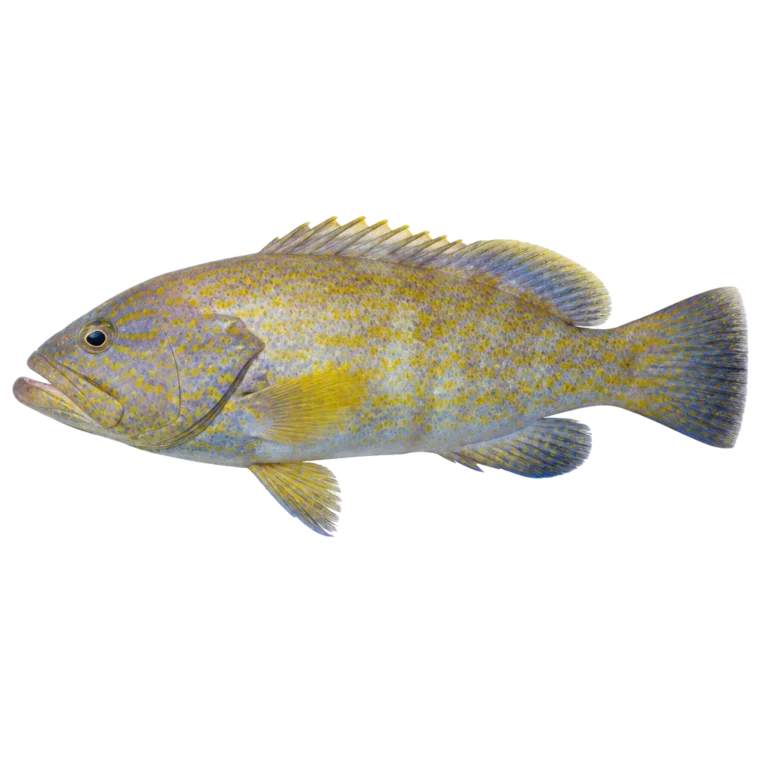
Blue-and-yellow Grouper
Summary
The Blue-and-yellow Grouper, Epinephelus flavocaeruleus, is a solitary ambush predator that spends much of its time resting close to rockwork, then accelerates suddenly to take suitably sized prey. Its quiet, sedentary manner should not be mistaken for community-safe behaviour: any fish or ornamental crustacean that can fit in its mouth is a potential meal.
Juveniles use shallower reef areas, while larger fish move onto deeper reefs. In an aquarium, this translates to a strong preference for a secure, dimmer retreat and a defined area around the rocks rather than constant open-water cruising. Expect its colour pattern to change substantially as it grows, so buy it for its adult requirements rather than its juvenile appearance.
Care
Build the aquascape around broad, secure caves, overhangs, and shaded resting areas, while leaving an unobstructed route along the front and around the rockwork. Set heavy rocks directly on the tank base or otherwise secure them before adding the fish; a large grouper can lean into structures, excavate around them, and turn an unstable display into a collapse risk.
Plan the entire system around the adult fish, not the small specimen commonly offered for sale. The listed minimum tank size is only a starting point: this species needs a long, wide footprint that lets it turn easily, claim a resting zone, and move away from other large fish without repeated face-to-face encounters.
Use robust mechanical filtration and make removal of uneaten food easy. Although it is not an especially active swimmer, messy meaty foods can lodge under rockwork; persistent scraps will foul the display and can draw the grouper back to harass smaller tankmates.
Feeding
Offer varied marine-based meaty foods such as pieces of marine fish, shrimp, squid, clam, and other appropriately sized crustacean flesh. Rotate items rather than relying on a single food, and avoid freshwater feeder fish; they are a poor staple and can encourage a narrow feeding response.
Feed juveniles more often in modest portions, then move toward spaced, substantial meals as the fish matures. Use feeding tongs or a target-feeding routine and make sure the food reaches the grouper before quicker tankmates strip it away. A fish that repeatedly rushes other animals during feeding is often competing for food, not becoming more suitable for a mixed community.
Keep portions small enough to be swallowed cleanly. Large chunks that are mouthed, dropped, and dragged into the rockwork create a water-quality problem and may condition the fish to lunge at any movement near its usual feeding spot.
Compatibility
Keep this grouper as the only E. flavocaeruleus in most home aquaria. It is naturally solitary, and adding another individual can create persistent territorial pressure around caves and feeding areas; a fish that remains hidden, breathes heavily after encounters, or is excluded from food should be separated rather than left to ‘sort it out.’
Choose tankmates that are robust, similarly sized, and not shaped or sized to be swallowed. Large, confident fish that occupy different parts of the aquarium are generally more workable than small, slow, elongated, or bottom-resting species. Add the grouper after established tankmates where possible, because introducing it first allows it to treat the whole aquascape as its feeding territory.
This is not reef-safe with ornamental crustaceans or smaller fish. Shrimp, crabs, lobsters, and similar invertebrates are prey items, and a tankmate can be lost even after a long period of apparent peace once the grouper grows or learns it can swallow it.
Good to know
The main long-term failure is underestimating growth and mouth size. Reassess every tankmate as the grouper matures rather than assuming a fish that was safe beside a juvenile will remain safe; disappearances are often predation events, especially after lights-out or around feeding time.
Do not interpret extended stillness in a sheltered area as illness by itself. Resting under an overhang is normal for this species, but refusal of food, laboured breathing, loss of balance, or remaining exposed while darkened in colour are reasons to investigate conditions promptly.
Sex change has been suggested for this species, as in many groupers, but sex cannot be used reliably to assemble a compatible pair in captivity. Avoid purchasing multiple individuals on the assumption that they will form a stable male-female arrangement.