
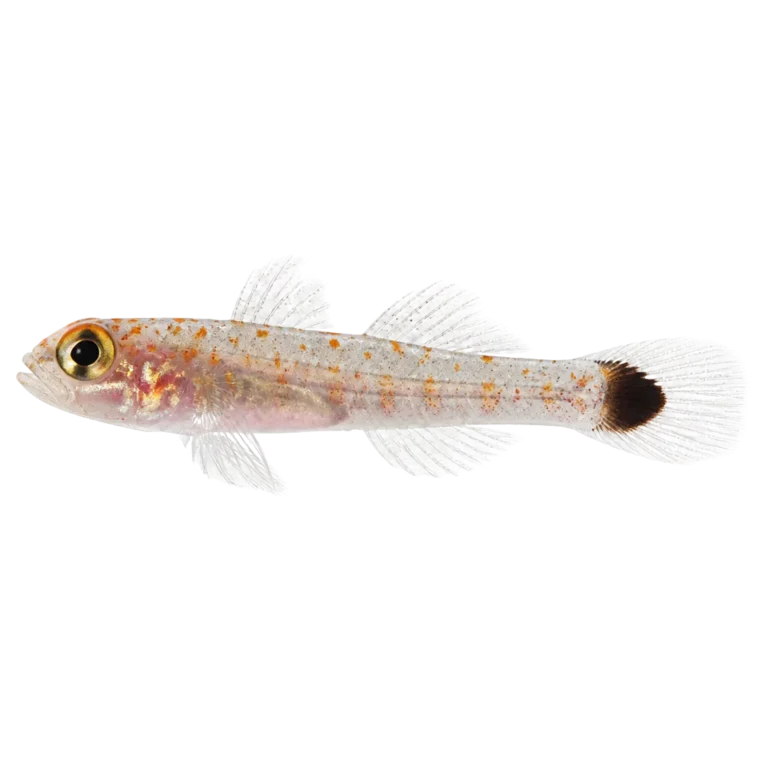
Blotch-tailed Pygmy Goby
Summary
Trimma caudomaculatum is a tiny, peaceful hoverer that spends much of its time close to rock faces, coral branches, and shaded ledges, making short dashes back to cover when alarmed. It is best suited to a calm, observant reef where its small-scale behaviour will not be overwhelmed by larger, faster fish.
This species naturally forms groups near reef structure. In an aquarium, a settled group should appear as several fish hovering around the same rockwork rather than constantly travelling through open water; a fish that remains hidden or is repeatedly displaced is usually being intimidated or cannot compete for food.
Care
Build the aquascape with closely spaced rock, branching coral skeletons, overhangs, and narrow retreats rather than leaving a broad, exposed rock pile. The gobies use these features as hovering stations and instant cover, and they are noticeably more visible when they can retreat only a short distance after a disturbance.
Place them in a mature reef with sheltered areas beside, rather than directly within, the strongest pump flow. They can manage water movement, but a continuously forceful, exposed current prevents their characteristic hovering and makes feeding inefficient.
Use a tight-fitting lid and protect overflow teeth, weirs, and exposed pump intakes. Their small size lets them enter gaps that are safe for most reef fish, and a startled fish may leave the display or be lost to filtration.
Feeding
Offer very small meaty foods that stay suspended long enough for a hovering goby to intercept them: copepods, enriched newly hatched brine shrimp, finely chopped crustacean foods, and suitably small frozen plankton are useful choices. The natural diet includes tiny crustacean prey, so large pellets, flakes, or chunky frozen foods should not be the main ration.
Feed several small portions across the day when possible, releasing food close to the gobies' cover rather than at the opposite end of the aquarium. Watch their bellies and position at feeding time: fish that remain in the rockwork while bolder tankmates clear the water column are not receiving enough, even if food is being added generously.
Do not rely on a visible supply of pods alone once the aquarium also contains pod-eating fish. Microfauna can supplement the diet, but competition can reduce it quickly and gradual weight loss is easy to miss on such a small fish.
Compatibility
Keep Trimma caudomaculatum singly or introduce a group together into an aquascape with many separate perches and retreats. Groups are natural for the species, but adding one later to an established group can concentrate attention on the newcomer; persistent chasing, exclusion from hovering sites, or a fish that only emerges after lights-out calls for separation.
Favour small, peaceful tankmates that do not monopolize fine foods. Avoid predatory fish and assertive bottom-oriented species, as well as quick planktivores that intercept every small food item before the gobies can feed.
This is reef-compatible with corals and typical larger ornamental invertebrates. The practical exception is the aquarium's smallest mobile crustaceans: copepods and similarly tiny fauna are prey, so it is not a suitable choice where preserving a dense visible microcrustacean population is the priority.
Add this goby before substantially larger or more assertive fish, or give it time to learn the rockwork and feeding routine first. A confident resident will hover in view; one added after dominant feeders may remain concealed and decline despite no obvious physical aggression.
Good to know
Trimma caudomaculatum has a social system that can include multiple males, and it is capable of bidirectional sex change. Do not try to select or maintain a fixed sex ratio from appearance; allow a compatible group to establish its own hierarchy and judge success by feeding access and normal hovering behaviour.
Males may hold a nest site and receive visiting females for spawning. Some guarding or site-focused displays can occur, but repeated pursuit that prevents another fish from feeding is not a harmless courtship detail and should be treated as a compatibility problem.
A sudden disappearance is often a husbandry warning rather than proof the fish has died: inspect lid gaps, overflow chambers, filter compartments, and the shaded underside of the rockwork before dismantling the aquascape.