
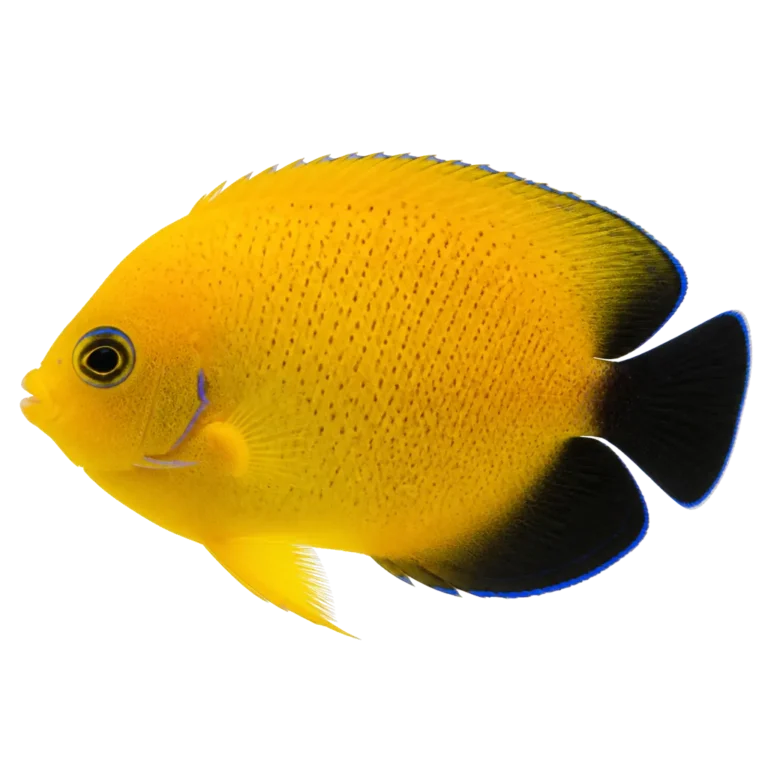
Blacktail Lemonpeel Angelfish
Summary
Blacktail Lemonpeel Angelfish is a naturally occurring hybrid of Centropyge flavissima and Centropyge vrolikii, so colour pattern and temperament can lean toward either parent rather than following one fixed standard. Expect an active, deliberate rock-picker that repeatedly patrols the same areas of reef structure, pausing to inspect algae, film growth and small sessile animals.
Its parents occur around coral-rich lagoons and reefs, which helps explain why a fish placed into bare or newly assembled rockwork may spend much of its time hiding or pacing the glass. In a mature reefscape it should gradually establish a browsing route and become visible for much of the day.
Care
Build the aquascape as a connected maze of rock faces, overhangs and narrow retreats rather than a single open pile. This angelfish needs broken sightlines to move away from conflict and sheltered crevices to sleep in; a fish that never emerges after the settling period, or is repeatedly forced into one corner, is usually being outcompeted or harassed.
Use a mature aquarium with substantial natural grazing surface. It spends much of the day picking at rockwork, and an established coating of algae and microfauna gives it occupation between feedings; in a sterile system it is more likely to scour corals and other sessile livestock for alternatives.
Feeding
Offer several small, mixed feedings across the day: quality angelfish or herbivore preparations, marine algae and spirulina-based foods alongside finely sized frozen marine foods. Keep vegetable matter as a regular part of the diet rather than treating it as an occasional supplement, because this hybrid is a continuous browser as well as an omnivore.
Watch feeding closely if active planktivores, tangs or assertive wrasses dominate the water column. Deliver part of the ration onto or near the rockwork so the angelfish can feed in its preferred picking style; a fish that continues grazing but loses body fullness is often receiving too little of the prepared food.
Compatibility
Keep one Blacktail Lemonpeel Angelfish as the default plan. It may defend chosen rockwork against other dwarf angelfish, especially similar-looking Centropyge, and trouble can develop after an initially calm introduction once territories are established. If combining dwarf angels is attempted, use a spacious, densely structured system and introduce the Blacktail Lemonpeel after less assertive residents have settled.
Choose confident, peaceful community fish that do not monopolize every feeding and do not relentlessly challenge it around the rocks. Avoid pairing it with similarly shaped dwarf angels in compact aquascapes, as well as predators capable of treating it as prey.
Treat reef compatibility as individual and conditional, not guaranteed. Persistent sampling of zoanthids, fleshy LPS, soft coral tissue, SPS polyps or clam mantles can occur even in a well-fed fish. Do not add one to a reef containing irreplaceable corals or clams unless removal remains practical.
Good to know
Coral picking can begin well after introduction, particularly once the fish is comfortable and has claimed a feeding route. Inspect susceptible corals at different times of day for repeatedly retracted polyps, torn mantle edges or a fish returning to the same specimen; redirecting food may reduce opportunistic sampling, but a persistent individual usually needs to be removed rather than trusted to stop.
Because Centropyge flavissima × Centropyge vrolikii is a hybrid, appearance is not a reliable predictor of behaviour. A mostly yellow individual may still behave like a more territorial dwarf angel, while a darker fish may prove comparatively mild; judge stocking decisions by the individual fish’s feeding, patrol and nipping behaviour rather than its colour pattern.