
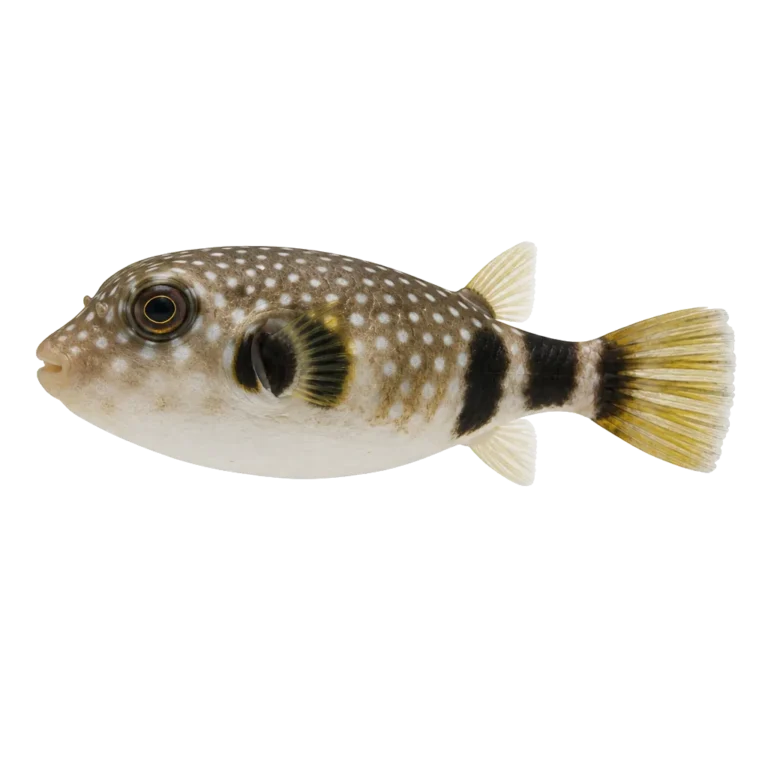
Bandtail Puffer
Summary
Sphoeroides spengleri, the Bandtail Puffer, is a deliberate, bottom-oriented hunter that spends much of its time inspecting rock, sand, and crevices for edible invertebrates. Its alert, investigative behaviour can make it seem personable, but it also means mobile invertebrates and sessile animals may be tested with repeated bites rather than ignored.
Choose this fish for a fish-focused marine display or a reef where losses of ornamental invertebrates are acceptable. It is not a passive community fish: a puffer that begins circling, following, or repeatedly approaching a tankmate is often assessing it as either food or a target.
Care
Build the aquascape with sheltered rockwork and broken sightlines, while leaving open areas of sand or low rubble for cruising and foraging. This species does not need to race continuously through open water, but it should be able to turn and patrol without being forced through dense coral branches or narrow gaps.
Keep flow varied rather than relentlessly forceful. A Bandtail Puffer should be able to hover, investigate the substrate, and retreat into cover; persistent struggling against a current or prolonged hiding after introduction suggests the layout or tankmate activity is too stressful.
Use a tightly fitted cover and move the fish only in a submerged container. Puffing is a defensive stress response, not a behaviour to provoke, and exposure to air can leave an inflated puffer unable to expel swallowed air.
Feeding
Offer a rotating menu of marine-origin meaty foods, centred on crustaceans, molluscs, and other hard-bodied invertebrate fare. Include suitably sized shell-on items regularly so the beak is worked naturally; a puffer that becomes hesitant to take food or drops pieces repeatedly should be checked for overgrown teeth.
Feed deliberately rather than relying on broadcast feeding. Use tongs or a target area when quick fish steal food, because a slow, inspecting puffer can be outcompeted before it commits to a bite.
Do not make soft shrimp, fish flesh, or one frozen food the entire diet. Monotonous feeding reduces dietary variety and gives little opportunity for normal crushing behaviour, while excess rich food can foul the aquarium quickly.
Compatibility
Keep one Bandtail Puffer per aquarium unless there is a very large, expertly managed system with a clear plan to separate fish. Similar-looking puffers are especially poor companions, as recognition and territorial conflict can escalate after the fish have settled in.
Favour robust fish that are too large to be swallowed and unlikely to harass a slow, observant puffer. Avoid tiny fish, ornamental shrimp, crabs, snails, brittle stars, and other accessible invertebrates; they match its natural prey types and may disappear even if ignored initially.
Add the puffer after a peaceful community is established only if every resident is an appropriate companion, or introduce it before highly assertive fish can claim the entire aquascape. Do not assume a reef is safe because the puffer leaves corals alone at first: it may nip fleshy sessile animals, and clams are a particular risk.
Good to know
Expect feeding-related boldness to increase with time. A settled Bandtail Puffer may approach the glass or patrol where food is usually delivered, but hand-feeding is risky because its beak can deliver a painful bite; use feeding tools instead.
Treat sudden inflation, frantic swimming, faded colour, or continuous concealment as warning signs rather than normal puffer behaviour. Reduce immediate harassment and check for a trapping aquascape, excessive flow, or a tankmate that has begun targeting it.
Never encourage inflation for display or remove the fish from water to photograph or transfer it. If it must be moved, keep it submerged in a specimen container to avoid air intake and unnecessary stress.