
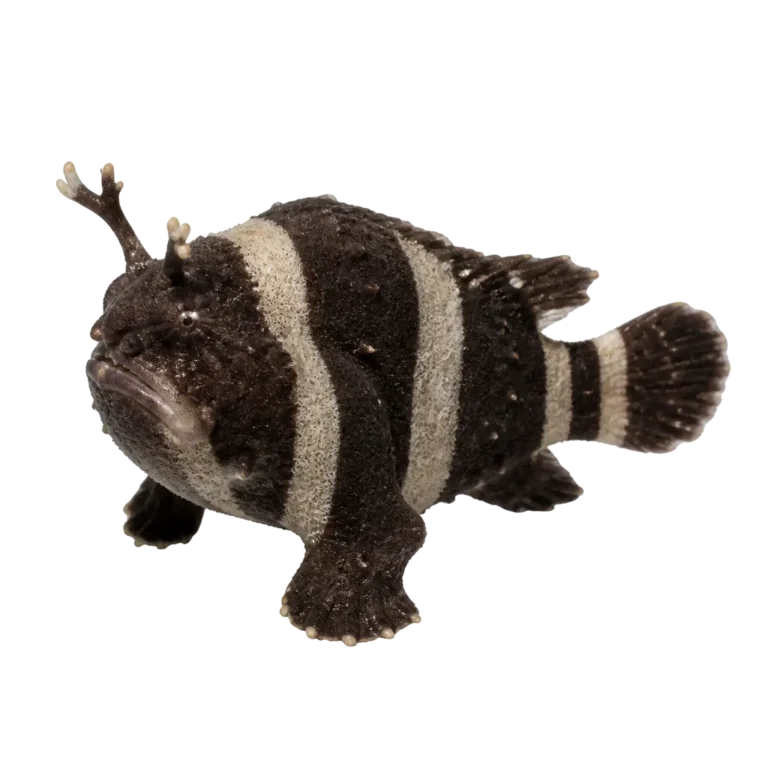
Banded Frogfish
Summary
Halophryne diemensis is a bottom-dwelling ambush predator that spends much of the day still, wedged into cover or blended with the substrate. Treat a fish that is calmly perched and watching its surroundings as normal rather than trying to encourage constant swimming.
paragraphs?
Care
Build the aquascape around stable, low-level retreats: broad caves, rock overhangs, and open bottom space where the fish can settle without being exposed to strong direct flow. Secure every rock structure well, because this heavy-bodied fish will rest against the base of the aquascape and should not be able to dislodge it.
Use a covered, species-focused aquarium where the frogfish can remain near the bottom and feed without being rushed by active open-water fish. Its sedentary hunting style means it benefits more from secure cover and a clear feeding area than from extensive open swimming room.
Feeding
Offer varied, marine-based meaty foods such as whole or chopped crustaceans, marine fish flesh, and suitably sized mollusc flesh. Present food close to its resting place with feeding tongs so the fish does not have to compete with faster tankmates.
Feed measured meals and watch body condition rather than repeatedly offering food to provoke a strike. Halophryne diemensis is built for intermittent ambush feeding, so uneaten food should be removed promptly; repeated large meals and leftover pieces can quickly foul the area where it spends most of its time.
Do not rely on freshwater feeder fish or shrimp as a staple. A marine-based variety is the safer long-term approach, and target feeding also prevents tankmates from consuming food intended for the frogfish.
Compatibility
Keep Halophryne diemensis singly unless there is reliable species-specific experience with a very large, carefully arranged system. It is not a community fish: any fish or motile invertebrate that can fit into its mouth is potential prey, even if it has been ignored initially.
Choose tankmates only from robust animals that are both too large to swallow and unlikely to harass a sedentary bottom fish. Fast, food-aggressive fish are poor companions because they can monopolize target-fed meals and continually disturb the frogfish at its shelter.
Add the frogfish only after deciding that ornamental shrimp, crabs, and smaller fish are expendable or absent. The reef-safety exception is decisive: sessile corals may be workable, but mobile reef livestock should be selected as prey-sized animals unless clearly beyond its reach.
Good to know
Judge compatibility by body depth as well as length. A tankmate that appears too long to eat may still be swallowed if it is narrow enough, and a successful predation event can happen suddenly after a long period of apparent peace.
Avoid handling the fish with bare hands. Its dorsal spines can inflict a painful wound, so use a rigid container for transfers and give it space when working around its chosen shelter.
A frogfish that remains motionless for long periods is usually displaying normal ambush behaviour. Investigate instead when it abandons cover, cannot hold its position, shows laboured breathing, or repeatedly refuses appropriately offered food.