
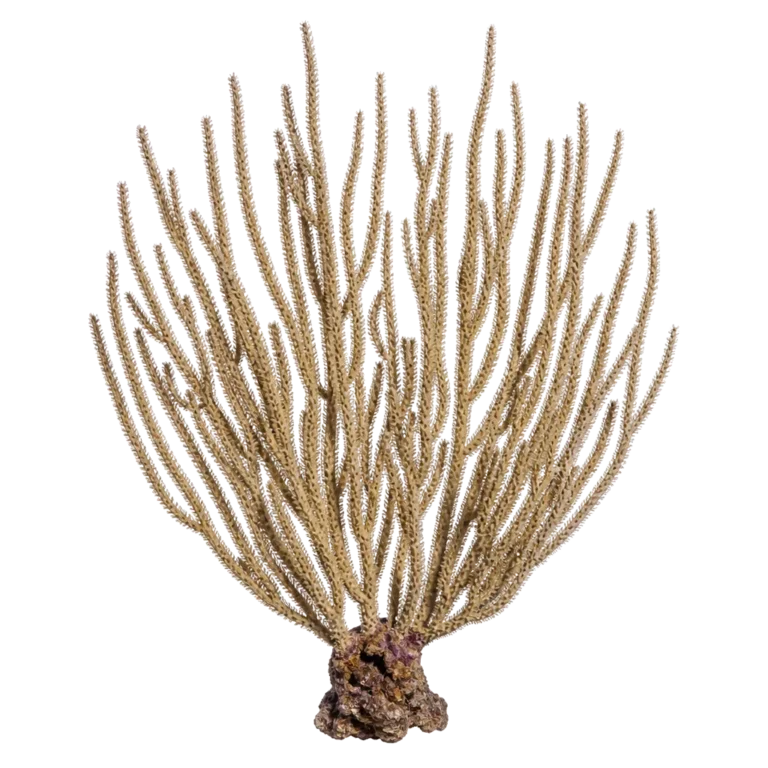
Bamboo Sea Fan
Summary
Isis hippuris is a zooxanthellate Indo-Pacific octocoral with a distinctive jointed, bamboo-like internal framework and a branching fan or bush form. Its shape can vary with local light and water movement, so buy it for the colony form in front of you rather than expecting every Bamboo Sea Fan to grow identically.
This is a photosynthetic coral that also uses its small polyps to collect suspended foods. It is best suited to an established reef where the colony can receive light, clean directional flow, and open space for a progressively taller, broader branching structure.
General care
Mount Isis hippuris securely on stable rockwork around the middle of the aquascape, with room for the branches to face into moving water. A loose or top-heavy colony can topple, abrading its living outer tissue against rock or neighboring corals.
Handle the rigid basal framework rather than squeezing or rubbing the branch surfaces. The jointed skeleton gives the colony its bamboo appearance, but branches can be damaged by rough handling; remove a fallen or trapped colony promptly if tissue is being crushed against the aquascape.
Lighting needs
Start a new colony in the lower end of the provided lighting guidance, then increase exposure gradually over several weeks while keeping flow and feeding consistent. This prevents a recently shipped coral from having to adapt to stronger light while also recovering from handling stress.
Too much light commonly shows as paling, tissue thinning, or polyps staying withdrawn after an increase in intensity; move the colony to gentler light or add temporary shading. Underlighting is more often a gradual problem: branch growth slows, the colony may darken or brown, and it may stretch its growth toward brighter areas despite otherwise normal polyp extension.
Flow needs
Aim a broad, alternating current across the branches rather than a narrow pump blast. At suitable flow, polyps extend into the current and the branches move lightly without being held over in one direction.
Insufficient flow allows detritus and mucus to collect in branch forks, often followed by persistently closed polyps or localized tissue recession. Excessive direct flow causes repeated retraction, whipping or bending of branches, and tissue wear on the side facing the pump; redirect the outlet rather than simply reducing all circulation.
Feeding and growth
Supplemental feeding is most useful when the polyps are open and the tank has little natural suspended nutrition, or when growth has stalled despite appropriate light. Offer fine zooplankton-sized foods such as rotifers and other suspended microfoods in a gentle flow; large meaty pieces are poorly matched to its small polyps and can foul the colony.
Growth is typically branching and three-dimensional, with new branches gradually increasing the colony's height and footprint. Leave room above and around the original mount, because crowding usually becomes a problem through shading, physical contact, and obstructed flow rather than sudden rapid spread.
Compatibility
Isis hippuris is generally peaceful and is not known for the long reach of highly aggressive large-polyp corals. Still, keep at least 10 cm3.9 in between the colony and neighboring corals so branches cannot rub, shade them, or become trapped as the fan expands; increase that space beside corals with long nighttime sweepers.
Avoid persistent polyp pickers, especially coral-feeding butterflyfish and angelfish. Repeated nipping can leave areas that remain closed during the day and may progress to tissue loss. Most reef-safe fish and mobile invertebrates are compatible, provided they cannot dislodge the mounting or repeatedly climb through and abrade the branches.
Water parameters
Treat this as a moderately demanding coral for an established reef rather than a good test subject for a newly cycling or frequently adjusted system. Isis hippuris depends on consistent conditions for both its photosynthetic tissue and its calcified internal framework, so abrupt salinity or alkalinity shifts can show up as prolonged closure or recession.
Keep dissolved nutrients from being stripped to an ultra-low state while also preventing chronic particulate buildup on the colony. A coral that is clean, open, and gradually adding branches is responding well; a colony that stays coated, closes repeatedly, or loses tissue in protected branch forks needs its flow, feeding, and recent water-chemistry changes checked together.