
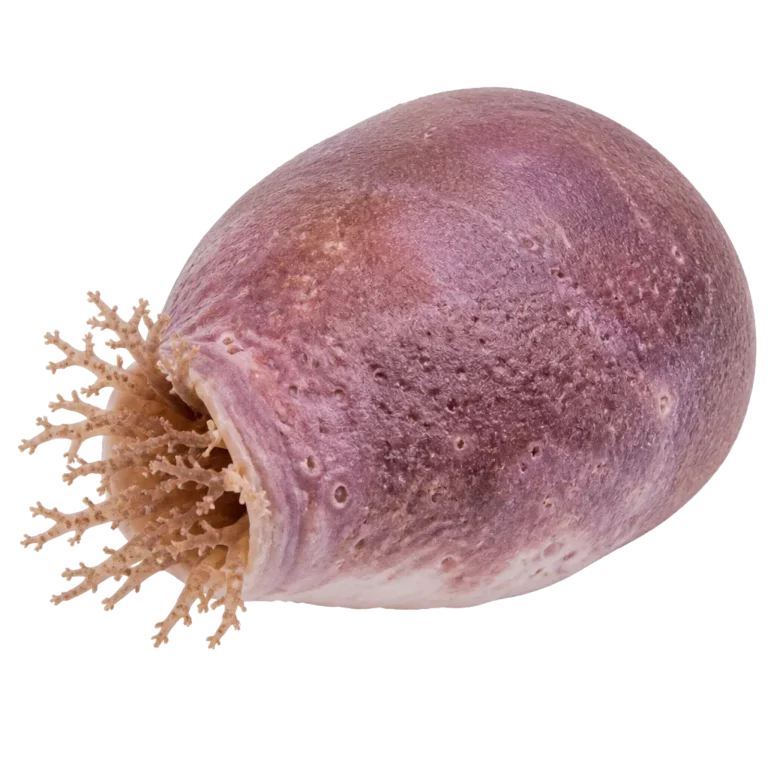
Australian Sea Apple
Summary
Pseudocolochirus axiologus is a suspension-feeding sea cucumber from northern Australian and nearby Indo-Pacific coastal habitats. Its conspicuous, branched feeding tentacles are extended into moving water to collect fine particles, so its care is defined by dependable planktonic food delivery rather than by sand-cleaning ability.
It is a high-consequence invertebrate: severe stress, injury, or death can release toxins into the aquarium. Keep it only where its feeding needs can be met and where equipment and tankmates cannot damage it.
Care
Choose a mature reef system with established live rock and a consistent supply of suspended microfauna and fine particulate food. Place the sea apple on secure rockwork or a vertical surface where it can settle into a food-bearing current; it is not a sand-sifting cucumber and should not be purchased to work the substrate.
Provide a moderate-to-strong, indirect current that carries food past the tentacles without blasting or repeatedly tumbling the animal. It may slowly relocate until it finds a suitable position; once it is settled and regularly extending its tentacles, avoid moving it unless it is approaching an intake or being harassed.
Lighting is not a feeding requirement. Prioritize a protected, accessible placement with enough open water around the tentacles for feeding and enough rock contact for the tube feet to hold securely.
Feeding and role
Feed fine suspended foods appropriate for filter feeders, including phytoplankton and other suitably small planktonic or particulate preparations. Deliver a diluted cloud upstream of the animal so the current passes food through the open tentacles; forceful direct feeding often makes it retract instead of feeding.
An animal that repeatedly keeps its feeding crown withdrawn, becomes progressively smaller, or has little opportunity to intercept food should be treated as underfed or stressed. A mature aquarium alone is rarely a substitute for deliberate, ongoing supplemental feeding.
Its cleanup-crew role is limited to filtering some suspended organic particles. It will not control algae, turn over sand, or remove settled detritus in a meaningful way, and heavy feeding for the sea apple can add nutrients that the aquarium must be able to process.
Compatibility
Pseudocolochirus axiologus is peaceful and generally does not consume or deliberately damage corals, but its safety around corals does not make it a low-risk reef inhabitant. Leave its feeding position clear so nearby corals do not intercept the current or repeatedly contact the extended tentacles.
Exclude fish and invertebrates that pick at soft-bodied animals or their appendages. Butterflyfish, large angelfish, triggerfish, pufferfish, and large crabs are particularly poor choices because repeated tentacle-nipping can cause chronic retraction, injury, and a toxin-release event.
Add sea apples individually. More than one substantially increases the demand for suspended food and the consequences of a feeding failure, so only consider additional specimens in a system already proven to support one while maintaining safe, separate feeding positions.
Good to know
Cover every pump, overflow, and powerhead intake with a secure guard before introduction. An animal drawn into an intake can be fatally injured and may contaminate the water with defensive toxins; if it begins travelling toward unprotected equipment, intervene before contact occurs.
Never use copper-containing medication in a system housing this echinoderm. It is also poorly suited to abrupt chemistry changes, so use a slow, careful acclimation and avoid placing it into a newly changed or otherwise unstable system.
Brief tentacle retraction can follow disturbance, but prolonged closure together with shrinking, limp posture, tissue damage, or rapid deterioration warrants immediate attention. Isolate or remove a clearly failing specimen if it can be done without further injury, and be prepared to run fresh chemical filtration and perform emergency water changes if toxin exposure is suspected.