
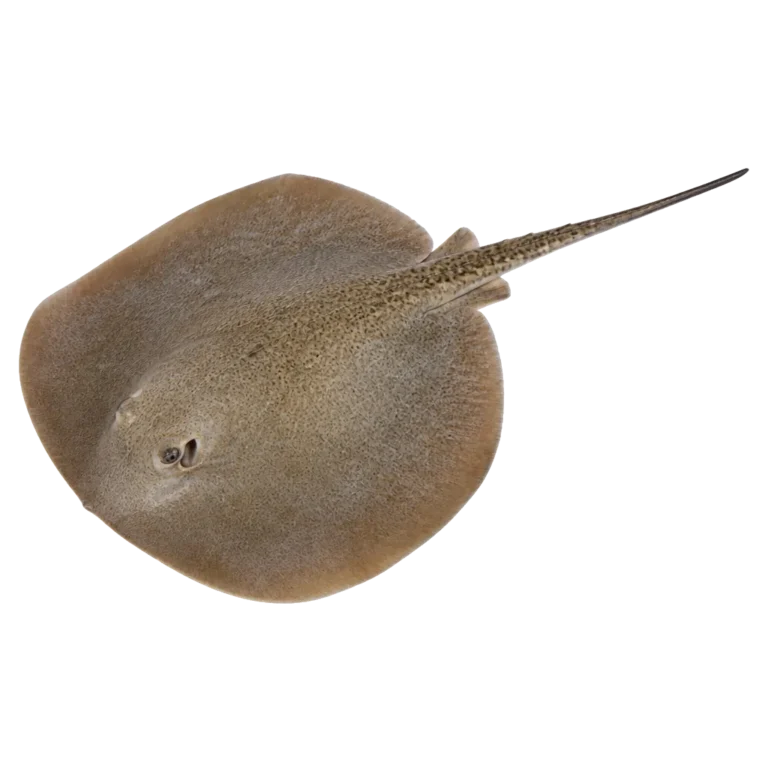
Atlantic Stingray
Summary
Atlantic Stingrays, Hypanus sabinus, are bottom-oriented rays that spend much of their time gliding over or partly settling into soft substrate while using the disc to uncover buried prey. That foraging style makes an open, sand-based footprint—not a rock-filled display—the central requirement.
This is a specialist animal rather than a conventional reef fish. Its tolerance of fresh, brackish, and marine habitats does not mean it should be moved casually between salinities; keep the individual in the salinity system in which it was acquired and avoid abrupt changes.
Care
Build the aquarium around a broad, uninterrupted area of fine, smooth sand. Keep rockwork securely supported before sand is added, with no unstable ledges, loose rubble, sharp skeletons, or narrow gaps beneath which the ray can trap or abrade its disc.
Leave generous turning space along the bottom and protect pump intakes, overflows, and heaters from contact with the ray. A ray repeatedly climbing glass, circling tightly, or colliding with aquascape is telling you the floor plan is inadequate, not simply displaying normal activity.
Treat water quality as a high-load husbandry issue: rays are substantial feeders and produce considerable waste. The system needs filtration and oxygenation sized for the animal’s feeding response, and the sand must remain clean enough that its underside is not continually exposed to trapped detritus.
Feeding
Offer a varied diet of appropriately sized marine-origin crustaceans, molluscs, and fish flesh, placing food directly in front of the ray with feeding tongs. Rotate items rather than relying on a single food, especially plain shrimp, so the diet is not nutritionally narrow.
Feed deliberately enough that the ray receives its share before fast midwater fish strip the food away. A ray that remains buried or inactive through repeated feeding opportunities, loses disc fullness, or begins searching the glass and corners after meals needs its intake and competition reassessed.
Do not use ornamental shrimp, crabs, clams, worms, or small fishes as assumed permanent tankmates; many are potential prey. Never hand-feed, because a food-focused ray can accidentally drive its tail spine toward the aquarist.
Compatibility
Keep an Atlantic Stingray singly unless the enclosure has been planned specifically for multiple rays and their combined floor-space and filtration demand. Wild aggregations do not make close confinement a social requirement, and crowding can turn routine feeding into repeated contact and food competition.
Choose peaceful, open-water fishes that are too large to be swallowed and unlikely to nip at the ray’s eyes, disc, or tail. Avoid persistent fin-nippers, territorial bottom fishes, large predatory fishes, and species that compete for the same bottom feeding zone.
Sessile corals are not usually the direct target, but this is not a reliably hands-off reef inhabitant. The ray can dislodge sand-bed frags, bury low corals, destabilize poorly secured rock, and remove mobile invertebrates that a typical reef display is built around. Add the ray only after the aquascape is fully secured, rather than trying to rebuild around it later.
Good to know
A tail spine is a defensive weapon, not a sign of aggression. Do not corner, net, grasp, or reach behind the ray during maintenance; guide it calmly with appropriate equipment and assume a buried individual may be present before putting hands into the sand.
Partial burying and resting on the substrate are normal. New abrasions on the underside, a reluctance to move, labored breathing, or refusal of favored food are not behaviors to ignore, because skin damage and declining condition can worsen quickly in rays.
Avoid copper-based medication in the display system. As an elasmobranch, this species is poorly suited to routine copper treatment, so disease planning should emphasize an appropriately equipped separate treatment process rather than medicating the main aquarium on impulse.