
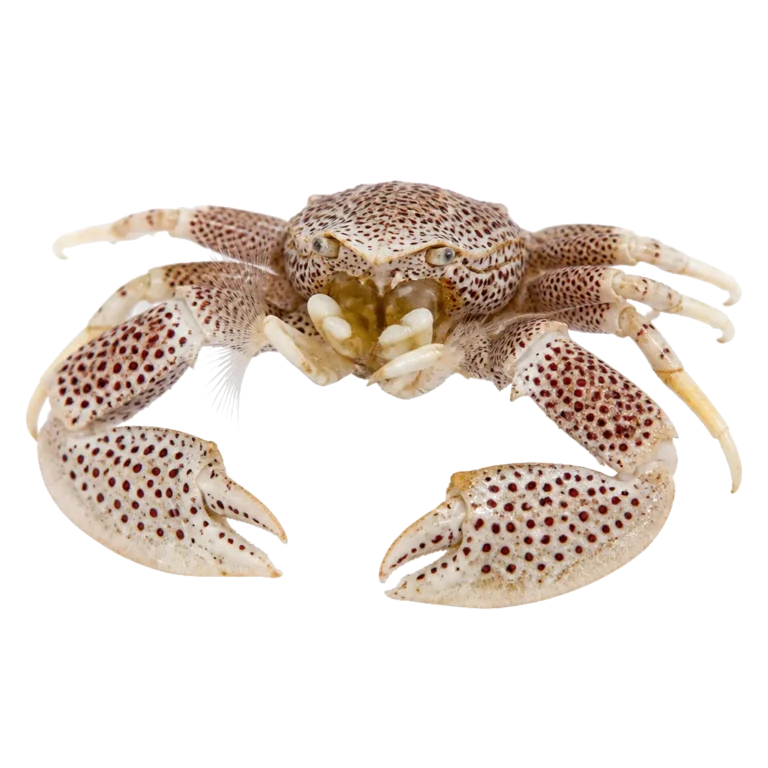
Anemone Porcelain Crab
Summary
Neopetrolisthes oshimai is a small, pale porcelain crab marked with red spotting and adapted to live among the tentacles of large Indo-Pacific host anemones. Its conspicuous fan-shaped feeding appendages are used to strain suspended food from the water, so a crab that sits exposed on its host and repeatedly fans the current is behaving normally.
A suitable anemone gives this crab both shelter and a reliable feeding station. Without one it may survive, but is more likely to remain hidden, wander in search of cover, or be displaced by tankmates.
Care
Add this crab only after its intended host anemone is established and securely settled. Choose placement and lighting for the anemone’s needs; the crab will usually remain on or immediately beside it rather than needing its own cave or substrate.
Provide moderate, indirect flow that carries fine foods across the host without continually folding or blasting its tentacles. A crab that never extends its feeding fans may be sheltered from useful flow, while an anemone that stays contracted or repeatedly detaches is receiving unsuitable current.
Treat tank maturity as an anemone requirement rather than a porcelain-crab requirement. A newly set-up aquarium may not yet support a healthy host, leaving the crab exposed and without the stable perch it normally uses for feeding.
Feeding and role
Feed fine planktonic foods, such as phytoplankton and zooplankton preparations, plus very finely minced marine foods. Release a small amount upstream of the host so Neopetrolisthes oshimai can capture particles with its feeding fans; a crab that persistently searches around the tank or rushes at large food may not be receiving enough suspended food.
It may collect particles and food remnants around its host anemone, but it is not an algae grazer or a meaningful substitute for a detritus-cleaning crew. Its useful role is localized filter feeding, not cleaning rockwork, sand, or nuisance algae.
Compatibility
This is a coral-safe crab that normally leaves coral tissue alone. Keep it away from crabs and fish that treat small crustaceans as prey, particularly predatory wrasses, hawkfish, puffers, triggers, and similarly opportunistic hunters; sudden disappearance after introduction is more likely predation than hiding.
Keep one crab per host anemone unless the anemone has ample space for a compatible pair. Pairs occur naturally, but cramped host space can lead to territorial pushing, chasing, or one crab being kept at the edge of the anemone. Add additional crabs only where separate suitable hosts are available.
A resident anemonefish may share the host, but watch the first days closely. Repeated biting or preventing the crab from reaching the tentacles means the host is effectively unavailable and the crab should be moved or rehomed.
Good to know
Neopetrolisthes oshimai molts. A motionless, intact-looking shell may be a shed exoskeleton rather than a dead crab; look for the crab tucked deep in the anemone or nearby cover. Do not disturb it during this vulnerable period, when even otherwise tolerable tankmates may injure it.
Avoid copper-based medications and other treatments not confirmed safe for marine crustaceans. Acclimate carefully to avoid abrupt salinity changes, then make sure fine food reaches the crab’s host; starvation can be gradual because an apparently settled crab may still receive little from a low-nutrient water column.