
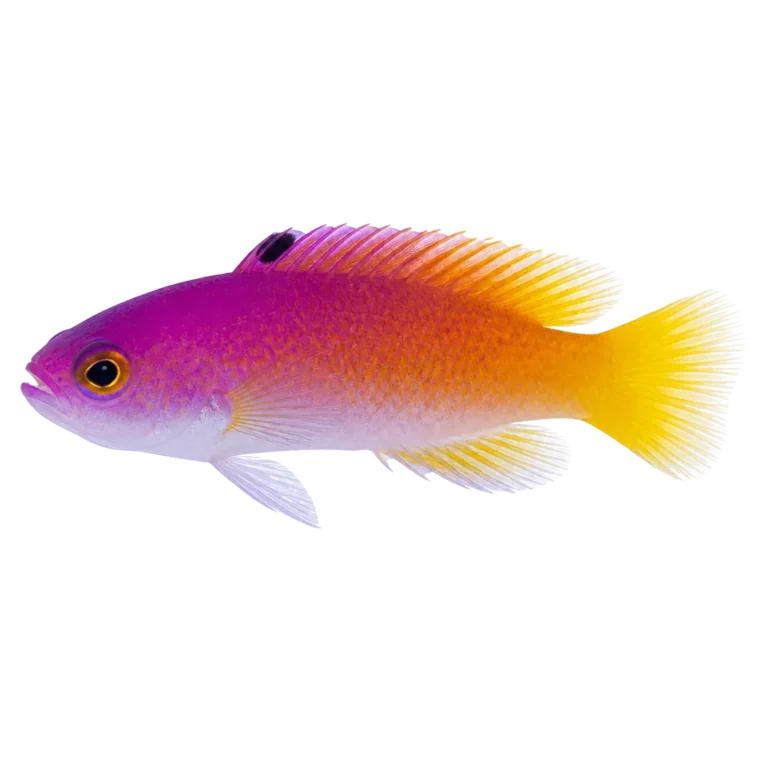
African Basslet
Summary
Liopropoma africanum is a secretive cave basslet that spends much of its time stationed at the mouth of a narrow refuge, making short dashes to take passing food before retreating. Its preference for deep reef crevices explains why a newly introduced fish may be almost invisible at first and why an open, sparsely scaped aquarium is a poor fit.
Choose this species for a quiet display where observing it emerge at feeding time is acceptable; do not expect continuous open-water activity. A fish that gradually watches the room and appears for food is settling in normally, whereas one that remains pinned deep in rockwork and misses repeated meals is being intimidated or cannot find a secure territory.
Care
Build the aquascape around several shaded caves, overhangs, and tight rock passages with more than one exit. Liopropoma africanum uses these spaces as a base rather than simply as a nighttime shelter, and a single exposed hole can leave it unable to avoid a dominant fish.
Keep flow from blasting directly through its chosen cave entrance. It is a short-range darting predator rather than a continuous swimmer, so it does best when it can hover near cover and intercept food without constantly fighting the current.
Use a mature reef with established rockwork rather than a bare, newly arranged setup. The fish is naturally cryptic and benefits from both stable surroundings and the small live foods that develop around rock; repeated rearrangement can cause it to abandon a refuge and disappear for extended periods.
Feeding
Offer small, meaty marine foods that can be swallowed easily, including mysis, enriched brine shrimp, copepods, and finely chopped marine flesh. Deliver food close to its cave entrance with a baster or target feeder at first, because a shy basslet often will not cross open water to compete.
Feed modest portions on a regular schedule and watch the individual rather than assuming food released into the aquarium reached it. A basslet that emerges promptly, takes several items, and returns to cover is feeding well; a fish that only watches faster tankmates take the food needs a more protected feeding approach.
Avoid relying on plain brine shrimp as the main diet. It may be accepted readily but is best used as part of a varied, enriched diet rather than the sole food source.
Compatibility
Keep Liopropoma africanum singly in most home aquariums. It is generally peaceful toward unrelated fish, but another African Basslet or a similar cave-oriented basslet can be treated as a territorial rival; chasing and jaw-to-jaw fighting can become severe once one fish claims the rockwork.
Favour calm fish that leave caves alone and allow deliberate feeding, such as peaceful gobies, dartfish, and other non-bullying community fish. Avoid large predatory fish, persistent rockwork patrols, and forceful feeders that can keep this shy species confined to its shelter and underfed.
Introduce it before adding more assertive fish, or add it only after creating a new, separate refuge zone. Established tank residents often regard every usable cave as theirs, while this basslet needs a defensible retreat immediately after introduction.
It is coral-compatible, but very small ornamental crustaceans are a meaningful exception. Tiny decorative shrimp and similarly sized crustaceans may be viewed as prey, especially when they live close to the basslet’s rockwork.
Good to know
Expect an acclimation period of hiding, particularly in a brightly lit or busy aquarium. Do not dismantle the aquascape to retrieve a fish that is eating after dark or appearing briefly at feeding time; intervene when it is visibly losing condition or has stopped taking food.
Use a tightly fitted lid. Liopropoma basslets can jump, especially during introduction, territorial pressure, or sudden disturbance near their refuge.
A sudden change from cautious cave-dwelling to continuous concealment, rapid breathing, or food refusal should be treated as a warning rather than normal shyness. Check for harassment first, then investigate water-quality problems or disease, because this species can decline quickly when it cannot safely emerge to feed.