
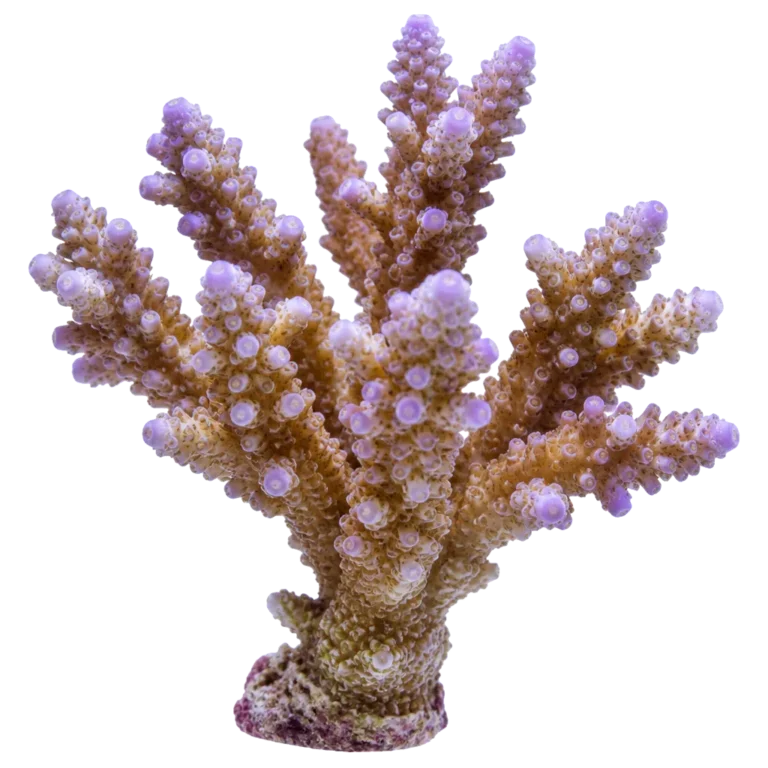
Acropora Coral
Summary
Acropora sp. is a genus-level SPS coral rather than one single species, so branch thickness, colony shape, and tolerance vary by specimen. Most aquarium forms are adapted to bright, turbulent reef conditions and build rigid skeletons with a thin living tissue layer; this combination supports fast growth but gives little margin for unstable conditions or rough handling.
Choose Acropora only for a mature reef with proven consistency. A healthy frag should show intact tissue over every branch, clear coloration, and no bare patches around the base or branch tips; damage can progress quickly once tissue begins to recede.
General care
Mount Acropora high on secure rockwork where it receives strong light and broad, changing flow. Glue or epoxy the plug and frag firmly before releasing it, because a fallen branch can be abraded, shaded, or buried and may lose tissue at the damaged area.
Handle the skeleton or plug rather than the living branch surface. The tissue is thin and easily scraped, while delicate branches can snap during transport or maintenance; inspect breaks promptly and remove or remount loose fragments before they rub against the colony.
Lighting needs
Acclimate a new Acropora gradually by beginning it lower or under reduced output, then increasing exposure in small steps as its color and polyp behavior remain steady. This is especially important for fresh imports and frags that have been kept under weaker lighting.
Too little light commonly shows as progressively darker or browner tissue, weak coloration, and slow tip extension. Too much light shows as paling or bleaching on the most exposed surfaces, sometimes followed by retracted polyps or tissue loss; reduce intensity or add temporary shading rather than moving the colony repeatedly.
Flow needs
Provide strong, turbulent flow from more than one direction so the branches receive changing water movement without being hit by a constant narrow jet. At suitable flow, polyps can extend between pulses, detritus does not settle in the branchwork, and the tissue remains clean without being whipped.
Increase or redirect flow if debris, mucus, or algae repeatedly accumulates between branches, or if the colony stays dirty despite otherwise good husbandry. Reduce direct force if polyps remain tightly retracted, tissue flaps against the skeleton, or one side of the colony develops abrasion or recession in the path of a pump.
Feeding and growth
Light supplies most of the energy for established Acropora, but small suspended foods can help newly cut frags, recovering colonies, and systems with very lean nutrient availability. Use fine planktonic foods or suitably small zooplankton and broadcast them into active flow; large particles are poorly matched to the small polyps and excess feeding can destabilize water quality.
Growth commonly begins by encrusting the mounting surface, then expands into branching, bushy, tabling, or plating forms depending on the unidentified species and its conditions. Plan for the mature outline rather than the frag size: fast-growing branches can shade lower corals and make later removal difficult.
Compatibility
Acropora competes mainly through direct contact, rapid overgrowth, and shading as branches expand. Leave at least 10–15 cm3.9–5.9 in of open space around a small colony at placement, then increase that clearance as it grows; contact with another coral can cause localized tissue loss even when neither colony looks overtly aggressive.
Avoid placing it where coral-eating butterflyfish or angelfish can repeatedly nip the polyps, and keep large, clumsy fish from using fragile branches as resting or turning points. Watch for Acropora-associated pests such as flatworms or tissue-feeding nudibranchs, because localized bite marks, pale patches, or unexplained loss of polyp extension require a close inspection before the problem spreads.
Water parameters
Acropora is less forgiving than a typical mixed-reef coral and responds poorly to rapid chemistry changes. Keep dosing, evaporation control, and water changes consistent, because sudden shifts can trigger polyp retraction, paling, or fast tissue recession even when a single test result appears acceptable.
Pay particular attention to alkalinity stability, salinity consistency, and avoiding abrupt temperature excursions. It also performs poorly in systems that swing between nutrient starvation and nutrient excess: persistently pale tissue and stalled growth suggest the system is too lean or unstable, while dirty tissue and declining color after heavy feeding point to excess accumulation rather than a need for more food.