
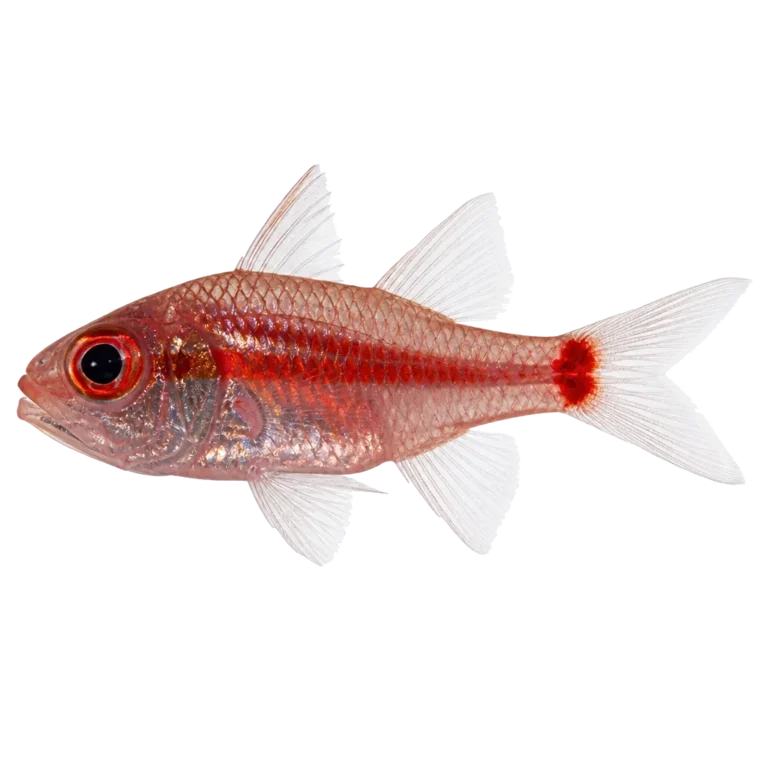
Red Stoplight Cardinalfish
Summary
The Red Stoplight Cardinalfish, Apogonichthys hyalinus, is a quiet, deliberate hoverer that spends much of the day close to cover rather than continuously crossing open water. Its tendency to gather around coral heads and other refuge in nature explains why a fish that looks shy on arrival often becomes much more visible once it has chosen a shaded home base in the aquascape.
Care
Build the aquascape with caves, ledges, branching rock, or dense coral structure that creates several shaded retreats, while leaving short, open lanes immediately outside them for hovering and feeding. A bare, brightly exposed layout can keep this species pinned in cover; a settled fish should emerge to hold position near its chosen shelter and make measured feeding sorties.
Keep it with calm, non-threatening fish and avoid placing its preferred refuge in the busiest part of the tank. It is not a strong, high-energy swimmer, so relentless flow or constant traffic from active tankmates can leave it hiding and underfed rather than using the aquarium normally.
Feeding
Offer small, meaty marine foods such as finely sized mysis, enriched brine shrimp, copepod-rich preparations, and suitably sized crustacean or fish-based frozen foods. Feed small portions at regular opportunities, targeting food toward the fish's shelter if it is reluctant to venture into the water column.
Do not rely on brine shrimp alone or on occasional large meals. A varied diet is more reliable for maintaining body condition, and the practical warning sign of feeding failure is a fish that remains thin behind the head or repeatedly watches food pass without joining faster tankmates.
Compatibility
A small group can work well when the fish are introduced together and the aquascape provides more than one retreat. Expect a pecking order rather than a perfectly even shoal: the lower-ranking individual should still be able to leave cover and feed. If one fish becomes confined to a corner or is consistently excluded at meals, add separation or reconsider the group.
Favour peaceful gobies, firefish, dragonets, and similarly calm community fish. Avoid large predatory fish and assertive, fast-feeding species such as many dottybacks or territorial damselfish, which can monopolize shelter and food even without visibly attacking the cardinalfish. Add this species before more forceful tankmates whenever possible.
It is suitable for coral reefs and does not make a habit of disturbing corals or rockwork. Its reef compatibility does not make it suitable prey-proof livestock, however; any fish large enough to swallow a small cardinalfish remains an unsuitable companion.
Good to know
This is often more active and willing to forage in dimmer periods, so daytime hiding is not automatically a health problem. Respond by checking whether it emerges for food and retains a full body profile, rather than trying to force it into open water with brighter lighting or exposed feeding stations.
A newly established hierarchy may be subtle. Watch for repeated displacement from a preferred cave, a fish holding an unusually dark, isolated position, or one animal missing several feeds in succession; these are more useful warning signs than occasional short chases.