
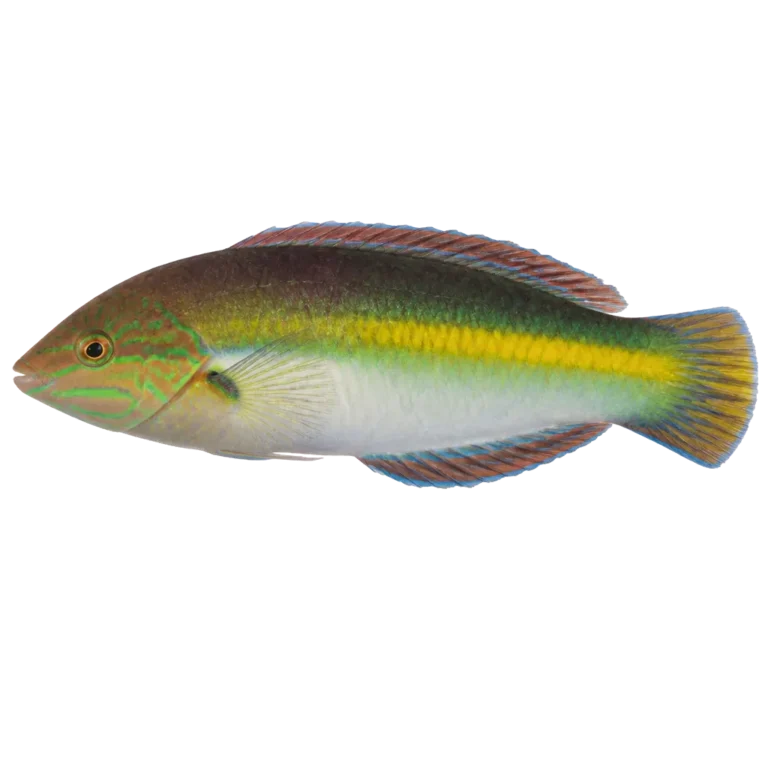
Vrolik’s Wrasse
Summary
Vrolik's Wrasse is an active daytime hunter that patrols the rockwork, sand surface, and small gaps for edible invertebrates. Its habit of disappearing into sand at night or when frightened is normal; a fish that vanishes immediately after introduction may be resting below the substrate rather than trapped in the rockwork.
Care
Build the aquascape with open sand lanes around firmly supported rockwork, then leave a broad area of soft, fine sand that the wrasse can enter completely. Coarse or sharp gravel can prevent normal burying behaviour, while rock placed insecurely on sand can shift when the fish digs or dives beneath it.
Give it clear swimming room as well as crevices to inspect, rather than filling every area with tightly packed coral or rock. A tightly fitting lid is important because a startled wrasse can launch upward during sudden disturbances, netting, or conflict.
Feeding
Offer several small meals of varied marine meaty foods, such as mysis, finely chopped crustacean or mollusc flesh, and quality carnivore pellets. This wrasse searches for food throughout the day, so a single large feeding can leave it conspicuously restless and hunting between meals.
Broadcast or target food across more than one area when fast feeders are present. Watch the wrasse's body condition rather than assuming it is eating because it is actively foraging; a pinched belly or repeated unsuccessful dashes at food calls for smaller foods and less competition at feeding time.
Compatibility
Keep one Vrolik's Wrasse per aquarium unless there is a deliberately planned, spacious social setup with carefully matched individuals. Wild observations are of solitary fish, and adding another established Halichoeres-type wrasse can turn routine foraging space into a source of chasing and stress.
It generally fits with peaceful to moderately assertive fishes that will not monopolize food or harass it when it settles into the sand. Add it before highly territorial wrasses and other dominant bottom-oriented hunters where possible, and avoid relying on it as safe company for ornamental shrimp, tiny crustaceans, or fan worms; these are potential prey even in an otherwise coral-focused reef.
Good to know
Do not excavate the sand or assume the fish has died when it fails to appear after shipping, a scare, or lights-out. It may remain buried while it settles, and repeatedly disturbing the area can prolong that response.
Its constant hunting is useful only if the aquarium’s desired small invertebrates are not part of the plan. Expect it to investigate crevices, turn over loose items, and reduce accessible small crustaceans; secure frags and avoid treating the wrasse as a dependable pest controller that can distinguish unwanted invertebrates from valued ones.