
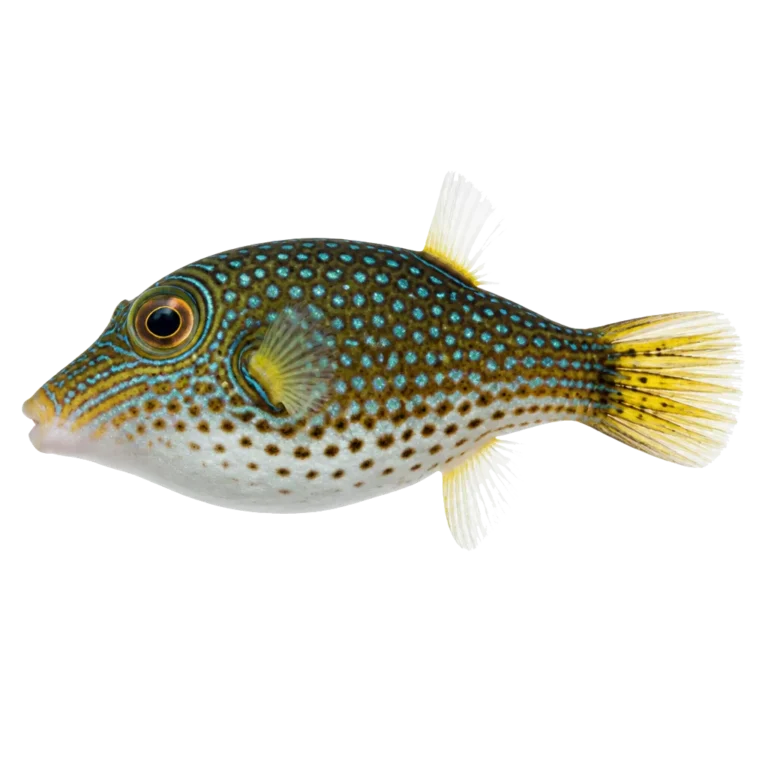
Peacock Puffer
Summary
Canthigaster margaritatus is a sharpnose puffer that spends much of the day making deliberate, stop-start inspections of rockwork, algae films, crevices, and sessile animals. That constant picking is normal for the species, but in a reef it means an individual may eventually test coral tissue, feather dusters, snails, shrimp, or other ornamental invertebrates rather than leaving them alone indefinitely.
Its shallow-reef lifestyle also explains its confidence around structure: a settled fish should patrol through the aquascape and investigate its surroundings rather than remain exposed in open water. Persistent hiding, darkened coloration, refusal to forage, or rapid breathing after introduction should be treated as a settling or compatibility problem, not as normal puffer behaviour.
Care
Build a mature rockscape with connected passages, shaded ledges, and several routes around the reef rather than a bare open layout. The fish uses structure as a foraging surface and as a boundary for its patrol; a single exposed pile of rock can make it pace the glass or repeatedly confront tankmates across the same small area.
Leave clear swimming lanes between rock structures while keeping the basework secure. This puffer is an active, precise swimmer that turns and backs into tight spaces while searching for food, and unstable rock can be dislodged during persistent exploration.
Keep the aquarium covered. A puffer startled during maintenance, feeding competition, or a territorial chase can launch from the water, especially when it has been conditioned to approach the surface for food.
Feeding
Offer varied marine-based foods in small portions across the day, rotating items such as mysis, chopped crustaceans, clam or mussel flesh, and quality omnivore preparations that include marine algae. Variety matters because this fish is a persistent browser as well as an invertebrate feeder; a menu based only on one soft frozen food often produces a fish that becomes selective or spends more time testing livestock.
Include hard, shell-bearing foods regularly, with pieces sized so the fish must bite and work at them. This helps wear the continuously growing dental plates; difficulty closing the mouth, dropping food, or an obvious overgrown beak calls for prompt dietary correction and, if advanced, experienced veterinary or specialist intervention.
Watch the puffer actually receive food. It may investigate each item before eating, so rapid feeders can clear the food first; use a feeding tool or release food near its usual patrol route if it is losing out. Conversely, remove excess promptly, since repeated scattered feeding can add unnecessary nutrient load.
Compatibility
Plan on one Peacock Puffer per aquarium. Canthigaster margaritatus has territorial social behaviour, with males defending areas that overlap smaller female territories, and even females may defend space. Adding another individual after one has established itself is particularly likely to produce chasing, threat postures, and one fish being excluded from food and shelter.
Choose alert, reasonably robust fish that can move away from its attention without provoking a chase. Avoid very slow, sedentary, long-finned, or easily intimidated tankmates, because the puffer may repeatedly nip or harass them even when it is not trying to eat them. Add the puffer late in the stocking sequence where possible, so it is less able to claim the entire aquascape before other peaceful fish settle.
Treat reef compatibility as an individual-risk decision, not a guarantee. A specimen may ignore corals for a time yet begin sampling fleshy polyps, worms, snails, shrimp, crabs, and similar invertebrates once established; a display built around ornamental crustaceans or a clean-up crew of snails is a poor match.
Good to know
Do not provoke inflation for photographs or handling. Territorial posturing can include raised or inflated skin along the body, but full-body inflation in the aquarium is a stress response. If it inflates during routine work, change the approach that triggered it and allow the fish to settle rather than pursuing it around the tank.
Escalating territory defence is often first visible as repeated circling, short rushes, body displays, or intercepting another fish at a favored crevice. Act before there is torn fin tissue or feeding exclusion by rearranging the contested area, using an acclimation box for the newcomer, or separating the incompatible fish.
A sudden increase in coral or invertebrate picking is often a husbandry signal rather than harmless curiosity. First confirm that the fish is receiving a varied diet with hard foods and is not being outcompeted, but be prepared to move either the puffer or the vulnerable livestock if the behaviour becomes targeted.