
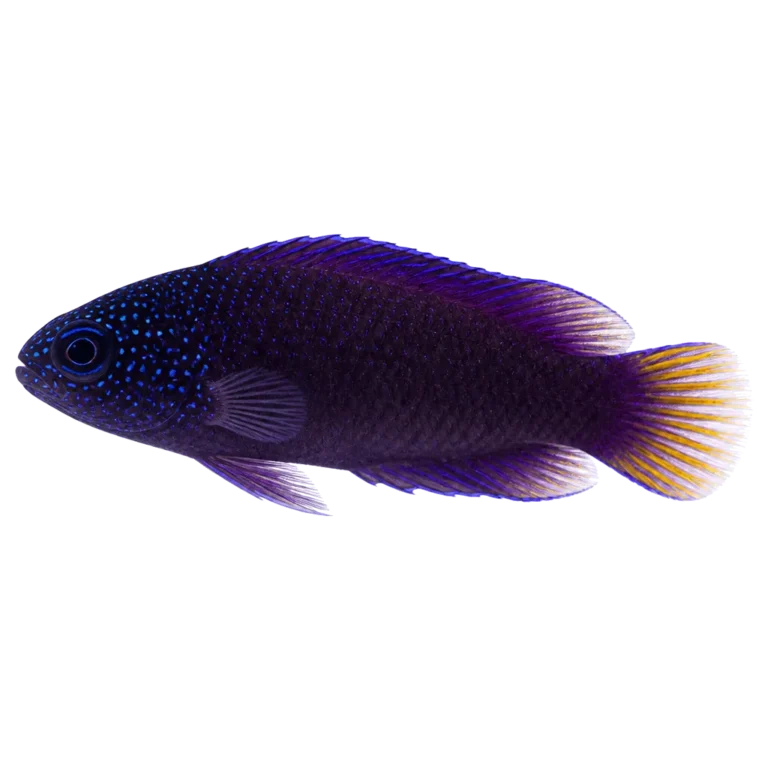
Black Neon Dottyback
Summary
Black Neon Dottyback is a captive-bred hybrid of Pseudochromis aldabraensis and Pseudochromis springeri, rather than a naturally occurring species with one fixed set of behaviours. Expect a bold, rock-hugging fish that makes short, fast patrols through crevices, then pauses to watch the rest of the aquarium from cover.
Its flank colour can shift from near-black to rusty brown with mood and surroundings. Treat a colour change on an otherwise active, feeding fish as normal; treat persistent darkening accompanied by hiding, rapid breathing, or refusal of food as a reason to check for stress or aggression.
Care
Build the aquascape with interconnected caves, narrow passages, and visual barriers rather than an open pile of rock. This dottyback uses holes as both shelter and a boundary for its territory, and a layout with several separate retreats reduces the chance that it can control every route through the tank.
Give it access to the lower and middle rockwork, but do not mistake its small, darting swimming style for a need for an empty aquarium. It is most settled when it can disappear instantly into the structure and re-emerge to patrol; repeated pacing along the glass or relentless pursuit of another fish usually means the territory is too exposed or too contested.
Feeding
Offer a varied carnivorous diet of quality marine pellets and finely sized frozen foods such as mysis, chopped krill, and other marine-based blends. Rotate foods rather than relying on brine shrimp alone, which is a poor staple unless enriched.
Feed in a way that spreads food across the tank or delivers some near its preferred rockwork. A confident Black Neon Dottyback is quick at taking food and can dominate a small feeding area, while timid gobies and similar bottom-oriented fish may be pushed away and gradually lose condition.
Compatibility
Keep one Black Neon Dottyback unless you have a demonstrably bonded pair introduced together into a suitably planned system. Adding another dottyback later is a high-risk way to trigger sustained chasing, jaw-locking, and confinement of the newcomer to a corner or overflow area.
Choose robust tankmates that neither fit the profile of a tiny, passive cave-dweller nor compete directly for the same crevices. Avoid pairing it with delicate dartfish, firefish, very timid gobies, or other dottybacks and basslets; it is better matched with assertive fish that occupy different parts of the aquarium. Add the dottyback after more peaceful fish have established themselves, because a settled individual can claim the rockwork quickly.
It is generally suitable around corals, but do not regard it as automatically safe with small ornamental shrimp or similarly sized mobile crustaceans. Predatory interest in these tankmates can appear after the fish has settled, even when it initially ignores them.
Good to know
Secure every gap in the cover before introducing this fish. A dottyback can launch from the rockwork during a chase, sudden disturbance, or territorial dispute, and a fish found outside the aquarium is usually the result of a brief event rather than ongoing surface swimming.
Watch the first weeks after stocking closely, because aggression may increase once it has selected a den. Brief displays and short chases are less concerning than repeated ambushes at a cave entrance, torn fins, or a tankmate that stops crossing part of the aquarium; rearranging a small amount of rockwork can interrupt an established territory before an injured fish must be removed.