
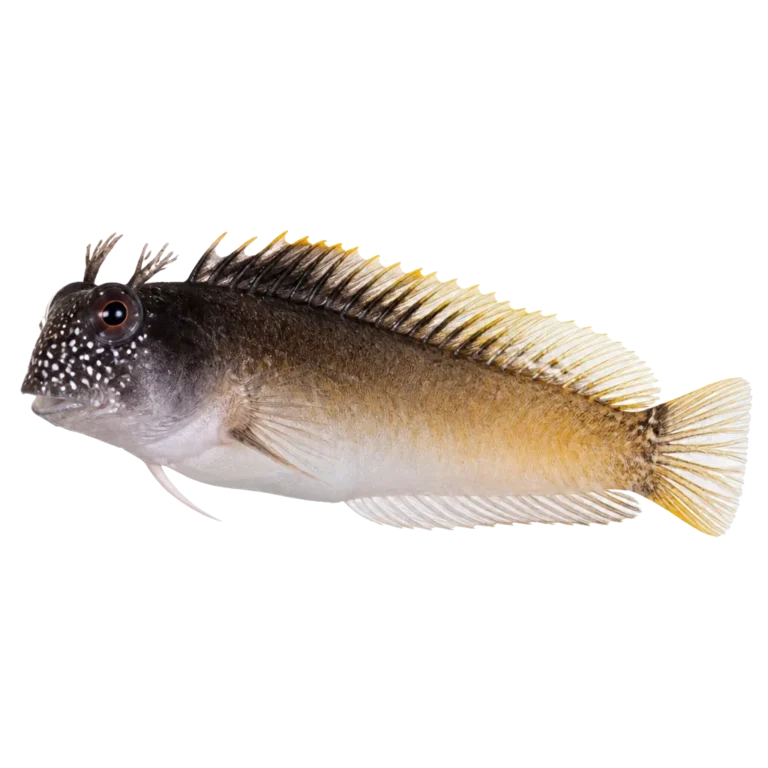
Scarface Blenny
Summary
Scarface Blennies are close-working algae and detritus grazers that spend most of the day perched on rock, making short hops between grazing patches rather than swimming in open water. Their shallow, surge-zone lifestyle explains their preference for exposed hard surfaces and their tendency to claim a small section of rockwork as their own.
A healthy individual should be regularly seen inspecting rock, glass, and crevices with a full, rounded abdomen. A fish that stays hidden, becomes thin, or ignores natural grazing surfaces may not be finding enough suitable food or may be losing access to its territory.
Care
Build the aquascape around mature, stable rock with broad grazing surfaces, tight crevices, and a few secure perches. The fish will use these features as both feeding ground and refuge, and a bare or overly sterile layout can leave it exposed and without enough natural forage.
Provide brisk, oxygen-rich water movement across parts of the rockwork while retaining calmer pockets where the fish can settle. It is adapted to working around turbulent shallow reef structure, so it should not be confined to a low-flow, open-bottom setup.
Introduce it only once the aquarium has developed visible film algae and other microgrowth on rock. It can graze continuously, but it still needs prepared foods when natural growth is sparse.
Feeding
Offer marine algae-based foods routinely, including dried seaweed secured near its usual perch, spirulina-rich pellets or flakes, and herbivore-oriented frozen blends. Supplement rather than replace grazing; the goal is to give it repeated access to vegetable matter without relying on nuisance algae to sustain it.
Feed in more than one place when active grazers, tangs, rabbitfish, or assertive wrasses are present. The Scarface Blenny is unlikely to compete successfully for food delivered high in the water column, so place some food directly on the rockwork or close to its established feeding area.
Do not use a meaty diet as its main ration. A fish that accepts only rich frozen foods may appear eager at feeding time while gradually losing the digestive support provided by plant-based fare and detrital grazing.
Compatibility
Keep one Scarface Blenny per established rockwork territory. This species is naturally encountered singly, and another algae-grazing blenny is most likely to be treated as a direct competitor once the resident fish has settled in.
Choose peaceful to moderately assertive tankmates that leave the lower rockwork available. Small planktivores, reef-safe community fish, and invertebrates that do not monopolize algae sheets are generally better companions than combative bottom dwellers or persistent grazers with the same feeding niche.
Add the Scarface Blenny before similarly shaped blennies or other territorial rock-perching fish whenever possible. Adding it after those fish have claimed the crevices can lead to repeated chasing and prevent it from grazing openly.
It is generally suitable for a coral reef aquarium, but it should be regarded as a rock grazer rather than an algae-removal solution. Dense established turf algae may still require manual control and broader nutrient management.
Good to know
Territorial problems often become apparent only after the fish has chosen a preferred ledge or hole. Brief displays and short chases can be normal, but continual exclusion from the rockwork, torn fins, or a fish that remains pinned in an upper corner means the stocking combination is not working.
The most common long-term mistake is assuming visible algae alone will feed it indefinitely. If the aquarium becomes very clean, continue providing marine vegetable foods and watch body condition closely; a noticeably hollow belly is an early warning sign.
Expect it to spend much of its time in plain sight but close to cover. Sudden prolonged hiding, especially alongside reduced grazing, is more useful as a warning sign than a naturally cryptic resting posture.