
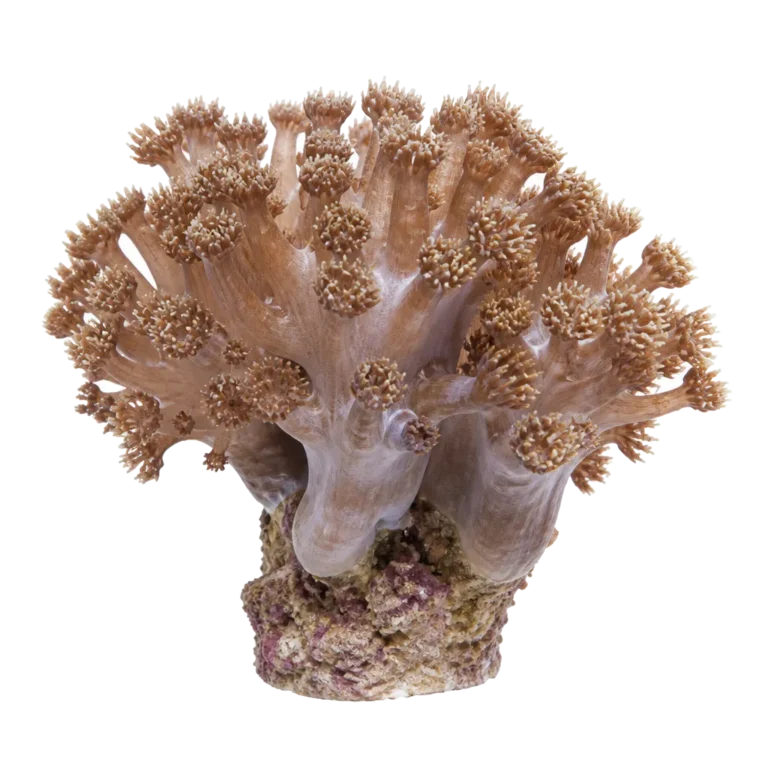
Branching Flowerpot Coral
Summary
Goniopora pandoraensis is a branching flowerpot coral whose long, flower-like polyps can hide its short columns when fully open. It comes from shallow, turbid reef environments, so it is best treated as a coral that appreciates gentle, indirect conditions rather than intense light or a direct pump stream. Buy a specimen only if its polyps show at least some extension and the tissue is intact around the branch tips and bases; a colony with bare skeleton or rapidly receding tissue can be difficult to reverse.
General care
Place this coral on stable rockwork in the lower to middle area of the aquarium, where its expanded polyps will not brush against surrounding corals. Allow it to settle before repeatedly moving it: Goniopora often stays withdrawn after changes in placement, lighting, or flow, making it easy to misdiagnose the problem and over-correct.
Handle it by the hard skeleton only, ideally with the polyps retracted. The living tissue is easily torn if a colony is gripped, scraped, or set down where extended polyps are pinched between the skeleton and rock; damaged areas may begin as a small patch of recession and then spread. Branches can also break if the colony is wedged or leveraged during placement.
Lighting needs
Begin a new colony in the dimmer end of the displayed lighting guidance, then increase exposure gradually only after it is extending reliably. This is especially important for freshly imported or recently shipped colonies, which may look healthy at purchase but bleach after an abrupt change in spectrum or intensity.
Healthy response is consistent daytime polyp extension with coloration that remains even across the colony. Persistent shortening, paling, or tissue recession on the upward-facing surfaces suggests excess light or an overly abrupt transition; move the coral to a gentler location before making large system-wide lighting changes. In insufficient light, the coral may remain dull, extend poorly, and lose condition gradually despite otherwise acceptable flow and feeding.
Flow needs
Aim for an irregular, gentle-to-moderate movement that makes the polyps sway independently without folding the entire colony in one direction. This movement should carry away mucus and settled particles while still allowing the oral discs and tentacles to remain open.
Too little flow commonly leaves detritus caught among the polyps or on the branch bases, followed by reduced extension in the affected area. Too much flow makes the tentacles stream sharply in one direction, stay tightly compact, or repeatedly slap against the skeleton; redirect the pump rather than placing the coral directly in its path.
Feeding and growth
Photosynthesis supplies much of this coral’s energy, but feeding can help when a colony is newly established, recovering from shipping, or maintained in a lightly stocked system with little suspended food. Offer fine particulate coral foods, phytoplankton, or very small zooplankton-sized foods in a low-flow period so particles can contact the extended polyps instead of being blown straight past them. Large meaty pieces are more likely to foul the colony than provide useful nutrition.
Growth occurs by adding and enlarging short branches, with the living polyp canopy often extending well beyond the visible skeleton. Leave room not only for the branches themselves but also for daytime expansion and occasional reach toward nearby corals as the colony matures.
Compatibility
This coral is semi-aggressive: extended tentacles can sting neighboring corals, including other Goniopora. Give it at least 10 cm3.9 in of open space on all sides, and increase that buffer if nearby corals show localized recession, remain closed on the side facing the colony, or if the flowerpot’s tentacles reach farther after lights-out.
Avoid placing it beside corals that routinely deploy long sweepers or quickly overgrow available rock. Fish that pick at coral polyps, particularly known coral-nipping species, can keep a Goniopora chronically retracted; repeated daytime closure with no obvious flow or lighting problem is a reason to watch for nipping.
Water parameters
Goniopora pandoraensis is more forgiving than some flowerpot corals only when it is kept in a mature, consistent reef system. It reacts poorly to rapid swings, especially in alkalinity and salinity, and may respond first by staying closed for days before tissue begins to recede. Correct a confirmed instability gradually rather than chasing daily changes in extension.
Avoid nutrient-starved conditions and abrupt nutrient reduction. A colony that once extended well but becomes progressively smaller, thinner-looking, or reluctant to feed may be responding to an overly stripped system, although flow, light, and tissue damage should be checked before changing nutrient management.