
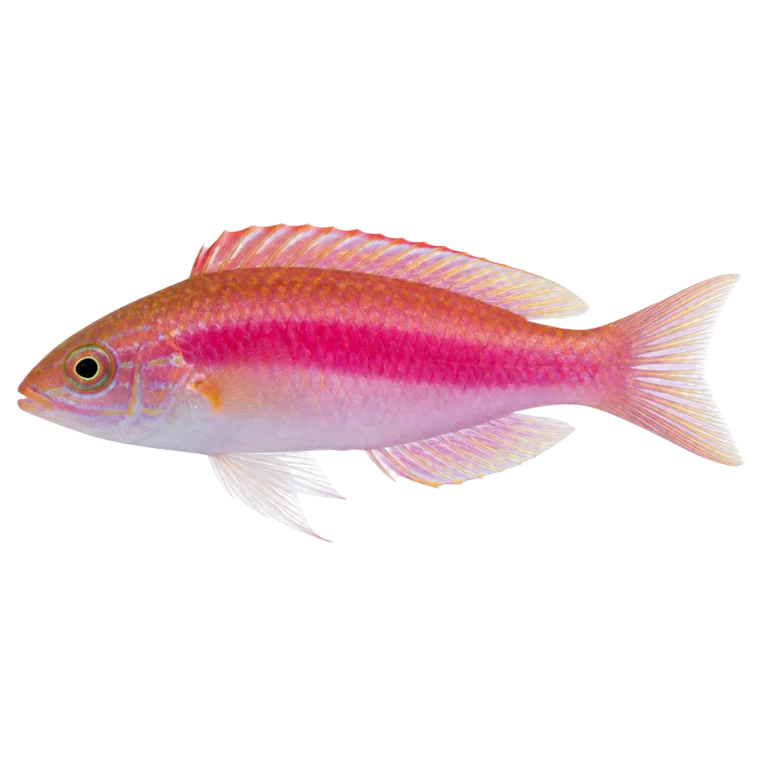
Rose-Band Fairy Wrasse
Summary
Cirrhilabrus roseafascia is an active, open-water fairy wrasse that spends much of the day making short, repeated passes above and around the rockwork for suspended prey. Expect a fish that is visible when it feels secure but retreats quickly when startled; prolonged hiding usually points to intimidation, overly abrupt lighting, or insufficient cover rather than normal shyness.
Its peaceful reputation applies best to a settled individual in a calm community. Mature males can become notably more assertive around similar-looking fairy wrasses and other fishes that feed in the same part of the water column.
Care
Build the aquascape with open swimming lanes in front of dense rockwork, plus several narrow crevices that can be reached without crossing another fish’s territory. C. roseafascia uses the water column rather than perching on the substrate, but it needs immediate access to cover when alarmed; a fish that repeatedly paces the glass or remains pinned behind one rock is not comfortably established.
Use a secure, gap-free lid from the day it arrives. This species can launch through surprisingly small openings when chased, startled, or disturbed during maintenance. It does not require a sand bed for sleeping, so choose the substrate around the needs of the rest of the reef rather than for this wrasse.
Feeding
Offer small, frequent meals of varied meaty plankton foods, such as finely sized mysis, copepods, calanus, enriched brine shrimp, and quality frozen marine blends. Feed into the current so food remains suspended long enough for this continuous picker to take repeated bites.
Watch the first few minutes of every feeding. Larger, faster planktivores and dominant wrasses can clear the water column before C. roseafascia has eaten enough; a fish that stays active but develops a pinched belly needs a less competitive feeding zone or an additional targeted feeding. Reliance on a single dry food is a poor strategy for a newly imported individual that has not yet learned to take it reliably.
Compatibility
A single C. roseafascia is the lowest-risk choice. Keeping more than one is best attempted as a deliberate male-with-females arrangement introduced together into a spacious, complex reef; adding another adult later can trigger sustained chasing, especially once a male has claimed the upper rockwork.
Favour peaceful fishes that do not monopolize suspended foods, including gentle gobies, cardinals, assessors, and similarly non-confrontational reef fishes. Avoid highly belligerent wrasses, dottybacks, large predatory fishes, and boisterous midwater feeders that can either harass it or outcompete it at every meal.
It is suitable around corals and sessile invertebrates, but compatibility with other fairy wrasses should be assessed by feeding niche and visual similarity, not by the general label of ‘peaceful.’ A male may single out another zooplankton-feeding fish even when neither fish is otherwise aggressive.
Good to know
A tight cover is essential rather than optional. Sudden lunges at the surface are most likely during introduction, social disputes, and abrupt room-light changes, so do not leave feeding portals, cable cut-outs, or overflow gaps uncovered.
Cirrhilabrus roseafascia can change sex, with a dominant individual developing male characteristics. In a group, a missing or weakened male can be followed by changes in behaviour and colour from the dominant female; do not assume a formerly compatible group will retain the same hierarchy.
At night it may disappear deep into rockwork and can be difficult to locate. Treat this as normal if it emerges promptly after lights come on and resumes feeding; investigate only if daytime hiding persists, respiration is elevated, or it is being excluded from food.