
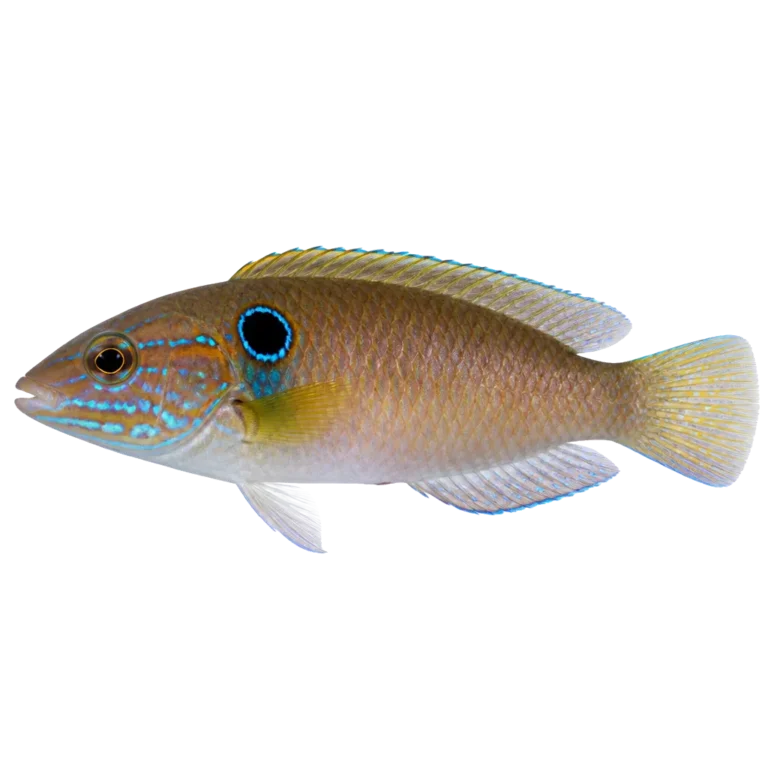
Shoulder-spot Wrasse
Summary
Leptojulis cyanopleura is a slender, constantly searching wrasse that spends much of the day cruising just above the bottom and picking suspended prey from the water column. In an aquarium, expect an alert fish that uses open space rather than staying tucked into rockwork, and that becomes conspicuous around feeding time.
Its natural social structure is a small harem, with females far more common than terminal males. That pattern helps explain why a lone fish can work well, while an attempted mixed-sex group needs to be planned rather than assembled gradually.
Care
Leave a broad, unobstructed swimming lane over open sand or rubble and use rockwork to create retreat routes at the edges. A solid wall of rock can restrict its normal foraging circuit; the fish should be able to move between cover and open water without repeatedly meeting a territorial tankmate.
Provide a soft sand bed deep enough for complete burial. Leptojulis cyanopleura uses the substrate for resting and sleep, so a fish that vanishes near lights-out may simply be buried; provide this option before introducing it rather than expecting it to sleep in rock crevices.
Use a secure, close-fitting cover. Startled wrasses can launch through small openings, especially during introduction, territorial disputes, or sudden changes in lighting.
Feeding
Feed small, varied meaty foods in repeated portions through the day rather than relying on one large meal. A mix of finely chopped crustacean-based frozen foods, mysis, copepod-rich foods, and quality prepared foods gives this active planktivore opportunities to feed in the water column.
Disperse food into the current at more than one point when housed with fast-feeding wrasses, anthias, or similar fish. Watch the Shoulder-spot Wrasse itself rather than the general feeding frenzy: it should make repeated feeding passes and retain a full-bodied profile, not hang back while dominant fish clear the food.
Do not treat ornamental shrimp, small crabs, brittle stars, mollusks, or other small motile invertebrates as part of the feeding plan. Even a well-fed fish may investigate or consume animals it can overpower.
Compatibility
A single Leptojulis cyanopleura is the lowest-risk choice. A harem can work when one male is kept with several females and the group is introduced together; avoid adding another mature male or an isolated newcomer after a social hierarchy has formed, as pursuit can become persistent in confined space.
Choose alert, similarly robust community fish that will not dominate every feeding opportunity. Avoid very small, passive fish, which may be repeatedly chased, and avoid large, highly territorial fish that can keep this wrasse pinned to cover instead of allowing it to forage openly.
Add it before strongly territorial fish whenever possible. In a reef, regard it as coral-compatible only in the narrow sense: sessile corals are not the main concern, but ornamental crustaceans and other mobile invertebrates remain at risk.
Good to know
Females and juveniles can develop into terminal males. A change toward more male-like colour and patterning can therefore be a normal social or maturity-related transition, not automatically a health problem; it also means a group bought as apparently similar fish may later develop a more uneven hierarchy.
Nighttime disappearance is normal if suitable sand is available. Do not dig through the substrate to locate a fish that has buried for rest unless there is a clear emergency, because repeated disturbance removes its secure sleeping behaviour.
Escalating chases, a fish confined to one corner, or failure to join feeding are more useful warning signs than occasional displays. Act early by separating the aggressor or revising the stocking plan, since this species needs regular access to open water and food to remain settled.