
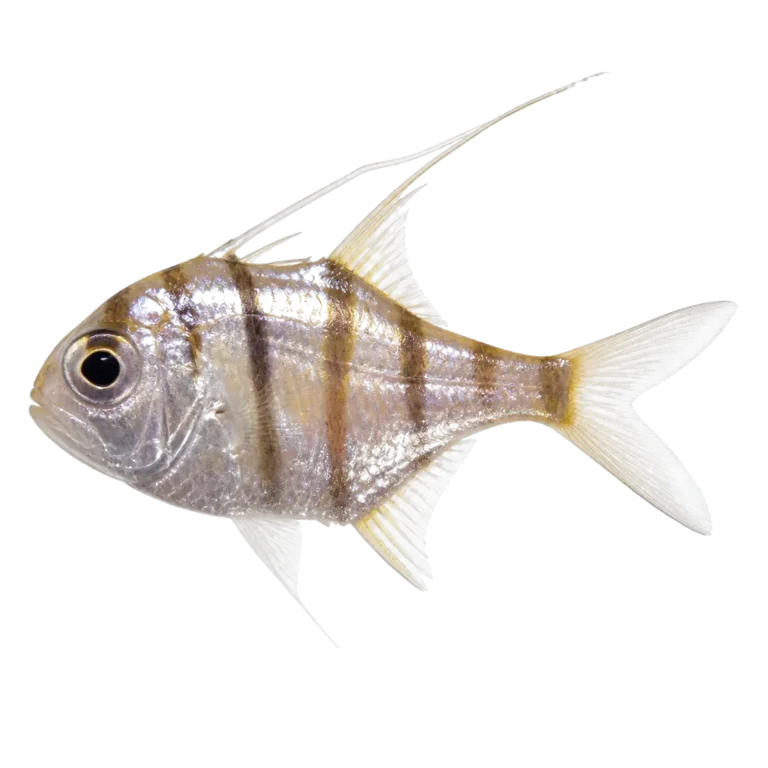
Threadfin Cardinalfish
Summary
Zoramia leptacanthus is a sheltered-water cardinalfish that spends much of the day hovering quietly beneath an overhang or among branching structure, then becomes more willing to forage as the light fades. A fish that remains tucked into cover in a bright, exposed aquarium is often showing normal daytime behaviour rather than illness.
It naturally gathers in dense aggregations, but do not expect a tightly coordinated school at every moment. In a well-settled group, individuals usually share a refuge area and make short hovering excursions; persistent isolation, clamped fins, or exclusion from the preferred shelter is a more useful warning sign than loose spacing alone.
Care
Build the aquascape around a shaded hovering station: a cave mouth, deep ledge, or branching coral structure with open water immediately in front. Zoramia leptacanthus needs somewhere to retreat without being forced into a narrow crack, and it is more likely to remain visible when it can hold position just outside cover.
Keep a calmer flow pocket around its daytime refuge rather than aiming a turbulent pump directly at it. The fish should be able to hover with only small fin movements; continual struggle against the current, retreating deep into the rockwork, or refusal to leave cover can mean its chosen area is too exposed.
A brightly lit, sparsely scaped display can make this species function as a hidden fish. Arrange the refuge before introduction and leave a dimmer edge or shadowed route between shelter and feeding water, especially if the aquarium lighting is intense.
Feeding
Offer small, varied marine foods that stay suspended long enough to be intercepted: copepods, cyclops, enriched brine shrimp, finely chopped mysis, and finely minced crustacean or fish flesh are useful staples. Feed small portions at least twice daily, with one feeding near dusk or under reduced lighting when a newly imported fish may respond most confidently.
Send food into the group’s hovering area with a pipette or baster before faster tankmates clear the water column. Watch each fish take repeated items; a fish that only makes brief dashes and then retreats may be losing the feeding competition even when the group appears interested.
Avoid relying on large, dense chunks of food. This species is adapted to picking small prey from the water column, so oversized pieces are often ignored or repeatedly mouthed and dropped, while a diet limited to one rich frozen food can leave nutrition unnecessarily narrow.
Compatibility
Keep Zoramia leptacanthus as a single fish only when the goal is a quiet, sheltered display; a group introduced together is the better choice where there is enough shared cover and feeding space. Natural aggregations coexist with monogamous pairing, so a pair forming within a group is normal and does not automatically mean the remaining fish must be removed.
Choose unhurried, non-predatory companions that allow it to hover in view, such as peaceful gobies, blennies, and similarly calm community fish. Avoid pushy dottybacks, highly assertive angelfish, triggers, large predatory fishes, and any tankmate that repeatedly rushes its refuge; the usual result is not open fighting but a cardinalfish that hides and misses meals.
Add this species before more assertive open-water fish whenever possible, so it can establish a daytime refuge and learn the feeding routine first. It is coral-safe, but its carnivorous feeding habits make it a poor choice for displays intended to protect very small shrimp or ornamental worms from opportunistic predation.
Good to know
Expect the group to be most active around dusk and after the main lights dim. Daytime hovering in shade is normal; a change worth investigating is a fish that stops emerging even for dim-light feeding, breathes rapidly, or is repeatedly displaced by tankmates.
This species is a mouthbrooder. A brooding male may develop a noticeably full mouth and stop taking food for an extended period; do not mistake that combination alone for a feeding failure or try to force-feed it. In a community reef, any released young are unlikely to survive without deliberate collection and suitable first foods.
Fish sold under the older trade name Apogon leptacanthus are generally the same fish now commonly listed as Zoramia leptacantha. Confirm the scientific name when buying, because several translucent cardinalfish look similar but do not always share the same social behaviour.