
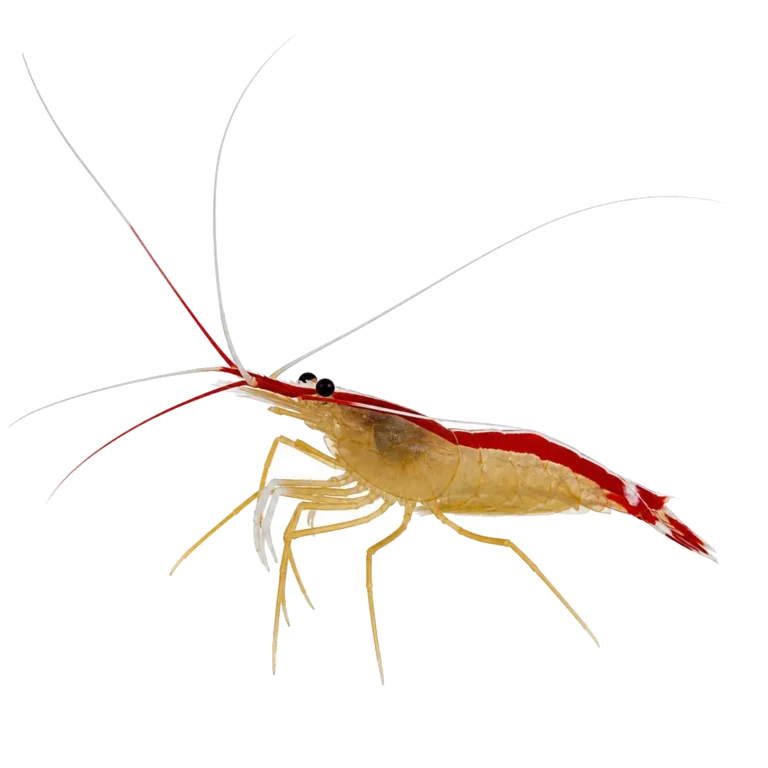
Red Line Cleaner Shrimp
Summary
Lysmata amboinensis, sold as the Red Line Cleaner Shrimp, is an Indo-Pacific reef shrimp that usually occupies a crevice, ledge, or cave as a cleaning station. Its long white antennae and red body with a pale dorsal stripe help fish recognize it; a shrimp that waves its antennae from a sheltered perch is behaving normally and may be inviting fish to be cleaned.
Use the scientific name when identifying this shrimp. Similar-looking cleaner shrimp are sometimes sold under overlapping common names, while L. amboinensis is the species known for the familiar stationary cleaning-station behaviour.
Care
Add it to an established marine aquarium with mature rockwork and several narrow, shaded retreats. It will often choose one protected overhang as its base, but should still be able to emerge easily to feed and interact with fish.
Lighting is not a direct requirement for this shrimp. Arrange the rockwork so it has dim recesses even in a brightly lit reef; a newly added shrimp that stays concealed at first is usually settling in, whereas persistent frantic climbing or repeated attempts to leave the water can indicate unsuitable conditions or a stressful acclimation.
Avoid strong, direct flow at its chosen perch. It needs enough circulation to keep the area clean, but a sheltered pocket lets it hold a cleaning station and feed without being continually displaced.
Feeding and role
Offer small meaty marine foods regularly, such as finely chopped crustacean flesh, mysis, or suitable sinking pellets. Do not expect scraps and fish-cleaning alone to feed it, especially in lightly stocked tanks; a shrimp that repeatedly searches exposed surfaces or rushes every feeding is often competing for insufficient food.
Its cleanup role is limited and specific. It scavenges uneaten animal foods and may remove external material from willing fish, but it will not control a fish disease outbreak or replace diagnosis and treatment. Fish that pause near the shrimp, flare their fins, or hold still with an open mouth may be presenting themselves for cleaning.
Feed corals and anemones deliberately if the shrimp starts taking food from their tentacles or mouths. This is usually food theft rather than coral predation, but frequent interruptions can keep a coral from retaining a meal.
Compatibility
Keep it with peaceful fish and invertebrates that will not view a small shrimp as prey. Hawkfish, large wrasses, lionfish, puffers, triggerfish, predatory crabs, and moray eels are poor choices because even a well-established cleaner shrimp can be eaten, often soon after introduction or while soft after a molt.
It is generally compatible with corals, but its opportunistic feeding can bother corals or anemones during target feeding. Watch for repeated picking at the same animal and redirect the shrimp with its own food before feeding the coral.
A single shrimp can do well, but a compatible pair is the more natural social arrangement. Add a pair together when possible rather than building a large group around one established individual; crowding several shrimp into a small aquarium can create competition for the best shelter and feeding station.
Good to know
Acclimate slowly and avoid abrupt salinity changes. Shrimp regulate poorly against rapid changes in salinity, and a stressed individual may become unusually inactive, lose coordination, or fail to recover after release.
Never expose it to copper-based fish medication. Copper is highly toxic to marine invertebrates, so move the shrimp before treating a display system and do not return it until copper has been fully removed.
Expect periodic molting. The discarded shell can look like a complete dead shrimp, but it is hollow; the live shrimp commonly remains hidden while its new shell hardens. Leave the exuvia in the aquarium for a time if tankmates will not drag it around, as the shrimp may consume it.
A shrimp that disappears after a molt needs protection rather than immediate intervention. Check that no predator can reach its retreats and make sure it receives food once it reappears; repeated incomplete molts or unexplained losses point to a husbandry problem rather than normal hiding.