
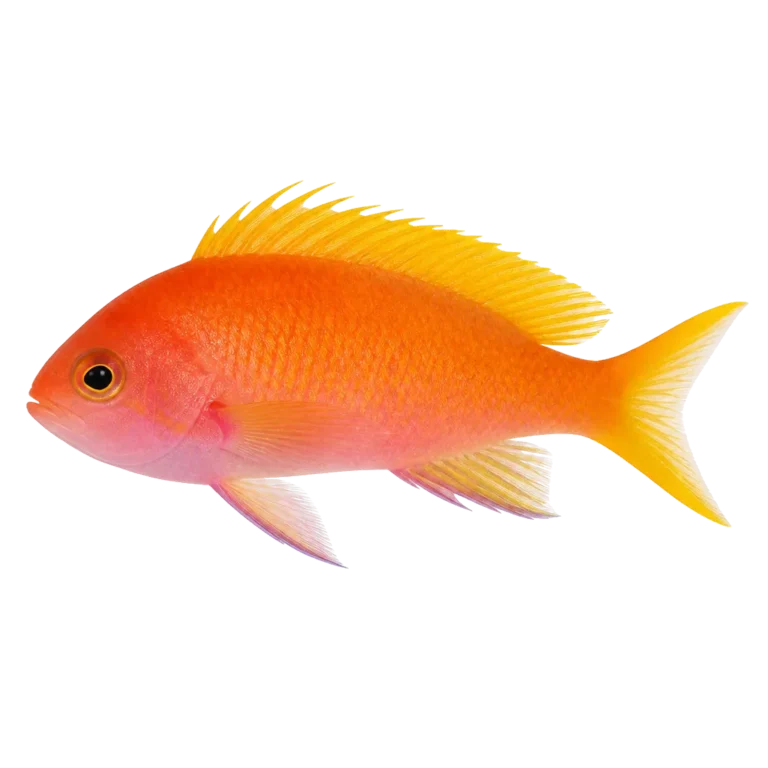
Yellowback Anthias
Summary
Pseudanthias evansi is a midwater planktivore that spends much of the day facing into current and picking suspended food from the water column. In an aquarium, a settled fish should hover in open water near the rockwork rather than constantly hiding; persistent withdrawal usually points to intimidation, insufficient feeding opportunity, or difficulty adapting to prepared foods.
This is a demanding anthias because its natural grazing pattern is hard to compress into occasional large meals. Buy only individuals that are visibly taking offered food, especially when selecting a group, as a newly imported fish that will not feed can decline quickly.
Care
Build the aquascape with a broad, unobstructed midwater swimming lane beside substantial rockwork. Pseudanthias evansi uses the open water to feed but needs nearby crevices and shaded retreats to bolt into when startled; fish that remain pinned in shelter after the settling period are not coping with the social environment.
Provide a brisk, irregular current through the upper and middle water column so fine food stays available in suspension. Avoid aiming a harsh, unbroken jet at its resting area, which can prevent it from holding position and feeding normally. High oxygenation is especially important because this species remains active while receiving frequent meals.
Treat the stated minimum aquarium size as appropriate for a carefully planned individual or small social arrangement, not as spare capacity for a crowded community. The practical limit is often open-water access and the ability to export the nutrient load created by frequent feeding.
Feeding
Offer several small meals spread through the day rather than relying on one large feeding. Use varied, small particle-size marine foods such as enriched frozen zooplankton, finely chopped mysis, copepod-based foods, and quality small pellets once accepted; deliver them into the current so the fish can feed in midwater.
Watch the fish at every feeding, particularly during its first weeks. A Yellowback Anthias that repeatedly hangs back while faster fish intercept the food needs a separate broadcast feed or a calmer feeding zone; a pinched belly, reduced activity, or loss of interest in food should be treated as an urgent husbandry problem rather than normal shyness.
Live copepods or other appropriate live plankton can help trigger feeding in a reluctant new arrival, then prepared foods can be introduced gradually. Do not use nutritionally weak brine shrimp as the sole long-term staple, as apparent feeding activity can still be followed by gradual loss of condition.
Compatibility
Keep Pseudanthias evansi either singly or as a properly planned social group. For a group, introduce several fish together, ideally as females or with one established male and several females; do not combine males, as rivalry can become persistent in an aquarium.
Choose peaceful tankmates that leave the midwater feeding zone accessible, such as restrained community reef fish. Avoid large predatory fish, territorial damselfish, and forceful feeders that turn every meal into a chase, because this anthias may be stressed or slowly outcompeted even when it is not visibly injured.
Add the anthias before highly assertive fish whenever possible, or add them to an already peaceful, stable display. They are reef compatible with corals and typical sessile invertebrates, but their constant plankton hunting means any deliberately maintained live microfauna population will be heavily grazed.
Good to know
Social rank is not fixed: Pseudanthias evansi is a protogynous hermaphrodite, so the dominant female may transition to male if a male is lost. Expect a period of chasing and display behaviour during hierarchy changes, but intervene if one fish is prevented from feeding or is confined to cover.
Use a secure lid or mesh cover. Startled anthias can launch from open aquaria, especially during introductions, sudden room movement, or conflict with tankmates.
Do not mistake a fish that survives but hides and eats only intermittently for a successful acclimation. This species can lose body mass before overt disease signs appear, so regular observation of feeding response and body profile is more useful than waiting for obvious illness.