
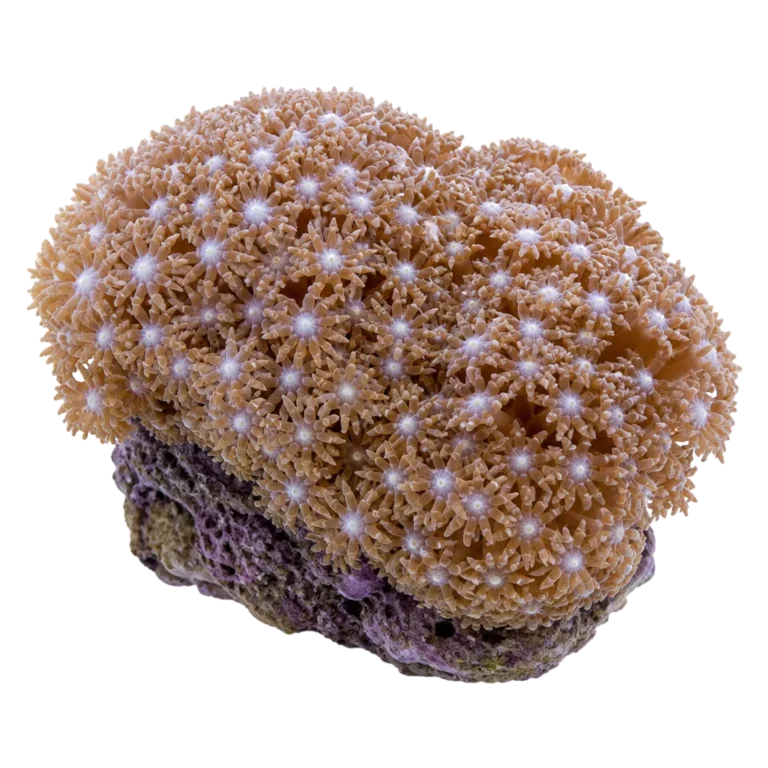
Goniopora Coral
Summary
Goniopora sp. is a genus-level identification rather than one species, so polyp length, growth form, and tolerance can vary between colonies. Most aquarium specimens behave as long-polyped stony corals from sheltered, often turbid Indo-Pacific habitats: they are best treated as a coral that needs gentle movement, suspended fine food, and room for its expanded polyp canopy rather than intense, exposed reef-crest conditions.
Buy a colony only if its tissue is intact across the skeleton and the polyps show a consistent, responsive extension pattern. A newly imported colony may stay guarded at first, but persistent recession around the polyp bases, bare white skeleton, or a shrinking living area is a warning sign rather than normal adjustment.
General care
Place Goniopora sp. on stable lower-to-middle rockwork or sand where it can open without touching surrounding corals. Secure the skeleton or plug firmly before the polyps expand; a colony that rocks, falls, or repeatedly has to be moved can tear tissue along the skeletal edge.
Handle it by the plug or exposed skeleton, not by the fleshy polyp tissue. Keep it away from abrasive rock faces and from sand that can bury the lower tissue, because localized irritation can lead to recession that spreads beyond the original damaged spot.
Lighting needs
Start a new Goniopora sp. toward the dimmer end of the provided lighting range and increase exposure gradually only after it has resumed regular daytime extension. Sudden placement under stronger light can cause shortened polyps, persistent withdrawal, paling tissue, or bleaching around the oral discs.
If light is insufficient, the colony may remain dull, extend poorly despite otherwise suitable flow, or slowly lose vigor. Do not use extension alone as a light meter: long polyps can extend in imperfect conditions, so judge the coral by sustained color, full tissue coverage, and gradual growth over several weeks.
Flow needs
Aim for indirect, changing flow that makes the tentacles sway independently and carries away waste without folding the entire colony in one direction. Correct flow lets polyps stay open while preventing detritus from settling between them.
Increase or redirect flow if debris repeatedly collects on the colony, a brown film lingers between polyps, or the same areas remain closed. Reduce direct flow if tentacles whip sharply, stay pinned to one side, retract after each pump pulse, or tissue begins pulling back near the exposed skeleton.
Feeding and growth
Photosynthesis supplies much of this coral’s energy, but supplemental feeding is most useful for recently established frags, colonies in lean systems, and specimens that are not gaining tissue or adding polyps. Offer fine suspended foods such as phytoplankton, zooplankton-sized fare, or finely powdered coral foods; large meaty pieces are poorly matched to its small feeding structures and can foul the colony.
Feed gently in reduced flow so particles contact the extended polyps, then restore circulation before food and mucus collect. Stop increasing feeding if the aquarium develops nuisance algae or the coral stays coated in uneaten food; more food is not helpful when delivery and export are poor.
Growth form varies within Goniopora sp.: colonies may spread as low mounds, encrust outward, or develop more upright forms. Plan for both skeletal expansion and a much wider daytime tentacle canopy, since a small frag can occupy substantially more space once fully settled.
Compatibility
Treat Goniopora sp. as semi-aggressive. Its long polyps and, in some colonies, sweeper tentacles can sting neighboring corals, while more aggressive LPS can injure it before it has a chance to compete. Leave at least 15 cm5.9 in of open space from its fully expanded tissue to the next coral, then increase that distance if nighttime contact or localized recession appears.
Avoid placing it beneath corals that shed mucus, trap detritus over it, or cast an abrupt shadow as they grow. Fish and mobile invertebrates are usually not a direct problem, but persistent picking, crabs walking across the polyps, or burrowing animals throwing sand onto the tissue can keep the colony closed and cause chronic irritation.
Water parameters
Goniopora sp. is moderately demanding because it often reacts poorly to abrupt changes even when the final test values look acceptable. Keep alkalinity, salinity, temperature, and nutrient availability consistent; rapid corrections can show up as partial extension, tissue recession at the base, or a colony that remains closed for days.
This genus is less forgiving of an ultra-clean, food-poor system than many hardy photosynthetic corals. Maintain enough dissolved and particulate nutrition to support feeding, but avoid swings caused by alternating heavy feeding and aggressive nutrient stripping. If a colony declines after a dosing or water-chemistry change, stabilize the routine first rather than repeatedly relocating it or making several corrections at once.